
Waiting for help

Gov. Jon S. Corzine is right to delay introduction of the state’s budget, given that the incoming Obama administration is promising a massive stimulus package that is expected to include money for cash-strapped states.

Consider the mess New Jersey is in and what a lack of federal aid might mean:

Corzine has said declining tax revenues amid the national recession could push next year’s budget as low as $29 billion, down from $32.9 billion this year.

That’s nearly $4 billion — which would only add a lot of formerly employed state, county and local workers to the growing list of out-of-work New Jerseyans at a time when state (and local) services will be in great demand. Cutting state spending, which Paul Krugman rightly raised concerns about in his column yesterday, will do little more than slow efforts at the federal level to staunch the economic decline.

Krugman called the governors “50 Herbert Hoovers,” a group being forced to “(slash) spending in a time of recession, often at the expense both of their most vulnerable constituents and of the nation’s economic future.”

These state-level cutbacks range from small acts of cruelty to giant acts of panic — from cuts in South Carolina’s juvenile justice program, which will force young offenders out of group homes and into prison, to the decision by a committee that manages California state spending to halt all construction outlays for six months.

He’s not laying blame at their feet. On the contrary, he reminds us that many — not all, as New Jerseyans know too well — of the states’ problems stem from the larger economic mess, long-term federal negligence of state issues and the Bush administration’s clueless response to the meltdown.

It’s true that the economy is currently shrinking. But that’s the result of a slump in private spending. It makes no sense to add to the problem by cutting public spending, too.

In fact, the true cost of government programs, especially public investment, is much lower now than in more prosperous times. When the economy is booming, public investment competes with the private sector for scarce resources — for skilled construction workers, for capital. But right now many of the workers employed on infrastructure projects would otherwise be unemployed, and the money borrowed to pay for these projects would otherwise sit idle.

And shredding the social safety net at a moment when many more Americans need help isn’t just cruel. It adds to the sense of insecurity that is one important factor driving the economy down.

That leaves them stuck between a rock and a hard place. I have been very vocal in my criticism of the state — governors and legislators of both parties, including the current crowd — and its willingness across nearly two decades to defer painful budget decisions. The list of bad decisions made with politics and not fiscal health in mind is long and does not need another recounting. Suffice to say that we went over the cliff a long time ago.

That said, “even the best-run states are in deep trouble,” Krugman writes, and “we shouldn’t punish our fellow citizens and our economy to spite a few local politicians.”

So President-elect Barack Obama should listen to Corzine and David Paterson of New York and Ted Strickland of Ohio, who is

pushing for federal aid to the states on three fronts: help for the neediest, in the form of funding for food stamps and Medicaid; federal funding of state- and local-level infrastructure projects; and federal aid to education.

This kind of aid can go a long way to easing the economic pain while building a new foundation for future growth.
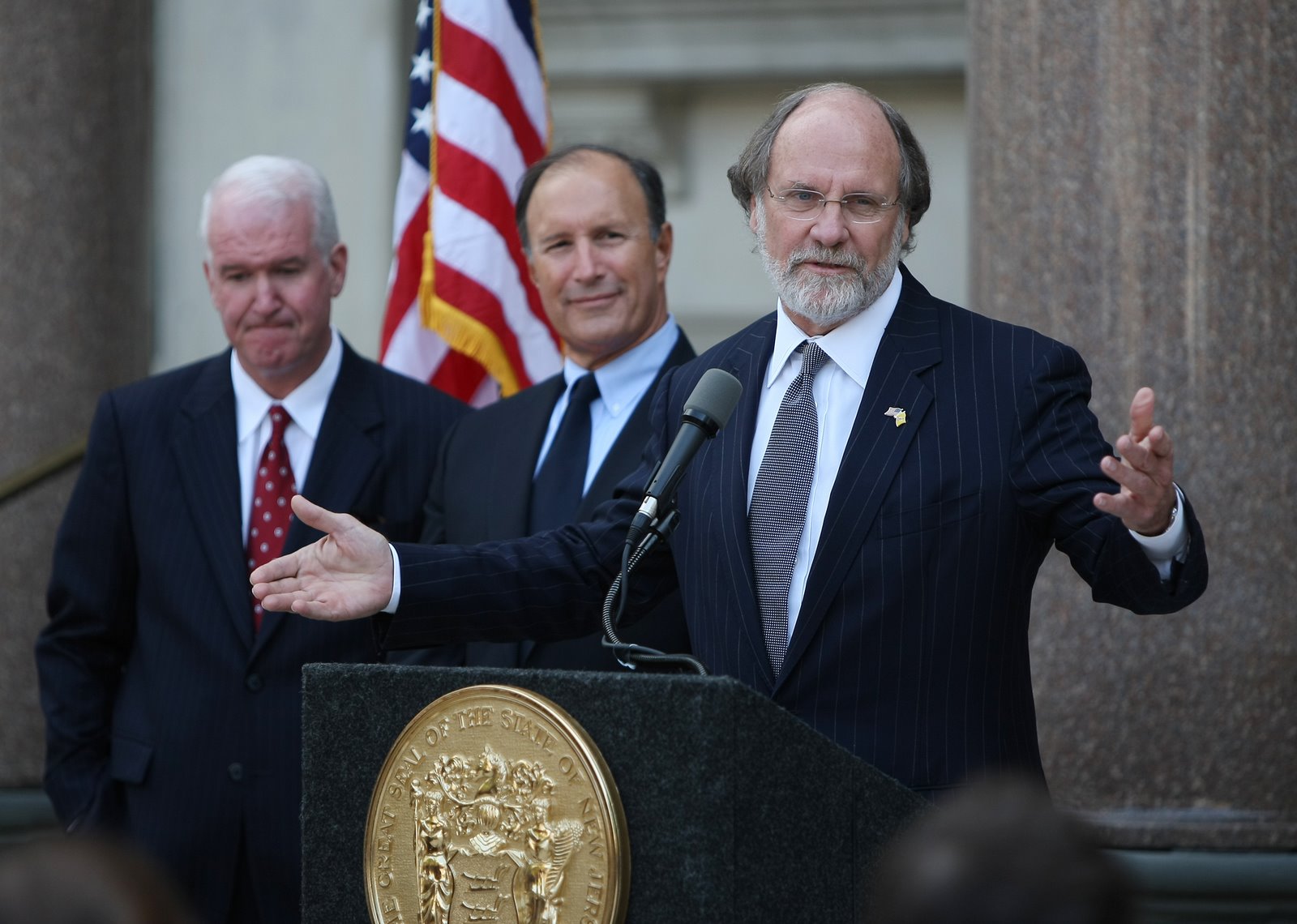
Corzine’s cleanup plan


I wrote the other day about Gov. Corzine’s new ethics reform package, which includes rather strict bans on pay-to-play and wheeling (the practice of passing campaign contributions from committee to committee). I just finished a telephone press conference with the governor during which he outlined his plans and offered a sense of how important he views these reforms:

There is a need for greater transparency and public accountability in government, he said, and it is important that new rules be put in place to give the state’s residents confidence that elected and appointed officials are working in the public’s interest.

“We’re trying to, through ethics reform, deal with financial responsibility to make sure we are not spending money we don’t have to be spending,” he said. “And we are taking actions that would give people greater sense that the mix of money in politics is not determining the direction of public policy.”

The governor is using a two-pronged attack — enacting some reforms by executive order and pushing a number through the legislative process. In the end, he is hoping for comprehensive controls on pay-to-play that will be in force at all levels of New Jersey government.

Prior to the governor’s Sept. 24 executive order, only state contracts were covered under state rules (towns like Monroe and South Brunswick have their own pay-to-play restrictions in place). Businesses or their principles — those owning at least 10 percent of the business — were ineligible for public contracts worth at least $17,500 if they made reportable campaign contributions (more than $300) to a candidate committee and/or election fund of any gubernatorial candidate, or to any state or county political party committee within the previous 18 months.

In addition to the earlier rules, enacted by executive order under Gov. Jim McGreevey, Corzine has placed restrictions on contributions to local candidates and local party committees for firms seeking state contracts. He also removed the 10 percent requirement, meaning that all partners, no matter how small a stake they may have in a company, are now on the restricted list.

The governor said he would like to see a more comprehensive ban on pay-to-play at the local level, and he is encouraging the Legislature as part of his reform package to cover local contracting, as well.

He said “there are a number of municipalities that have been proactive in moving forward on (pay-to-play bans), but it is very uneven across the state.”

“I think there are only 60 of the 566 municipalities in New Jersey that have taken up these rules,” he said. “We’re asking for uniformnity on that so that the public can have the confidence that money in political contributions does not determine where contracts go.”

At the same time, he does not want state law to pre-empt stronger local laws, but “set a floor for every municipality.”

The wheeling ban may be more significant, because it should limit the ability of individual legislators or county freeholders to act as power brokers outside of their geographical regions.

“We want money raised in Bergen to stay in Bergen and money raised at the local level to stay at the local level — within limits,” he said.

On a related note, I asked him about the recent decision regarding Arizona’s clean elections law, in which its rescue money provision was deemed unconstitutional, a decision that has tabled the New Jersey clean elections experiment for the time being. The Arizona decision was based on a New York ruling over the summer that found unconstitutional a provision of federal rules altering contribution limits when candidates face self-funded opponents.

He says he remains committed to clean elections. He would “like to continue to expand its operation in the state” and was “disappointed in (the courts) its most recent negative interpretation” of the law.

“I am hearing legal advice that there has been an overreading of how much (the earlier New York decision) it affects clean elections,” he said.

“The more we can move in that direction, the better we can be served by reducing the role of political contributions as the basis on which candidates are chosen and elections are decided,” he said.

Toll hikes back on the table

One thing you can’t say about Gov. Jon Corzine is that keeping his office is more important than his vision for the future.

The governor is proposing to hike tolls on the N.J. Turnpike and Garden State Parkway by 50 percent in 2009 — the year he is expected to seek re-election. That’s a gutsy move, consider how unpopular his earlier toll-hike plan was.

The governor’s plan, which is expected to be unveiled by the N.J. Turnpike Authority next week, would use the added cash for transportation upgrades.

If enacted, it would mean the cost of a typical 23-mile trip on the Turnpike would jump from $1.20 to $1.80 next year. It would rise to $2.70 in 2012 and reach $3 after 2023.

Tolls on the Garden State Parkway would rise at a similar pace. The current average of 35 cents per passenger car would rise to 50 cents next year, 75 cents in 2012 and reach 85 cents in 2023. The hikes would be the first since 2000 and would be used to widen the Turnpike and Parkway, invest $1.25 billion in a new rail tunnel under the Hudson River and repair and replace decrepit bridges.

The proposal will be a difficult one to sell, but it has support from the Tri-State Transportation Campaign, a nonpartisan transportation and environmental group that advocates for mass transit and using money to maintain existing infrastructure, which believes that it should be scaled down and the highway widenings eliminated. It says that the “plan ultimately falls short by including $3.3 billion for wasteful expansions of these two roads.”

“This plan recognizes that Access to the Region’s Core is essential to New Jersey’s economic vitality and will help reduce traffic congestion throughout the state,” said Kate Slevin, Executive Director of the Tri-State Transportation Campaign, a regional policy watchdog organization. “But chaining it to wasteful, old-fashioned, and poorly planned road projects is the wrong move.”

The Turnpike Authority has not made the case that the Turnpike or the Parkway widening projects are needed. As currently designed, neither will provide long-term congestion relief. In fact, according to state data, parts of the new lane on the Parkway will be filled with traffic as soon as construction is complete. Alternatives like congestion pricing and cashless tolling have not been examined in the environmental documents, though they could provide long-term traffic relief at a fraction of the cost of highway expansion.

“Decades of road widening have shown that highway expansion doesn’t ease traffic congestion in the long run. New Jersey needs projects that look to the future, not the past,” said Slevin. Alternatively, the Campaign recommended a smaller toll increase to pay for necessary road maintenance and bridge repair and ensure that the ARC tunnel remains on track.

NJ Future also is backing the plan. A press release quoted NJ Future Executive Director Peter Kasabach, called “the Access to the Region’s Core (ARC) tunnel project and continued improvement and expansion of our mass transit system toward sustaining and enhancing our state’s economy, environment and quality of life.”

We welcome the Turnpike Authority’s proposal to use new funding proceeds for both the Trans-Hudson tunnel project and funding for mass transit.

Fiscally, the proposal makes more sense than the earlier plan to borrow against tolls to pay debt, but I think in the end it asks Turnpike drivers to foot the bill for improvements that probably should be paid for by a larger swath of people — through a gas tax increase, through development fees, etc.

But as practical as this plan may be, the politics may trump things in the end. The Legislature plans hearings on it — though it is not directly under the Legislature’s control — and the governor will have to run his re-election campaign with the toll hikes fresh in voters’ minds.

One thing is for certain, though, the state needs to fix its infrastructure sooner rather than later. We don’t need to have another Minneapolis bridge collapse and, while the business lobby might claim otherwise, the business community is more likely to flee a state with aging and nonfunctional infrastructure than it is a state that has to ask its businesses to pay a little more in taxes.

Buying the farm

The state’s money troubles could have a severe impact on one of its most popular programs, according to a story today in The Star-Ledger.

The Garden State Preservation Trust, which finances the preservation of New Jersey’s open space and historic sites, yesterday detailed its recommendations for doling out $91 million in farmland preservation money for projects all over the state.

The allocations leave $120 million in the fund — $109 million for open space preservation and parkland development and $11 million for historic site preservation. When that money is given out by the end of this year, the trust will be out of money.

The state is looking to put a funding question on the 2009 ballot, but that will come too late to provide money for next year.

Sean Darcy, a spokesman for Gov. Jon Corzine, said the governor has stressed the need to protect open space throughout New Jersey. Corzine said on June 30 he expects to wait until fall before launching an effort to find more funding for the trust and indicated he wants to look at open space funding as part of the larger issue of funding public works and transportation projects and reducing state debt.

Sen. Bob Smith (D-Middlesex), chairman of the upper house’s Environment Committee, said a poll taken by environmental activists in May and June showed more than 60 percent of potential voters support funding open space, either through an $800 million bond issue, a 40 cents per 1,000 gallons of water user fee to raise $150 million annually, or by dedicating sales tax revenue. Smith said it would take a special session of the Legislature to get either proposal on the Nov. 4 ballot.

“The sad part is that if we wait until 2009 for a ballot question the program will have come to a halt,” Smith said. “That would be a shame because now is the time to be buying open space. The state could really get land at a bargain right now.”

And, as anyone who lives in Central Jersey knows, open space and farmland preservation are among the few avenues we have to control sprawl and limit growth.

On a side note, the governor continues to link the fund to transportation projects and debt, meaning he is likely to put another version of the Turnpike plan on the table. That would be a mistake that could imperil both open space and infrastructure programs.

Let’s just be honest with everyone and raise the money openly. One way or another, we’re going to have to pay.

Reversing course again

The Corzine administration is looking increasingly like a rudderless boat lost at sea. The administration has spent the better part of its three years in control of the state offering controversial proposals and then backing away from them, allowing the state Legislature and the special interests that surround it to fill the vaccuum.

The latest reversal is his decision to restore some of the cuts he proposed in aid to smaller municipalities. While I’ve never viewed the aid cuts as a good idea — using aid as a hammer is unfair; if the governor wants large-scale consolidation he should push the state Legislature to mandate a broad study and then have the Legislature vote on the results — the governor’s willingness to abandon nearly everything he has proposed when faced with political opposition has left him weak and ineffectual.

It is no way to run a state and a waste of the executive’s office — the most powerful executive’s office in the country.

South Brunswick Post, The Cranbury Press
The Blog of South Brunswick

E-mail me clicking here.