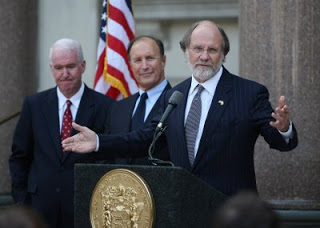
Victory on campaign finance for the good guys

The state Supreme Court has endorsed the state’s pay-to-play ban — and now needs to turn its attention to local bans seeking to accomplish the same thing.

The court in a unanimous decision Thursday affirmed an appellate court ruling that found that

the State’s interest in insulating the negotiation and award of State contracts from political contributions that pose the risk of improper influence, purchase of access, or the appearance thereof, is a sufficiently important interest to justify a limitation on political contributions. The panel further found that the $300 limitation on contributions to gubernatorial candidates and political committees by businesses and principals of businesses who enter into substantial State contracts constitutes a “means” of protecting this interest that is “closely drawn to avoid unnecessary abridgement of association freedoms.”

In particular, it is important that the state — whether it be the judiciary or the Legislature — step in and expand it to municipalities. The courts had nixed a portion of Monroe’s pay-to-play rules earlier this year — those governing money contributed by land developers — forcing the town to rewrite its ordinance. That was unfortunate and needs to be changed — as campaign finance reformers point out.

Harry Pozycki, chairman of the Citizens’ Campaign Legal Task Force that helped draft the campaign-finance law, applauded the Supreme Court decision and said the law’s reach should be expanded to all levels of government.

“Now that the Supreme Court has spoken so decisively, it’s time to quickly expand the approach used at the state level to county and municipal government,” he said.

State Sen. Bill Baroni (R-Mercer) also called for a statewide ban.

“We must finally clean up New Jersey’s culture of corruption and restore
New Jerseyans’ faith and trust in their government,” he said.

It’s difficult to argue with that.

Let’s hope Lawrence makes the leap

Lawrence may — just may — take a rather historic leap into public financing of local elections.

The proposal, which has been kicking around for about two years, now has the support of a sharply divide local panel charged with studying public financing.

The panel found that

7,000 of the township’s 19,000 registered voters belong to the Democratic or Republican parties. The nominees for the Township Council are chosen from the ranks of registered Democrats and Republicans, generally without primary election challenges.

“It would be desirable to broaden the choice of nominees, but without party support, the raising of campaign funds is difficult,” the report said. “If public funds were available, it might broaden interest in running for office, and the candidates would not be beholden to a political party or private donors.”

An analysis of the 2007 Township Council election revealed the six candidates spent $56,425, which amounts to $1.47 per household per year, the report said. There are 12,554 properties in Lawrence that are assessed for tax purposes.

“This is certainly within reason and without significant effect on the township budget, even in these recessionary times,” the report said. “It may be beneficial when political contributors no longer have to buy ‘no-bid’ contracts with their contributions. Competitive bidding may well save more than public financing of the election costs.”

The report also found that the four states with so-called clean elections laws, “the majority of candidates participated.”

“We conclude that public funding has shown itself to be feasible and beneficial in other places. It is affordable in the township, and the voters should be given the opportunity to act on it,” the report concluded.

Will they? Hard to say. The eight-member committee was split on the issue and it is now up to the Township Council. I’m hoping they endorse the idea and let Lawrence lead the way on reform.

Corzine’s cleanup plan


I wrote the other day about Gov. Corzine’s new ethics reform package, which includes rather strict bans on pay-to-play and wheeling (the practice of passing campaign contributions from committee to committee). I just finished a telephone press conference with the governor during which he outlined his plans and offered a sense of how important he views these reforms:

There is a need for greater transparency and public accountability in government, he said, and it is important that new rules be put in place to give the state’s residents confidence that elected and appointed officials are working in the public’s interest.

“We’re trying to, through ethics reform, deal with financial responsibility to make sure we are not spending money we don’t have to be spending,” he said. “And we are taking actions that would give people greater sense that the mix of money in politics is not determining the direction of public policy.”

The governor is using a two-pronged attack — enacting some reforms by executive order and pushing a number through the legislative process. In the end, he is hoping for comprehensive controls on pay-to-play that will be in force at all levels of New Jersey government.

Prior to the governor’s Sept. 24 executive order, only state contracts were covered under state rules (towns like Monroe and South Brunswick have their own pay-to-play restrictions in place). Businesses or their principles — those owning at least 10 percent of the business — were ineligible for public contracts worth at least $17,500 if they made reportable campaign contributions (more than $300) to a candidate committee and/or election fund of any gubernatorial candidate, or to any state or county political party committee within the previous 18 months.

In addition to the earlier rules, enacted by executive order under Gov. Jim McGreevey, Corzine has placed restrictions on contributions to local candidates and local party committees for firms seeking state contracts. He also removed the 10 percent requirement, meaning that all partners, no matter how small a stake they may have in a company, are now on the restricted list.

The governor said he would like to see a more comprehensive ban on pay-to-play at the local level, and he is encouraging the Legislature as part of his reform package to cover local contracting, as well.

He said “there are a number of municipalities that have been proactive in moving forward on (pay-to-play bans), but it is very uneven across the state.”

“I think there are only 60 of the 566 municipalities in New Jersey that have taken up these rules,” he said. “We’re asking for uniformnity on that so that the public can have the confidence that money in political contributions does not determine where contracts go.”

At the same time, he does not want state law to pre-empt stronger local laws, but “set a floor for every municipality.”

The wheeling ban may be more significant, because it should limit the ability of individual legislators or county freeholders to act as power brokers outside of their geographical regions.

“We want money raised in Bergen to stay in Bergen and money raised at the local level to stay at the local level — within limits,” he said.

On a related note, I asked him about the recent decision regarding Arizona’s clean elections law, in which its rescue money provision was deemed unconstitutional, a decision that has tabled the New Jersey clean elections experiment for the time being. The Arizona decision was based on a New York ruling over the summer that found unconstitutional a provision of federal rules altering contribution limits when candidates face self-funded opponents.

He says he remains committed to clean elections. He would “like to continue to expand its operation in the state” and was “disappointed in (the courts) its most recent negative interpretation” of the law.

“I am hearing legal advice that there has been an overreading of how much (the earlier New York decision) it affects clean elections,” he said.

“The more we can move in that direction, the better we can be served by reducing the role of political contributions as the basis on which candidates are chosen and elections are decided,” he said.

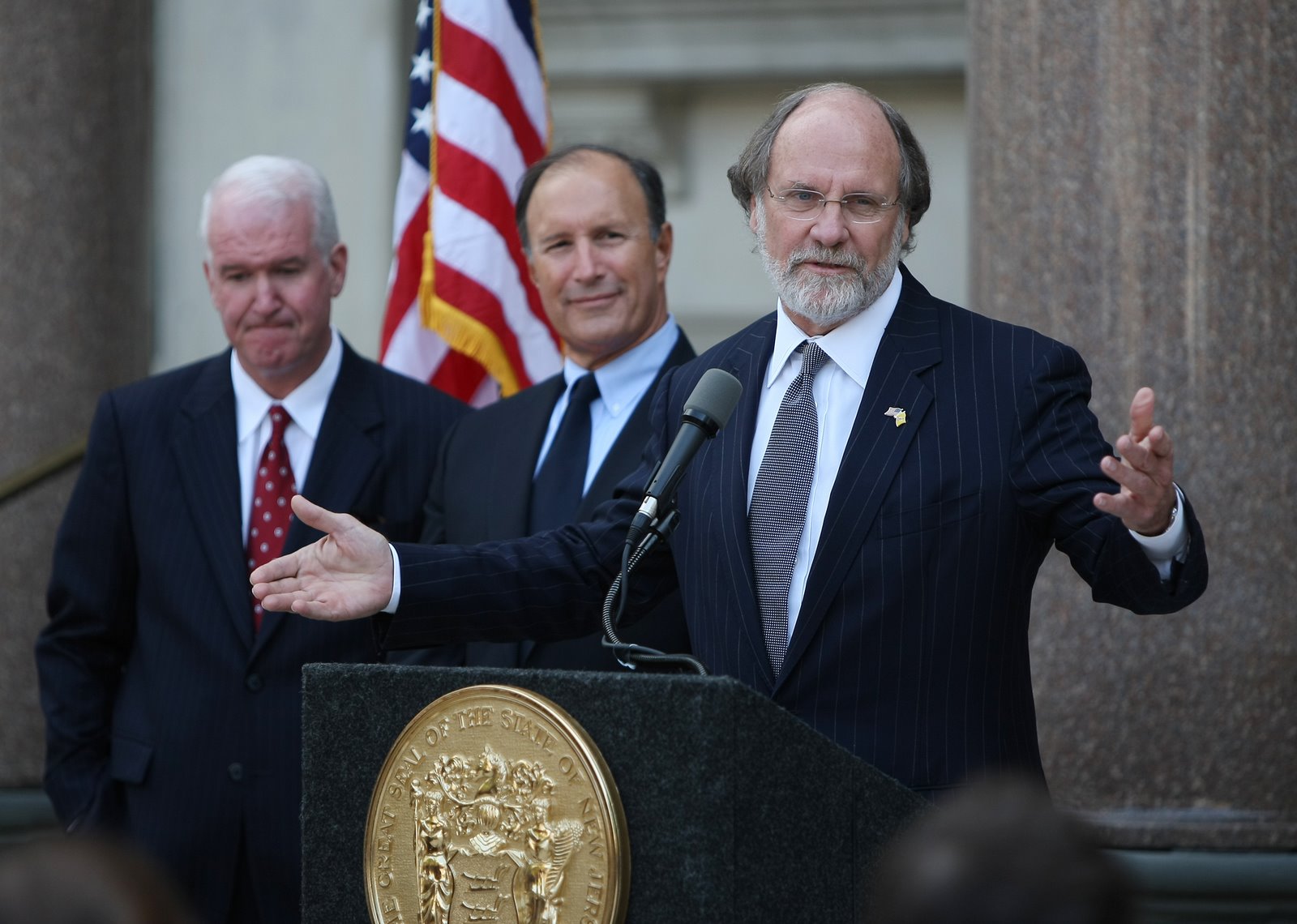
Surprise: Anti-clean elections groupissues report condemning clean elections

The Center for Competitive Politics — the euphemistically named organization that opposes public financing of elections — has issues what it is calling a “study” that it says shows that special interests still control New Jersey politics.

The organization says that

members of interest groups provided the majority of “qualifying contributions” for candidates participating in the 2007 ?Clean Elections’ pilot project.

The New Jersey Education Association (NJEA) was the most frequently represented interest group among contributors.

NJEA members made up more than one quarter of all contributors. Members of the National Rifle Association (NRA) were the top givers to Republican candidates in the 24th district, making up nearly one-third of all donors in that district. NRA members also provided 17.9 percent of contributions to Republicans in the 14th District.

Other interest groups whose members provided significant support included New Jersey Right to Life (18.1 percent to Republicans in the 24th District), NARAL Pro-Choice New Jersey (16.7 percent to Democrats in the 14th District), the Communications Workers of America (16.7 percent to Republicans in the 14th District), and the Sierra Club (15.6 percent to Democrats in the 24th District).

This would be damning if it were more than just a direct-mail attack on the program. While the Center has some academic connections, the so-called study was just a mail survey similar in nature to the surveys that the Democratic and Republican National Committees send out as fundraising tools.

Sen. Bill Baroni, a Mercer County Republican and clean-elections backer, said the numbers issued in the so-called report do not match his experience with the program.

He told PolitickerNJ:

“I don’t know where they got their data, so God bless them. I can tell you that every one of our contributions was one in a series of backyard barbeques and coffee gatherings organized by individuals, along with some mailings,” he said.

Assembly Speaker Joseph Roberts, D-Camden, a supporter of clean elections, was more blunt, telling The Star-Ledger,

“This unscientific ‘survey’ and its results are not persuasive at all and just another excuse (for opponents) to oppose the program.”

(Tomorrow’s Dispatches will focus on the Davis decision that opponents are using to challenge clean elections.)