
Christie budget math does not add up

Gov. Chris Christie rode into office promising to put the state’s fiscal house in order. According to him, it’s mission accomplished.

According to everyone else — including one of the nation’s most influential bond rating agencies — the state fiscal house remains a mess.

S&P, the first major credit-rating agency to analyze Christie’s proposal, found little to praise: The budget relies on more one-shot revenue sources than last year; the $300 million surplus is too small; the hole in the pension fund is still too big; tax cuts are expected to drain $530 million, and revenue-growth estimates of more than 7 percent defy the conventional wisdom among economic analysts, especially since the state is under target for the first half of the current fiscal year.

“We believe revenues could rebound significantly in a strong economy,” an S&P analyst, John Sugden-Castillo, said. “(But) some of these revenue assumptions have been optimistic given the current growth the state has been experiencing. That could put pressure on the budget.”

 Christie, portrayed by most as a straight-talking, no-nonsense leader, is really no different than the governors who have preceded him in office. While he slashed the budget, he also has relied on a tried and trued New Jersey budget-balancing trick: one-shot revenue/spending cut.

Remember, the governor has withheld paying money into the state’s pension funds (a short-term saving that will bite us on the ass down the road), used money set aside for climate change efforts to balance his budget and raided urban enterprise money.

This year’s sleight-of-hand involves a shockingly positive revenue outlook, based on the notion that the state is out of the woods even as it deals with a 9 percent unemployment rate and towns continue to lose tax ratables.

But they are necessary to his larger political and policy agendas — the proposed income tax cut (which will primarily benefit the rich) and a generally positive message designed to buttress his re-election campaign next year.

The state needs tax reform, but the income tax is not the problem, or not in the way Christie paints it. What we need is property tax reform that shifts away from property and sales taxes to income taxes along with an aggressive reorganization of local and county government to reduce the number of taxing entities in New Jersey.

Putting that on the table would take real courage. Promising a tax cut and pretending the recession is over for budgetary purposes does not.

  • Send me an e-mail.
  • Read poetry at The Subterranean.
  • Certainties and Uncertainties a chapbook by Hank Kalet, will be published in November by Finishing Line Press. It can be ordered here.
  • Suburban Pastoral, a chapbook by Hank Kalet, available here.
Getting things done and getting rid of cops

Chris Christie became the darling of the national media because he is said to be getting things done. But is he? Read this piece from today’s New York Times and let me know what you think.

  • Send me an e-mail.
  • Read poetry at The Subterranean.
  • Certainties and Uncertainties a chapbook by Hank Kalet, will be published in November by Finishing Line Press. It can be ordered here.
  • Suburban Pastoral, a chapbook by Hank Kalet, available here.
Manufactured crisis v. real crisis

The American government is barrelling foward into an abyss in which the nation’s credit-worthiness will be called into question and its economic well-being badly damaged.

And yet, the crisis we face is one created in Washington having little to do with the way our economy functions.

The federal government — specifically, the president and the two houses of Congress — has until next week to raise the national debt ceiling or face the shutdown of government programs, the inability to send out government checks and default on some of our debt.

The crisis is real, if contrived, and the solution is actually rather simple: eliminate the debt ceiling. The ceiling, as The New York Times points out in a useful Q&A today, is a relic of an earlier time:

The system goes back to World War I, when Congress first put a limit on federal debt. The limit was part of a law that allowed the Treasury to issue Liberty Bonds to help pay for the war. The law was intended to give the Treasury greater discretion over borrowing by eliminating the need for Congress to approve each new issuance of debt. Over the years the limit has been raised repeatedly, to $14.3 trillion today from roughly $43 billion in 1940. But outside observers have noted that the failure to make increases in the debt limit part of the regular budget process can be risky. The G.A.O. concluded that it would be better if “decisions about the debt level occur in conjunction with spending and revenue decisions as opposed to the after-the-fact approach now used,” adding that doing so “would help avoid the uncertainty and disruptions that occur during debates on the debt limit today.”

It is an arbitrary limit that treats all debt the same way and strips legislators of their responsibility to consider the long-term implications of their budgeting decisions. Removing our multiple wars from the budget, as was done by President George W. Bush, makes it seem as though the budget is responsible, that we have the revenues to pay for what we want to spend. But the billions that are being tossed down the rabbit hole of our wars in Afghanistan and Iraq (and Pakistan and Libya and South America) come from somewhere. So we borrow.

The same goes for the Bush tax cuts, which were described by the president at the time as stimulative to the economy and, therefore, a revenue generator. The absurdity of the claim was obvious at the time, and has only grown more ridiculous as time has passed.

So, what might we consider good debt? Spending on roads and bridges, for instance, because the result is something with a long shelf life. Basically, you are paying off the use of the roads, bridges, solar grids, rail lines, etc., over the length of their lives. And, this is a philosphical point, you are asking future generations to contribute to the cost of infrastructure that they will be using.

Education would fall under good debt, because it adds value to the workforce (I hate looking at education in this way, but from a budget and debt standpoint, I think we have to). The same goes for R&D and weatherization programs, upgrades to public housing and affordable housing, environmental enforcement (because it maintains a long-term societal good), and so on.

The issue is not debt, but the kind of debt we are dealing with (we have reached a point where we are borrowing to pay off previous debt, a problem that will not be aided by a failure to raise the debt ceiling). And it is a problem with revenue — let the Bush-era tax cuts expire on everyone.

Revenue, of course, is the key issue here. Beyond the Bush tax cuts, we face a serious drop-off in revenue caused by the recession. With unemployment approaching 10 percent and about one in six Americans either unemployed or underemployed, by most estimates, the amount that the middle class can contribute to the federal budget is in decline. The only way to address this is to put Americans back to work. And the only way to do this is for the federal government — i.e., the entity empowed by the American people to act on their behalf — to step in with public works projects, aid to states (to avert public worker layoffs), etc.

And we should eliminate the debt ceiling and leave it to the market to determine whether the United States is a creditable risk.

  • Send me an e-mail.
  • Read poetry at The Subterranean.
  • Certainties and Uncertainties a chapbook by Hank Kalet, will be published in November by Finishing Line Press. It can be ordered here.
  • Suburban Pastoral, a chapbook by Hank Kalet, available here.
Drawing lines on abortion and the budget

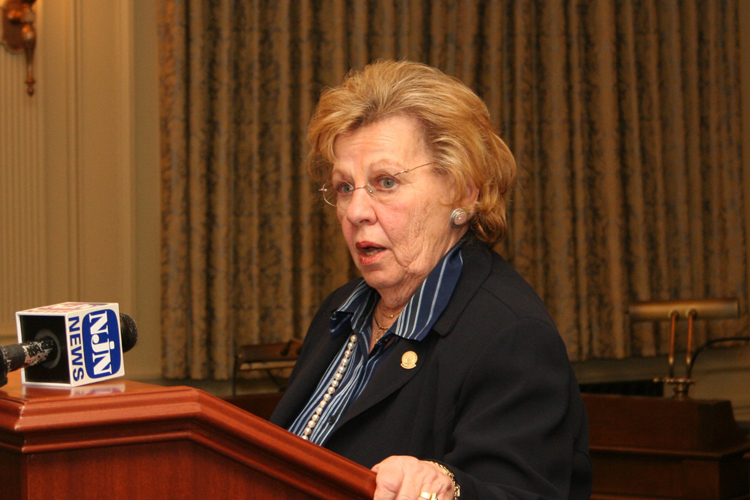
Sen. Loretta Weinberg, D-Bergen

In the context of a massive budgetary shortfall, the governor and his party push several huge tax breaks for upper-income folks and corporations. But $7.45 million in family planning — no dice, the GOP says.

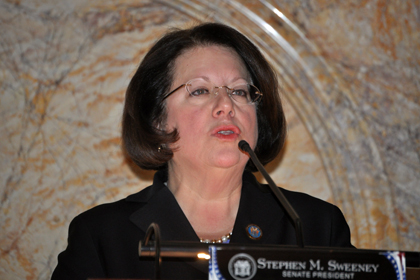
Sen. Linda Greenstein, D-Middlesex/Mercer
Sen. Joseph Vitale, D-Middlesex

A Senate vote today on S2899 — sponsored by Democrats Loretta Weinberg, Linda Greenstein and Joe Vitale — elicited some interesting responses from Republicans, who accused Democrats of by-passing process (will they make the same argument if the governor defies the state Supreme Court?) and supporting a group (Planned Parenthood) that, in Sen. Gerald Cardinale’s words, “supports abortion at every turn.”

“This bill is not about women’s health, it’s about partisan politics,” he said.

He is right, of course. The bill was as much about drawing clearer lines between the parties on two key issues: abortion and the budget. The GOP — or at least the governor and a majority of GOP senators — is willing to toss out funding for poor women’s health to limit abortion services for poor women, even as they hand over cash to those who need it least.

Sen. Greenstein offered this statement:

“The simple fact of the matter is that the Governor’s cuts to family planning and women’s health services have left women at a disadvantage in receiving basic health care,” said Senator Greenstein, who serves as a member of the Senate Budget Committee. “With unexpected revenues coming into the State, I think it’s fiscally wise and socially conscientious to reverse cuts to women’s health care. When you consider the total savings to the State from federal matching funds, there’s simply no fiscal argument you can make against investing this money in programs that make a difference in people’s lives.”

The Democrats know that Gov. Chris Christie is going to veto the bill. They have 26 “yes” votes, one short of overriding a veto — but either way, they will have made their point. Will it matter at the polls? Probably not for the governor. But the entire Legislature is up and I suspect it will help a handful of Democrats in an election that likely was going to favor the party anyway.

  • Send me an e-mail.
  • Read poetry at The Subterranean.
  • Certainties and Uncertainties a chapbook by Hank Kalet, will be published in November by Finishing Line Press. It can be ordered here.
  • Suburban Pastoral, a chapbook by Hank Kalet, available here.

An offensive defense of military spending

Defense Secretary Robert Gates, who had been advocating cuts in military spending, is now counseling against significant cuts saying that reductions would leave the nation vulnerable.

Is he kidding? United States military spending accounts for 43 percent of all military spending world wide and more than the next 14 countries combined. In fact, we could cut our spending by a third and still outspend the next biggest spender by a 5-to-1 ratio, while accounting for $1 of every $3 spent on defense world wide.

The Gates comments, made at the University of Notre Dame commencement, have nothing to do with maintaining an adequate level of defensive readiness and everything to do with fear — fear on the part of the military-industrial complex that it will lose its privileged place in Washington and its access to American tax dollars, fear on the part of politicians who count on defense contractors for campaign funding and the need to sow fear among voters who otherwise would prefer to see defense spending cut and social programs left in place.

Gates’ comments unfortunately signal a likelihood that defense spending is going to be left at historically high levels even as our friends in Washington talk about shrinking government and the programs that help those of us who live in communities like South Brunswick, Princeton and New Brunswick will be gutted to make the bond markets happy.

  • Send me an e-mail.
  • Read poetry at The Subterranean.
  • Certainties and Uncertainties a chapbook by Hank Kalet, will be published in November by Finishing Line Press. It can be ordered here.
  • Suburban Pastoral, a chapbook by Hank Kalet, available here.