
On affordable housing: delay, do not destroy

A delay like this, given the confusion and the difficulty of accommodating changes in state affordable housing law, seems appropriate — especially with Republicans looking to overturn some of the changes imposed by Democrats’ reform of the Fair Housing Act.

The key element of the reforms, which won approval earlier this year, was the end of regional contribution agreements. Such agreements had been created when affordable housing rules were established after the Mount Laurel decisions in the 1980s. RCAs allowed towns to transfer up to half of their state-mandated obligation to urban communities in the same region at a cost. Towns like Cranbury and Monroe have taken advantage of them over the years.

RCAs, however, also allowed towns to skirt the intent of the Mount Laurel rulings, which were not about providing housing but instead about ensuring that all communities in the state provided their fair share. RCAs continued the practice of concentrating low-income housing in the cities, perpetuatinga a pattern of economically induced segregation that has plagued New Jersey and fuels much of its unequal distribution of publice resources.

That said, the confusion surrounding the rules is real. Which is why Assembly Speaker Joe Roberts, D-Camden, and Speaker Pro Tem Jerry Green, D-Union, are seeking a delay. According to a letter they wrote to the Council on Affordable Housing, there are “many communities struggling to adapt to COAH’s third-round housing rules,” which means that “the state must provide more flexibility to help towns adjust.” Plus, the Assembly members said, economic and environmental concerns ahve been raised and “municipalities should be given the chance to apply for additional time so they can submit thoughtful and realistic housing plans that reflect the latest changes and the economic and wastewater management concerns.”

A delay, as I said, seems wholly appropriate — and a far better option than the RCA provision being pushed by Senate Republicans. An October bill “would reestablish the regional contribution agreement as a viable method for a municipality to assist in affordable housing construction” as part of a larger group of changes being pushed by the GOP. The changes, which would make suburban communities happy, would do little more than eviscerate the state’s affordable housing goals, even if some of its provisions are worth considering (meeting obligations through rental vouchers, for instance).
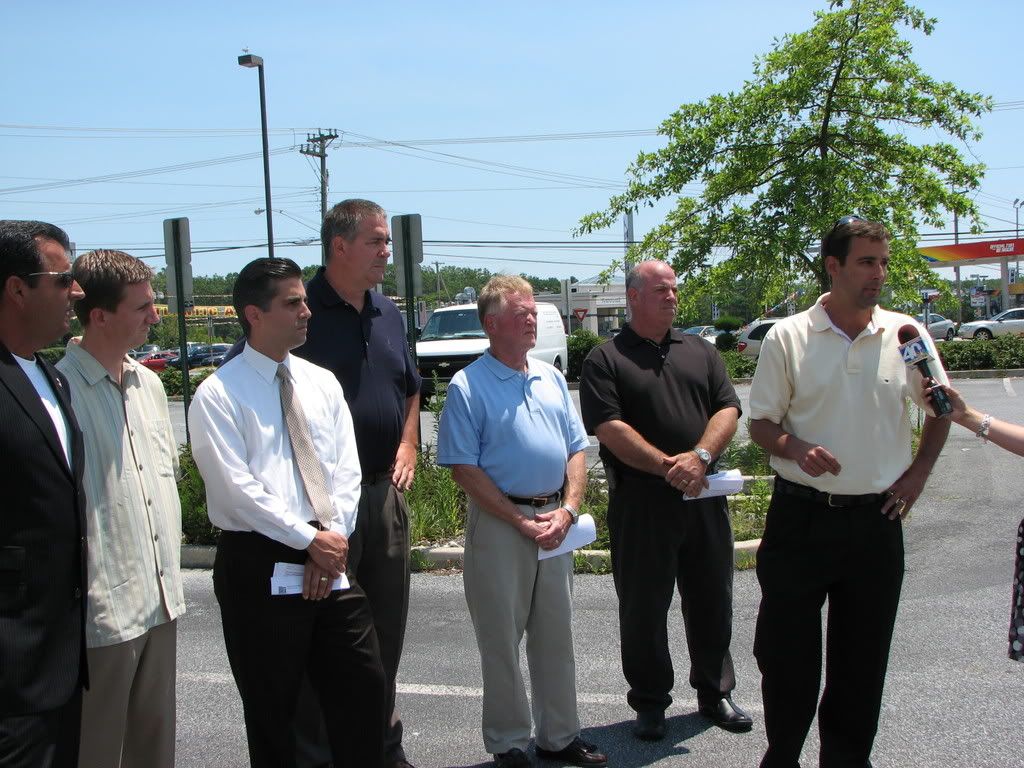
A picture is worth a thousand words

This picture of a Republican press conference in Atlantic County — which ran on PoliticerNJ — offers a pretty good explanation for much of the opposition to affordable housing programs in the state. There is legitimate concern — about open space and overbuilding — but much of it comes down to this picture and this question: What do these seven men have in common? And, perhaps more importantly, what do the vast majority of those living in the state’s cities — including Atlantic City, Trenton and New Brunswick — have in common? And what do these two groups, for the most part, not have in common?
Then again, I guess these things just arent’ black and white….

More thoughts on COAH

Lawrence Aaron of The Record offers a good column — with a huge flaw — on the end of RCAs. (The flaw is that the RCA provision has nothing to do with the budget.) He explains the basic stakes involved, calling the “Long overdue” elimination of RCAs” a milestone that will “end years of dodging by municipalities and developers who have successfully made the building of affordable housing an exercise in hope unfulfilled.”

A few municipalities might occasionally be able to justify the necessity for relocating affordable housing developments. But the regional contribution agreements have been abused to the point of killing the chances of many working poor and middle-class families to live in decent housing near better schools and shopping opportunities in wealthier New Jersey towns.

The potential to change the lives of tens of thousands of families for the better lies in ending such regional contribution agreements.

And that what this is supposed to be about. There are other issues to address (such as the growing conflict between open space and farmland preservation and providing affordable housing, and flaws in the currently proposed COAH rules that could force towns to make drastic changes in their long-term plans), but eliminating RCAs had to come first to make it clear that every town has a responsibility to provide housing to low- and moderate-income people and that the poor and working class should not be warehoused in Newark, Trenton and Paterson.

RCAs — good riddance

I know this is not a popular view — especially in Monroe and Cranbury — but the state is taking a positive step forward in eliminating regional contribution agreements from its affordable housing program.

RCAs, as they are known, have done little but give towns a way out of providing housing while keeping the few affordable units that have been built in the state’s cities. It has contributed to a pattern of segregated housing that has left the state’s suburban communities overwhelmingly white and its cities overwhelmingly black and Latino.

Doing away with RCAs should help spread the obligation out to a greater degree. To make up for the lost revenue in urban areas, the bill creates a developer fee that will be used to create a pool of money that can be distributed to cities and towns to pay for units.

While the bill addresses a significant shortcoming of the Fair Housing Act — bringing it in line with the original Mount Laurel decision that created the affordable housing requirement — it ignores another issue that is likely to come more and more to the fore in the coming years: the shrinking availability of land on which to build units.

This is a major issue in Cranbury, for instance, which has done a remarkable job preserving open space and farmland and is near build out because of it, and it is fast becoming an issue in South Brunswick, which also is nearing build out. The bill that has made its way through the Legislature and now awaits the signature of Gov. Jon Corzine requires that the Council on Affordable Housing take this into consideration. The problem is that the bill does not provide a way of doing so.

What happens if COAH and a town disagree over what constitutes available, developable land? What happens if COAH’s requirements clash with specific planning decisions made at the local level? Who makes that decision?

Consider: Cranbury and South Brunswick build warehouses that create a total of 1,000 jobs (this is a hypotehtical). Under the current rules, each town would have to zone and then build housing to accommodate a portion of the workers who take those jobs. Seems fair, but it may not be practical. As state Sen. Bill Baroni pointed out to me last week, this issue could create a constitutional conflict of its own.

“How do we provide affordable housing, keeping the commitment we’ve made, but also recognize that there are economic, health and space issues that towns have already run into?” he asked. “At what point, do you say we can do no more.

“At one point, you will have a clash between affordable housing and open space. If trends that are apparent now don’t change, you will have towns faced with requirements to build but the only space available would be the open space.”

We are not there yet, but we’re not as far off in Central Jersey as one might think. After several decades of what can only be described as warp-speed development that has more than doubled the population of most towns (South Brunswick has gone from about 17,000 residents in the early 1980s to about 42,000 today), there is not a lot of space left on which to build new housing — at least, not without using deed-restricted open space or forcing towns to rezone commercial areas. Neither approach — one because it would violate contracts, the other because it violates the principles of sound planning and penalizes towns under the state’s outmoded tax system — makes sense.

That’s why the developer fee makes sense. It essentially allows some revenue sharing to occur — towns that build the warehouses, create the jobs and earn the tax revenue — woule be helping fund housing in neighboring towns.

Again, consider the example I offered earlier: Cranbury and South Brunswick, via their developers, would pay into the fund while New Brunswick, North Brunswick, East Windsor, Jamesburg and other neighboring towns could get trust fund money, addressing the cost of building the units needed to address the regional housing need without creating too much of a tax burden.

The residual costs — education, police, etc. — would still be picked up by local taxpayers, however, which is why there is a need to change in the tax sytem — away from property taxes — or, at the very least, to share revenues among communities.

But that’s a piece of legislation that is still a ways off.

In the meantime, here’s hoping the governor signs the COAH reforms and pushes the Legislature to continue working to fix its other ills.

A brewing conflict on affordable housing:An interview with Bill Baroni

Assembly bill 500, which would eliminate the use of regional contribution agreements as a way for suburban towns to meet their affordable housing obligation, is now in the hands of the state Senate.

The bill, a first step toward reforming the state’s affordable housing program, comes at a time when most suburban communities in the state are challenging a rule proposal put forward by the state Council on Affordable Housing that would dramatically increase the housing obligation created by new warehouse construction.

A500, as I said, is a good first step, but it has its flaws — read my recent posts or our editorial.

State Sen. Bill Baroni — whose 14th District includes Cranbury, Jamesburg, Monroe, Plainsboro, South Brunswick and West Windsor among towns covered by Packet Publications — also sees flaws in the bill. In a conversation today, he told me that he was working in the Senate to address the warehousing issue, especially as it pertains to Cranbury.

The warehousing formula, as he says, is “not even close to being based on science — there is no data to support it.” Plus, he adds, the retroactive nature of the rules — which require towns to factor in development that occurred as far back at 2004 — contradicts the planning basis on which the Mount Laurel decisions were made.

“One of the goals of the Mount Laurel decisions was to have towns plan better, to make sure that they plan for affordable housing in their towns,” he said. “Retroactivity runs counter to that smart-growth approach and I have a problem with that.”

He said the final product needs to respect the “core moral responsibility of providing affordable housing,” but also respect the needs of local towns.

He said he agrees with criticism of RCAs, but he would prefer to see them phased out over time.

“I don’t think you can go cold turkey with RCAs,” he said. “Donor and receiving towns have been dependent on them for too long.”

The Legislature, he says, has a potentially larger issue to address, however, one that could create new constitutional complications — that of shrinking space. I asked him about towns that are at or close to build out but that are considered by COAH to be developing. A town like Cranbury, or even South Brunswick, is fast running out of buildable land in no small part because of municipal commitments to open-space preservation. COAH, however, has not generally factored in preserved land.

It creates a conflict that should be resolved sooner rather than later.

“How do we provide affordable housing, keeping the commitment we’ve made, but also recognize that there are economic, health and space issues that towns have already run into?” he asked. “At what point, do you say we can do no more

“At one point, you will have a clash between affordable housing and open space. If trends that are apparent now don’t change, you will have towns faced with requirements to build but the only space available would be the open space.”

The conflict does not lend itself to a simple answer.