The gender gap explained

Recent polling shows that the Republican Party is quickly becoming overwhelmingly white and terrifyingly male.

The latest example of what the GOP thinks of women comes in the form of a bizarre anti-abortion law adopted by the Arizona Legislature and signed into law by Gov. Jan Brewer.

It bans all abortions after 20 weeks except in a “medical emergency” where an abortion would prevent the mother’s death or “substantial and irreversible impairment of a major bodily function.”

Seven states have similar restrictions.

The bill signed into law Thursday makes other changes to abortion regulations, including the requirement of an ultrasound 24 hours before the procedure. The law becomes effective 90 days after the Legislature ends its session, which is likely to occur later this month.

Supporters say the law protects women, an absurd contention that lacks any statistical evidence. This law is not about women’s health; rather, it is an attack on women’s freedom — it achieves its so-called protections by eliminating women’s rights to make their own decisions about their bodies and their pregnancies.

  • Send me an e-mail.
  • Read poetry at The Subterranean.
  • Certainties and Uncertainties a chapbook by Hank Kalet, will be published in November by Finishing Line Press. It can be ordered here.
  • Suburban Pastoral, a chapbook by Hank Kalet, available here.

Drawing lines on abortion and the budget

Sen. Loretta Weinberg, D-Bergen

In the context of a massive budgetary shortfall, the governor and his party push several huge tax breaks for upper-income folks and corporations. But $7.45 million in family planning — no dice, the GOP says.

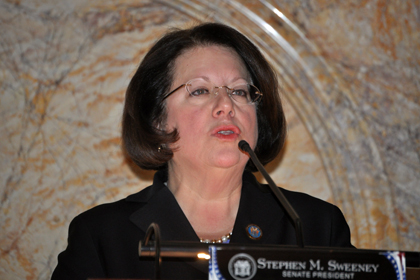
Sen. Linda Greenstein, D-Middlesex/Mercer
Sen. Joseph Vitale, D-Middlesex

A Senate vote today on S2899 — sponsored by Democrats Loretta Weinberg, Linda Greenstein and Joe Vitale — elicited some interesting responses from Republicans, who accused Democrats of by-passing process (will they make the same argument if the governor defies the state Supreme Court?) and supporting a group (Planned Parenthood) that, in Sen. Gerald Cardinale’s words, “supports abortion at every turn.”

“This bill is not about women’s health, it’s about partisan politics,” he said.

He is right, of course. The bill was as much about drawing clearer lines between the parties on two key issues: abortion and the budget. The GOP — or at least the governor and a majority of GOP senators — is willing to toss out funding for poor women’s health to limit abortion services for poor women, even as they hand over cash to those who need it least.

Sen. Greenstein offered this statement:

“The simple fact of the matter is that the Governor’s cuts to family planning and women’s health services have left women at a disadvantage in receiving basic health care,” said Senator Greenstein, who serves as a member of the Senate Budget Committee. “With unexpected revenues coming into the State, I think it’s fiscally wise and socially conscientious to reverse cuts to women’s health care. When you consider the total savings to the State from federal matching funds, there’s simply no fiscal argument you can make against investing this money in programs that make a difference in people’s lives.”

The Democrats know that Gov. Chris Christie is going to veto the bill. They have 26 “yes” votes, one short of overriding a veto — but either way, they will have made their point. Will it matter at the polls? Probably not for the governor. But the entire Legislature is up and I suspect it will help a handful of Democrats in an election that likely was going to favor the party anyway.

  • Send me an e-mail.
  • Read poetry at The Subterranean.
  • Certainties and Uncertainties a chapbook by Hank Kalet, will be published in November by Finishing Line Press. It can be ordered here.
  • Suburban Pastoral, a chapbook by Hank Kalet, available here.

A matter of choice

Ruth Marcus takes Sarah Palin at her word on the abortion issue and finds in her story a strong defense of a woman’s right to choose. Palin, of course, decided not to have an abortion when she became pregnant at age 44 with a Down syndrome child. She decided to keep the baby — a decision she made but that in her public statements she would deny others.

As Marcus writes,

I respect Palin’s decision not to “make it all go away.” She describes her doubts about whether she had the fortitude and patience to cope with a child with Down syndrome, and, with the force of a mother’s fierce love, the special blessing that Trig has brought to her life. She speaks as someone who is confident that she made the correct choice.

For her. In fact, the overwhelming majority of couples choose to terminate pregnancies when prenatal testing shows severe abnormalities. In cases of Down syndrome, the abortion rate is as high as 90 percent.

For the crowd listening to her at last week’s dinner, Palin’s disclosure served the comfortable role of moral reinforcement: She wavered in her faith, was tempted to sin, regained her strength and emerged better for it.

As for those us less certain that we know, or are equipped to instruct others, when life begins and when it is permissible to terminate a pregnancy, Palin’s speech offered a different lesson: Abortion is a personal issue and a personal choice. The government has no business taking that difficult decision away from those who must live with the consequences.

The Bush court strikes

Sometimes even Ruth Marcus makes sense. She writes in her column today that the U.S. Supreme Court’s decision last week to let stand a federal ban on so-called partial birth abortions “was alarming for a number of reasons.”

First, the majority’s unstated but unmistakable willingness to dispense with inconvenient precedent. As nominees, the president’s two choices for the high court treated us to pious pronouncements about their respect for the rule of law.

But they didn’t flinch in overturning, in all but name, a seven-year-old case in which a differently constituted court, considering a nearly identical statute, came out the other way. For all that talk about impartially calling balls and strikes, Mr. Chief Justice, it turns out that it matters a whole lot who the umpires are.

Second, the Father Court Knows Best tone of Anthony Kennedy’s majority opinion. “Respect for human life finds an ultimate expression in the bond of love the mother has for her child,” Kennedy intoned. This is one of those sentences about women’s essential natures that are invariably followed by an explanation of why the right at stake needs to be limited. For the woman’s own good, of course.

Women, Justice Anthony Kennedy wrote for the majority, may come to regret their decision later, especially “when she learns, only after the event, what she once did not know: that she allowed a doctor to pierce the skull and vacuum the fast-developing brain of her unborn child, a child assuming the human form.”,

This, of course is a slippery slope, as Marcus points out, the state’s right to step in here easily expanded to include a broader array of prohibitions.

But if Congress can ban the partial-birth procedure, why can’t it express its “ethical and moral concerns” with the standard procedure for second-trimester abortions, dilation and evacuation? As Kennedy notes, this procedure, in which the fetus is dismembered before being removed, is “in some respects as brutal, if not more,” as the partial-birth procedure.

Why can’t Congress impose its ethical views by requiring any woman seeking an abortion to wait a few weeks, watch a sonogram of her developing fetus, listen to an antiabortion lecture?

The decision is a real reminder of what is at stake in 2008, especially when you consider that Justice John Paul Stevens, the court’s most liberal judge, is likely to retire. A conservative Republican is likely to follow the script written by President George W. Bush, a script that gave us Chief Justice John Roberts and Associate Justice Sam Alito.

The decision, for me, is not just about abortion (I remain ambivalent about abortion), but about the rights of women to decide for themselves how to live and what to think, and it is about respect for precedent and the longterm impact that a conservative court that is hostile to the notion of individual rights but sanctions executive privilege might mean for the future of America.

South Brunswick Post, The Cranbury Press
The Blog of South Brunswick
The Cranbury Press Blog

E-mail me by clicking here.