Expanding clean electionswithout giving them a chance

I am getting the distinct impression that the folks who control the state Legislature do not want public financing of elections to actually work.

Assembly Speaker Joe Roberts (D-Camden) has introduced legislation that would expand state’s clean elections pilot program for the 2007 election to a third legislative district and lower the seed-money threshold, but he has kept a tight leash on the program — though you wouldn’t know it from Tuesday’s story in The Star-Ledger:

Candidates next year would have to raise only 800 donations of $10 each — at least $8,000 — to qualify for public subsidies. The state’s Election Law Enforcement Commission would be given more money to promote the program. And, for the first time, the program would be tried in a competitive district where a challenger might have real chance of winning.

“If enacted, these reforms will help prove that public financing can strengthen the democratic process by keeping special interest money out of election campaigns,” said Roberts.

The Roberts bill, though, ignores most of the recommendations made by a commission — which included 14th District Assembly members Linda Greenstein, the Democrat who formulated the initial pilot program, and Republican Bill Baroni — appointed to study the 2005 experience.

The main findings were that the seed money threshold was too high, limiting access to the program. It also said the program should be tried in up to six legislative districts, explicitly include independent and third-party candidates and cover the primaries.

The Roberts bill does none of this.

Including just three districts, as The Asbury Park Press points out,

leaves 37 districts where the special-interest spigot can be turned on to influence an election in which all 120 seats in the Legislature are up for grabs. If the legislative leaders really want to cut off special interests, candidates in all districts must have a chance to run “clean.”

While

Public financing of primaries would give party outsiders a shot at the nomination, which is invariably controlled by county party leaders. Giving third-party and independent candidates public money would bring competition that is lacking in too many districts, especially those dominated by one political party.

The clean elections system is supposed to open the electoral process up to more candidates while removing the taint of private money. If we insist on keeping a tight leash on it, the program will never accomplish what it’s supposed to.

Here are some columns from our archives from earlier this year — sorry, they are not free:

South Brunswick Post, The Cranbury Press
The Blog of South Brunswick

Holt and Menendez on the ISG

Not everyone in Washington was fooled by the Iraq Study Group report. Here is Rush Holt‘s statement:

I commend the Iraq Study Group for understanding that our present course in Iraq “is not working” and for recommending a significant drawdown of American combat forces. However, the ISG’s recommendation to make withdrawal contingent on “developments in the security situation on the ground” is a loophole big enough to drive many divisions through. President Bush should not interpret this qualification as license to stay the course.

Earlier today, U.S. Sen. Robert Menendez sent this statement — ar more long-winded and another example of how this report is a political Rorshack test:

For the past several years the American people have cried out for a dramatic change in our nation’s Iraq policy. And as one who voted against the war in Iraq I, too, have called for a new, smart foreign policy that brings change to the Middle East and brings American troops home. Last month’s elections and today’s recommendations from the Iraq Study Group make it clear that change is indeed in the air.

It is critical to note how far the discussion on the Iraq War has shifted in such a short period of time. It was only several months ago that those of us who called for a gradual redeployment of U.S. troops were criticized for not fully understanding the
global challenges Americans face in the War on Terror. Yet today we hear from a bipartisan commission of distinguished Americans that, barring drastic unforeseen circumstances, American troops can indeed be out of Iraq by the first quarter of 2008 – a goal not too far from the one I’ve advocated for several months. I appreciate the group’s general call for US troops to be out of Iraq by the beginning of 2008 and I also believe wholeheartedly that without a firm deadline America will still fall short of our foreign policy goals.

I agree with the group in their call for the U.S. to engage in substantive and vigorous diplomacy to solve the Iraq conflict. I have long called for a regional conference to engage Iraq’s neighbors and a renewed effort to engage our allies in Europe and around the globe.

Leaders of the Iraq Study Group said today that implementing their recommendations will require an extraordinary amount of political will from both the Congress and President Bush. They further make it clear that the previous ‘stay the course’ method is no longer viable. Both points are critical. Only sincere bipartisanship in both the legislative and executive branches of government can bring about true change in America’s Iraq policy.

As an incoming member of the Senate Foreign Relations Committee, I look forward to further discussions on these pressing matters. And I thank the members of the Iraq Study Group for their service to America on such a critical issue.

Consider this a public service.

South Brunswick Post, The Cranbury Press
The Blog of South Brunswick

A study in expediency

So, the Baker commission report is out and, well, no surprises.

The group — officially called Iraq Study Group — lays out what can at best be described as a conservative approach that might slowly extricate us from a foreign policy disaster of historic proportions.

The basic gist is this, (from the online story in The New York Times):

The executive summary of the report declares that its two main recommendations are “for new and enhanced diplomatic and political efforts in Iraq and the region, and a change in the primary mission of U.S. forces in Iraq that will enable the United States to begin to move its combat forces out of Iraq responsibly.”

But it warned that “the most important questions about Iraq’s future are now the responsibility of the Iraqis,” and said Mr. Bush must make clear to the government of Prime Minister Nuri Kamal al-Maliki that the American commitment of large numbers of troops is not “open ended.”

American forces would remain after 2008, in units embedded with or otherwise supporting Iraqi troops, and in rapid reaction and special operations forces, the panel said.

It also recommended, according to the Times:

¶ Immediately launching a diplomatic offensive “to build an international consensus for stability in Iraq and the region,” including “all of Iraq’s neighbors.”

¶ An effort to engage Iran and Syria “constructively.” It said Iran needed to stem the flow of arms and training to Iraq and respect its territorial integrity, while Syria should act to stem the flow of terrorists, insurgents and money in and out of Iraq.

¶ The Iraqi government should increase the number and quality of its army brigades.

¶ The United States should significantly increase the number of military personnel imbedded with or supporting Iraqi units.

¶ The United States could move most combat troops out of Iraq by early 2008, leaving a smaller force to focus on rapid-reaction, training, equipping, advising, and search-and-rescue operations.

Nothing Earth-shattering. We leave — slowly, incrementally, but not really. We swallow our pride and bring in the regional powers, nations we haven’t talked with in a while and who we don’t like all that much to help stabilize the situation. We threaten al-Maliki, but not really, telling him our commitment of troops is not open-ended but then promise to leave some troops there.

My response is based on the news reports, of course, but I just don’t see why Washington allowed itself to be so invested in this process. But then, as Matt Taibbi points out in this wonderfully cynical piece from Rolling Stone (via Alternet), the panel was a product of the kind of political expediency that characterizes mainstream Washington. Written before the final product was released, the essay neatly sums up the process that resulted in the report we not have in front of us (well, sort of — we have the summary, :

Baker-Hamilton was a classic whore-panel in every sense. None were Middle East experts. None had logged serious time in Iraq, before or after the invasion. All of them had influential friends on both sides of the aisle all over Washington, parties in the future they wanted to keep getting invites to, ambitions yet to be realized. You could assign Jim Baker, Lee Hamilton, Sandra Day O’Connor and Vernon Jordan to take on virtually any problem and feel very confident that between the four of them, they would find a way to avoid the ugly heart of any serious political dilemma. If the missiles were on the way, and nuclear Armageddon was just seconds off, those four fossils would find a way to issue a recommendation whose headline talking points would be something like “heightened caution,” dialogue with Sweden, and a 14% increase in future funding for the Air Force.

Hence the conclusions of the Baker-Hamilton report were predetermined virtually from the start. We could all have expected that the group’s only unequivocal conclusions would restate the obvious — that we need an eventual withdrawal of troops, that there needs to be more “robust regional diplomacy,” that Iraqi forces need to assume more of the security burden, and that there will be no hope of a political solution without some cooperation from Syria and Iran. Duh! Because the really thorny questions are the specifics: when do we leave, and, more importantly, what do we offer Iran and Syria in return for their cooperation, what horrifying inevitable humiliation will we be prepared to suffer at their hands, and what form will talks with those gloating countries take?

Baker-Hamilton blew off those questions, and it’s no wonder, because no one in Washington wants to deal with them. The Republicans don’t want to agree to a withdrawal timetable because it’s an admission of defeat and policy failure, while the Democrats don’t want to be the first to call for a withdrawal because they’re afraid of being pilloried in the next election season for a lack of toughness. Both sides are afraid of being responsible for a civil war bloodbath if the U.S. troops pull out, and neither side wants to be the first to suggest taking the humiliating step of inviting Syria or Iran to the negotiating table with anything like equal status.

Baker-Hamilton takes all of this into account, offering no concrete or controversial suggestions that would bind either party to unpopular action in the near future. In essence, all Baker-Hamilton accomplished was a very vague admission that Bush’s Iraq adventure is somehow irrevocably ****ed and that we have to get our troops out of that country as soon as possible, a conclusion that was obvious to the entire world two long years ago. But even this pathetically timid intellectual assertion was deemed too controversial to risk unveiling before the 2006 midterm elections, and it’s obvious now that both parties have decided to wait until 2008 to deal with the more important questions of “when” and “how.”

The end result, as he says, is an over-hyped report — the headline on the Times online story, “Panel Backs Overhaul of Iraq Policy,” is pretty typical, as is the “Iraq Panel Calls Conditions ‘Grave and Deteriorating,'” a “no duh” headline from The Washington Post.

At the same time, the report is apparently serving as a political Rhorshack, with everyone using it to bolster their own arguments. Read these comments from the Times:

The White House spokesman, Tony Snow, speaking to reporters after the president’s briefing, emphasized that the report’s 79 recommendations do not include either a firm timetable or a call for an immediate withdrawal.

“There is nothing in here about pulling back militarily,” he said.

***

Senator John F. Kerry, a Massachusetts Democrat who called earlier this year for a firm timetable for withdrawing American forces in Iraq, said in a televised interview this morning that he thought the group’s recommendations amounted to a timetable in everything but name.

“I think they’re about as close as you can come without getting into a direct confrontation with the president,” he said on CNN.

He said that he hoped Mr. Bush will “embrace” the findings.

So there you have it — a whole lot of noise, “Sound and fury,” as they say, “signifying nothing.”

We should have seen this coming.

South Brunswick Post, The Cranbury Press
The Blog of South Brunswick

Seeing double (standards)

Here is a post from TPM Muckraker (part of the Talking Points Memo site) outlining the behind-the-scenes grumbling among Democrats over what has been a rather less-than-stellar transition back to the majority. In this case, the Congressional Black Caucus (correctly) questions the apparent decision to allow Rep. Alan Mollohan of West Virginia to keep his seat on the House Appropriations Committee even though he is under investigation by the FBI.

members of the all-Democrat Congressional Black Caucus are said to be grumbling that the party’s leadership is exhibiting a double standard by letting Mollohan,who’s under FBI investigation, keep his seat on the Approps committee (where he’ll likely control the Justice Dept. budget) after forcing a CBC member, Rep. Bill Jefferson (D-LA), to step down from another powerful committee for facing a similar federal investigation.

Under scrutiny for bribery allegations, Jefferson got a sharp elbow from now-Speaker-elect Nancy Pelosi (D-CA) to leave his seat on the House Ways and Means committee.

Let’s just say that this looks bad and undercuts the speaker’s stated commitment to clean up the House.

South Brunswick Post, The Cranbury Press
The Blog of South Brunswick
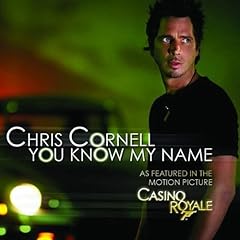
You’ll know his nameand his voice

I’ve been meaning to mention this song, one I think maybe the best single of the year to date. The song, “You Know My Name,” the theme from Casino Royale, has Chris Cornell, formerly of Soundgarden and currently with Audioslave, in fine voice, singing a driving hard-rocker that has embedded within it the Bond sound — something in the horns or the guitar, I wish I could put it into words.

Here is the MTV link to the video. Check it out.

South Brunswick Post, The Cranbury Press
The Blog of South Brunswick