
While there have been reports that Hillary Clinton will suspend her campaign today and that a large number of superdelegates will be endorsing Barack Obama, putting him over the top in the nomination fight, I have my doubts. Nothing concrete, of course — I’m just a lowly local journalist without the contacts that the TV folks have — but given the way this race has unfolded, it seems imprudent to assume anything until it happens.
Feeling unstimulated
My wife and I have already spent our federal economic stimulus check, though I doubt we used it in the way that the president and the Congress intended.
The $1,200 windfall went straight to our car insurance company to pay off this year’s policy — which apparently makes us the typical recepient of the checks.
The federal government is showering households with tax rebates to spur spending and invigorate a troubled economy. But many Americans are so consumed with debt and the soaring price of gasoline that they are opting to save the money or use it to pay bills, according to surveys, sales data and interviews with people from Florida to California.
Between late April and the end of last week, the Treasury handed out more than $50 billion of the $100 billion in tax rebates it plans to distribute to 132 million households. But only once in the last six weeks have chain stores registered an increase in sales, according to the International Council of Shopping Centers, whose weekly sales survey is a widely watched barometer.
While many economists still think the checks will have some impact, surveys of consumers point to a darker forecast:
Recent surveys underscore that many households are now too worried about the rising cost of driving and eating to spend freely, even as cash lands in their laps.
A February survey by the National Retail Federation extrapolated that about 12 million rebate recipients planned to use some of the money to buy gasoline. By May, the number had grown to 17.2 million — a jump of more than 40 percent.
Another survey by the International Council of Shopping Centers found that those planning to use rebate checks to largely pay down debt jumped to 51 percent of respondents in mid-May from 46 percent in February.
The question is whether sending checks out to taxpayers is the best way to get the economy jump-started. Louis Urchitelle, writing in The Times Week in Review section, considers the impact that local and state spending have on the larger economy.
State and city governments have yet to shrink the economy; indeed, they have even managed to prop it up. They have quietly maintained their spending at pre-crisis levels even as they warn of numerous cutbacks forced on them by declining tax revenues. The cutbacks, however, are written into budgets for a fiscal year that begins on July 1, a month away. In the meantime the states and cities, often drawing on rainy-day savings, have carried their share of the load for the national economy.
State and municipal governments spend about $1.8 trillion a year, he writes, about twice the federal government and about 13 percent of the overall economy.
When librarians, lifeguards, teachers, transit workers, road repair crews and health care workers disappear, or airport and school construction is halted, the economy trembles. None of that, or very little, has happened so far, not even in California, despite a significant decline in tax revenue.
When it does, things are likely to get worse.
Quite the opposite, the states and municipalities have increased their spending in recent quarters, bolstering the nation’s meager economic growth. Over the past year, they have added $40 billion to their outlays, even allowing for scattered spending freezes and a few cutbacks in advance of July 1. Total employment has also risen. But when the current fiscal year ends in 30 days (or in the fall for many municipalities), state and city spending will fall, along with employment — slowly at first and then quite noticeably after the next president takes office.
Sometime next year, the decline will reach an annual rate of $50 billion, Goldman Sachs estimates. “It is a big reason to expect a weak economy in 2009,” said Jan Hatzius, chief domestic economist at the firm.
The $90 billion swing — from more spending to less — could be enough to
push down a weak economy to zero growth or less, because state and city spending
has accounted for as much as half of total economic growth since last fall. (A
robust economy has a growth rate of 3 percent to 4 percent, compared with the
0.9 percent or less of the last two quarters.) The $90 billion would certainly
offset most of the $107 billion stimulus package now going out from the federal government to millions of Americans in the form of tax rebate checks. The hope is they will spend this windfall on consumption and in doing so sustain the economy. That might happen — for a while. But with the cutbacks in state and city outlays canceling out the consumption, the next president, struggling to revive a weak economy, will almost certainly have to consider a second stimulus package.
Sending more checks to consumers, the favored option in recent years, is not likely to work. Giving it to the states, however, just may — and this comes not from some lefty economist, but from Wall Street.
“If you want to make sure that federal money gets spent, and jobs are created, you give it to them,” said Nigel Gault, chief domestic economist at Global Insight, a forecasting firm.
Like many others, Mr. Gault contends that more than 50 percent of the $107 billion in stimulus checks now going to households is likely to produce no stimulus at all. Instead, it will be used to pay down debt or buy imported goods and services. Imports bolster production in other countries; not in the United States.
The model, of course, is a Keynesian one in which public spending is used to prime the pump and counteract an economic meltdown.
Government has to step in, Keynesians argue, when private spending is not enough to lift the economy, despite the nudge from tax cuts or lower interest rates or rebate checks. This downturn might be one of those moments, involving as it does the bursting of a huge housing bubble. That has precipitated sharp declines in various tax revenues on which the states and cities depend, forcing them into extraordinary spending cuts — not yet, of course, but after July 1.
Consider New Jersey, which is suffocating under a heavy debt load and shrinking revenues. Had the Bush administration handed the $3 billion to $4 billion it paid out in stimulus checks directly to the state as transportation aid, New Jersey could have put state residents to work building and repairing roads, bridges, etc.
This won’t happen, of course, given the antipathy that still exists toward Keynesian economics in Washington. So rather than priming the pump with public spending, most of us are going to take our checks, pay off our personal debt or fill our gas tanks, while the state slashes its workforce, cuts programs and allows its infrastructure to crumble.
Bo’s beat will live on
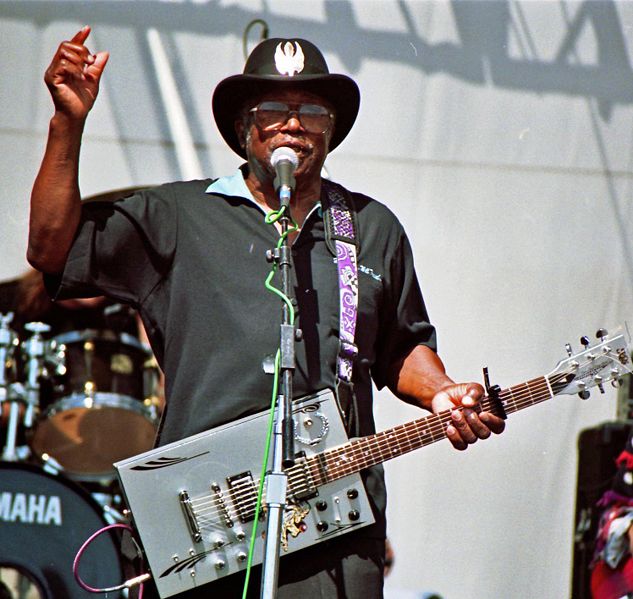
Without Ellas B. McDaniel, it is likely we wouldn’t have rock ‘n’ roll — or at least rock ‘n’ roll as we know it.
McDaniel — better know as Bo Diddley — died this morning. He created a signature sound that has been a staple of musicians across the rock spectrum, from Buddy Holly and the Rolling Stones to The Clash, Bruce Springsteen, Bow Wow Wow and others. The Animals, Yardbirds, Jimi Hendrix, John Hammond Jr., the Flaming Groovies and others covered his songs.
The New York Times said that Diddley in the late 1950s,
along with Chuck Berry, Little Richard, Jerry Lee Lewis and a few others — helped reshape the sound of popular music worldwide, building it on the templates of blues, southern gospel and rhythm and blues. His original style of R&B influenced generations of musicians. And his Bo Diddley syncopated beat — three strokes/rest/two strokes — became a stock rhythm of rock ’n’ roll.
I saw Diddley play back in the late ’70s during a free show at a small venue in Hershey Park. My friend Rich and I were at the park as part of a sophomore class (I think) trip and heard the rock pioneer was going to be playing. The show was sparsely attended, but that mattered little. Diddley did not disappoint and, in the process, expanded my appreciation of rock music’s origins that I carried with me as I continued to explore music.
When Bo Diddley come to town,
The streets get empty and the sun go down,
Sheriff’s standing in the doorway,
You know he’s so scared to say.“Bo Diddley’s a Gunslinger” (1960)
Runner’s diary, Monday
My back and neck have been sore since Saturday, made worse by yard work (holding the weed trimmer with one arm for about an hour), so I was unsure what kind of run I’d manage this morning. I did get in four miles — in an awful 38:33 — followed by about a half hour of stretching.
Music: Jesse Malin, Glitter in the Gutter
Fractured party time
No surprises from the Democratic Party rules committee today — deciding to seat the Florida and Michigan delegations, but only give them half their votes — but the question remains whether irreparable damage has been done.
If you read the quotations from Clinton supporters in the MSNBC.com report, the party seems like it is in trouble.
“How can you call yourselves Democrats if you don’t count the vote?” one of the many hecklers in the audience yelled loudly and repeatedly before being escorted out by security. “This is not the Democratic Party!”
MSNBC described a “sharply divided audience” that “shows Obama will have a long way to go to bring the party together after a long and divisive primary.”
‘We just blew the election!’”We just blew the election!” a woman in the audience
shouted. The crowd was divided between cheering Obama supporters and booing
Clinton supporters. “This isn’t unity! Count all the votes!” another audience
member yelled.
I still think that the people screaming loudest about this will come over to the Obama camp when the realization that a fractured party will ensure a McCain victory in November. But there are no guarantees (Democrats are famous from grasping defeat from the jaws of victory).
In the end, if the Democratic Party can’t find a way to bridge this gap, given the rather small differences that really separate the candidate, then perhaps the Democratic Party should not be viewed as the vehicle to achieve progressive goals.
I’d argue that the party offers little more than a brake on the dangerous actions of the Republicans, but is not a beacon of change. Change can only come — as I wrote in my Dispatches column this week — if we take responsibility for making it happen. Elections are only a small part of this process.
 Hank Kalet