Reading the signs:Uphill for local GOP

Local Republican candidates John O’Sullivan and Steve Walrond are facing long odds in the campaign for Township Council.

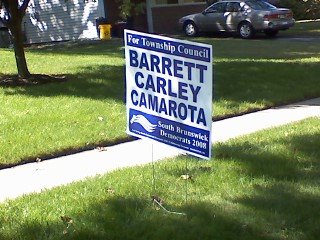
The evidence — admittedly unscientific — is the dearth of signs around town, especially when compared to the ubiquitous presence of Barrett-Carley-Camarota signs.

Signs, to be sure, are a somewhat dubious way in which to gauge support. But a lack of signs, when combined with several factors both current and historical help paint a larger problem facing the GOP.

Consider some recent history: During the previous five elections dating back to 1998 campaign, when the council was created, 15 council seats have been on the ballot. Of those, the GOP has won just two — and both times it was incumbent Ted Van Hessen who won.

Of the other 13 candidates, eight had run in the past (seven of whom had lost) and the party has had difficult during the last three elections — including this one — finding people to run or money to fund their campaigns.

Add to the mix a demographic change that has turned the township bluer with each passing year and you have two Republicans running up hill during an avalanche. That’s not to say they won’t win. It just won’t be very easy.

Irritable candidate syndrome?

So, just to get this straight, Sarah Palin looked like she was a deer caught in a headlight during the Katie Couric interview, because of “irritation with the questions.”

“I was thinking, ‘Man, Americans wanna know about how I think we’re gonna win the war,’” and solve the country’s economic problems, she said, not learn about what she reads.

This is nonsense, of course, but we’re likely to keep hearing it over and over again until Nov. 4.

Tongue twisters

Sarah Palin and the comedian Norm Crosby have a lot in common — though that is not a good thing.

Crosby was famous for being likably prone to verbal gaffs, building an entire career on mangling the language.

Palin, the Alaska governor and vice-presidential candidate, has proven prone to what best can be described as verbal diarrhea, mangling her syntax as she rambles through her talking pints and cliches. (Read the transcript to understand what I’m talking about).

Consider this meandering, barely coherent answer to Gwen Ifill’s question about encouraging bipartisanship and curing the poisonous atmosphere in Washington:

You do what I did as governor, and you appoint people regardless of party affiliation, Democrats, independents, Republicans. You — you walk the walk; you don’t just talk the talk.

And even in my own family, it’s a very diverse family. And we have folks of all political persuasion in there, also, so I’ve grown up just knowing that, you know, at the end of the day, as long as we’re all working together for the greater good, it’s going to be OK.

But the policies and the proposals have got to speak for themselves, also. And, again, voters on November 4th are going to have that choice to either support a ticket that supports policies that create jobs.

You do that by lowering taxes on American workers and on our businesses. And you build up infrastructure, and you rein in government spending, and you make our — our nation energy independent.

Or you support a ticket that supports policies that will kill jobs by increasing taxes. And that’s what the track record shows, is a desire to increase taxes, increase spending, a trillion-dollar spending proposal that’s on the table. That’s going to hurt our country, and saying no to energy independence. Clear choices on November 4th.

Gail Collins offers what can best be described as a back-handed compliment, describing what is like to happen, now that the vice-presidential debate has come and gone.

(A)fter the Couric debacle, you can bet your boots that the campaign is going to take Palin’s debate performance, declare victory and wrap her up until after the election.

This is all a terrible shame. For us, mainly. But also for Palin, whose intelligence and toughness may wind up buried under the legend of her verb-deprived ramblings.

This is a good way to describe her linguistic approach, which Steven Pinker, a Harvard psychology professor, views as potentially indicative of an inability to grasp issues.

The debate, he says, was not a “test of clear thinking,” because its “format was far less demanding than a face-to-face interview — the kind Ms. Palin had with Katie Couric of CBS.”

Why? Because in a one-on-one conversation, you can’t launch into a prepared speech on a topic unrelated to the question. Imagine this exchange — based on the first question that the moderator, Gwen Ifill, gave Ms. Palin and Senator Joe Biden — if it took place in casual conversation over coffee:

LISA How about that bailout? Was this Washington at its best or at its worst?

MICHAEL You know, I think a good barometer here, as we try to figure out has this been a good time or a bad time in America’s economy, is go to a kid’s soccer game on Saturday, and turn to any parent there on the sideline and ask them, “How are you feeling about the economy?”

Lisa would flee. (This was, in fact, Ms. Palin’s response.) In a conversation, you have to build your sentence phrase by phrase, monitoring the reaction of your listener, while aiming for relevance to the question. That’s what led Ms. Palin into word salad with Ms. Couric. But when the questioner is 30 feet away on the floor and you’re on a stage talking to a camera, which can’t interrupt or make faces, you can reel off a script without embarrassment. The concerns raised by the Couric interviews — that Ms. Palin memorizes talking points rather than grasping issues — should not be allayed by her performance in the forgiving format of a debate.

Her ramblings, of course, are reminiscent of the ramblings of another former governor, one who did ascend to the White House and whose lack if intellectual curiosity is directly responsible for recklessly driving our foreign policy off a cliff.

Draft of a poem writtenoutside a shopping center on Rt. 202

Autumn and cold clouds
hover above the whooshing
noise of speeding cars,
highway near Somerville,
standing in the parking lot
of a shopping center
full of shoppers,
though the talk is of recession,
no loans to be had,
freezing the machinery
of commerce.
Cloud covering, the gray hue
is like an unanswered question,
or that question
you refuse to ask,
wondering about the mortgage,
how much do we owe
and can we pay it?
We're lucky, I know,
we've been in this house
a good long while,
so the loan's not too big,
but still, when I read of
that woman with the two kids
who couldn't make her payments
when her husband died,
I can't help but worry….

This message was sent using the Picture and Video Messaging service from Verizon Wireless!

To learn how you can snap pictures and capture videos with your wireless phone visit www.verizonwireless.com/picture.

To play video messages sent to email, QuickTime� 6.5 or higher is required. Visit www.apple.com/quicktime/download to download the free player or upgrade your existing QuickTime� Player. Note: During the download process when asked to choose an installation type (Minimum, Recommended or Custom), select Minimum for faster download.

Bailing out the bad guys

The bailout has passed. There is rejoicing all around — well, OK. I’m being facetious.

At best, this is a flawed plan, a rather massive give-a-way to the financial sector that may have only limited psychological impact.

Even before today’s vote, there were some in the financial community who were “already wondering: What is being left out and what will have to be done next?”

The rescue package may be missing measures intended to offset shrinking bank balance sheets, free up capital for non-financial companies squeezed by the credit crisis, or prevent the possible collapse of a $58 trillion unregulated market in loan insurance policies — known as credit default swaps — written by a variety of firms, say financial experts.

Most urgently, the short-term lending system remains largely frozen, endangering the ability of everyone from small businesses to universities to General Electric to finance day-to-day operations. The financial rescue package will not fully thaw it.

“The market for commercial paper issued by a large number of corporations has essentially shut down,” said Mohamed A. El-Erian, co-chief executive of Pimco, an investment firm with about $800 billion under management.

The market for commercial paper, which companies use to borrow money, shriveled by $94.9 billion, or 5.6 percent, to a seasonally adjusted three-year low of $1.6 trillion for the week ended Oct. 1, the Federal Reserve said yesterday. With banks, insurers and other investors shying away from corporate loans, the amount of outstanding commercial paper has dropped by more than $600 billion since hitting a peak of $2.223 trillion in July 2007.

Peter R. Fisher, a former Treasury undersecretary and former senior New York Federal Reserve official, said that in buying troubled loans, the new agency created by the legislation would attack the credit crisis “indirectly . . . by trying to lighten the load on the balance sheets of the banks, but it is unlikely to do enough to change the propensity of banks to shrink their balance sheets from here to year-end.”

That means less lending by banks and tight times for Americans who need to borrow money.

And that doesn’t account for the lack of assistance to homeowners in the bailout plan.

Here is U.S Rep. Dennis Kucinich (via John Nichols, on The Nation) detailing the problems with the bailout:

Some people will ask of this Congress, what were we thinking? Why did we give $700 billion bailout to Wall Street without fixing what caused the problem in the first place? Why did we rig the free markets for security fraudsters? Why didn’t we explore alternatives to let Wall Street solve its own problems? Why didn’t we have money to save millions of homeowners, create millions of jobs, and a green economy? Why didn’t we stop the speculators? Why wasn’t there accountability? Why didn’t we take time to make an intelligent decision?

Why? Why? Why?

The Wall Street mess has obscured other bad economic news, explain succinctly by this headline from The New York Times: “U.S. Sheds 159,000 Jobs; 9th Straight Monthly Drop.”

This is a dark time, indeed.