Better late than never — a New Jersey tradition

There’s nothing like a crisis to get New Jersey legislators moving. Too bad they rarely move until the crisis occurs.

Consider the legislation Steven Sweeney announced today that would prohibit the state from dipping into its unemployment insurance fund to balance its budget. It seems like a logical proposal — until you consider the history behind it, outlined in today’s Star-Ledger.

State lawmakers in recent years “diverted more than $4 billion from it to cover the cost of state aid to hospitals,” which depleted the fund just unemployment started to rise. That’s helped shrink the fund from about $3 billion four years ago to $161 million earlier this year, the Ledger said, “not even enough to meet one month’s worth of claims.” That, says Gov. Corzine, has forced state government to scramble to cover an expected shortfall.

“Now the piper is coming home to roost,” Corzine said. “We have to pay that piper. We have to do that either by putting money into that system from some other place, or we’re going to have to get help from the federal government.”

The unemployment fund, of course, is no different than any other fund at the state’s disposal. Over the last two decades, the state repeatedly has sought ways to offset increased spending my moving money between accounts, whether it has been selling roadways to itself, raiding the pension fund or borrowing against health benefits. In each case, as the governor puts it, the piper is now asking for payment.

The payment, in this case, could be “an automatic $400 million tax hike next June” on businesses that John Rogers, vice president of human resource issues for the New Jersey Business and Industry Association, told the Ledger “would certainly devastate New Jersey’s economy.”

The business group — which pays “about $2 billion a year into the fund” — had feared that the diversion would create problems down the road.

“We warned the diversions the Legislature has done to the fund would come home to roost at the worst possible time,” said Rogers. “We’re hemorrhaging money out of a fund that was almost insolvent.”

Hence, the Sweeney bill:

“If we start thinking about the future a little bit we won’t run into the crises that we are facing today,” said state Sen. Stephen Sweeney (D-Gloucester), sponsor of the measure (SCR-60). “We have to start thinking about the future.”

The Senate Labor Committee held a brief public hearing on Sweeney’s measure, which would allow voters next November to consider a Consititutional Amendment that would ban diversions from employee benefit funds like the Unemployment Insurance Trust Fund, the workers compensation Second Injury Fund and the state Temporary Disability Fund.

It’s a great idea. Too bad he didn’t put it on the table years ago.

Quaker Bridge plan still a go

Quaker Bridge Mall has long been in need of some alterations.

Once the premiere mall in the area, it has over the alst decade or so been surpassed by mammoth malls to its north and east.

That’s why it came as good news over the summer that the Simon Properties Group had won approval from the Lawrence Township Planning Board to increase the mall’s size by about 50 percent and to bring in new, high-end anchor stores to augment its current line-up.

Timing, however, tends to be everything in business so the question of whether the expansion would actually go through was an open one as Annie and I wandered the mall on our first foray into the Christmas shopping season. The mall, as I wrote in an earlier post, was only moderately busy, especially by holiday season standards, leaving me to wonder whether any retailers — let along retail property developers — would want to commit to expansion while the economy was contracting.

The answer to that question, however, comes in this story from NJ.com: “Mall expansion remains a go.” According to the story, the expansion may not be moving as quickly as first expected, but it is moving.

Jonathan Epstein, an attorney for the developers, said the plans have not been disrupted by troubles in the retail and commercial industries.

“It’s obvious what is going on in the capital markets is having an impact on large real estate developments around the country,” Epstein said in an interview recently. “But Simon continues to have the financial wherewithal to proceed with a project of this magnitude.”

Meanwhile, a spokeswoman for Nordstrom reaffirmed that the upscale retailer is still committed to the project. She said plans call for the store to open in an expanded mall in the fall of 2011.

Mall owners currently view the mall as being in the “B category.” It is 33 years oldneeds to be “reposition(ed) … to compete in a retail environment that has been transformed by big-box and lifestyle shopping centers.”

Sounds good. I only hope there’ll be someone out there with the cash to do the buying.

The times they are a-changin’

The old homestead has changed. I grew up in this house in Brunswick Acres in the 1970s when it had brown shaker shingles and the development was still new. How times change….

This message was sent using the Picture and Video Messaging service from Verizon Wireless!

To learn how you can snap pictures and capture videos with your wireless phone visit www.verizonwireless.com/picture.

To play video messages sent to email, QuickTime� 6.5 or higher is required. Visit www.apple.com/quicktime/download to download the free player or upgrade your existing QuickTime� Player. Note: During the download process when asked to choose an installation type (Minimum, Recommended or Custom), select Minimum for faster download.

Fixing health care will help heal economy

There is an element of the auto-industry bailout debate that has Watching the debate over the car industry’s implosion and the need for federal largess that has received scant attention: the impact that health benefit costs have on costs.

A few analysts have comment on this — Robert Reich, Paul Krugman, the UAW and this piece from The Coastal Journal — but for the most part the health care issue has been off the table, except when it has been framed as one in which greedy employees are killing competition.

Progressives would be smart to counter this anti-worker rhetoric forcefully and use the auto-industry debate to bring the discussion of health care into the larger issue of our economic future.

Too many analysts — like Michael Boskin, for instance — are offering this kind of misguided advice:

The most important issues facing the country right now are income, jobs and wealth — not energy, health care, the environment or the distribution of income. This recession is the real thing, far worse than the two brief, mild recessions of the last quarter-century.

Mr. Obama needs to think about everything his administration does through the prism of how it will affect the economy in the next two years. That means postponing, scaling back or slowly phasing in proposals that impose significant costs on the economy. For example, his energy and health care proposals, if enacted, would destroy investment and jobs now, whatever they might accomplish later.

But investment in green technology and reforming health care will go a long way to fixing what ails us. Consider how health care affects the price of cars — and the decisions made by Detroit on what kinds of cars to build and market:

GM’s obligations to its employees and retirees add about $2,500 to the cost of each automobile sold. In part because of the high cost of these benefits, and in part because GM simply failed to read the market properly, GM manufactures and sells mostly large vehicles with large price tags. They also consume large amounts of fuel.

Toyota, on the other hand, benefits from a national health program and a retirement program in Japan, and in most of the countries where it manufactures its goods … Canada, and the countries of the European Union. So even though Toyota does buy insurance for its employees in Kentucky, the costs are more than offset by benefits it does not have to purchase for its employees in Kyoto. While GM’s average car price tag includes $2,500 for benefits, Toyota’s average car price tag includes about $300 for benefits.

As a result, GM can’t compete with Toyota on a straight apples-to-apples cost comparison. A Camry-like vehicle, manufactured by GM, would be a couple of thousand dollars more expensive. GM would lose comparison shoppers in price. And Toyota has developed a well-earned reputation for reliability over the years, too.

So, to compensate, GM manufactures mostly big vehicles … trucks and SUVs, high-priced sporty vehicles, such as the Corvette, and luxury cars, like the Cadillac. And for a time, these vehicles were the vehicles of choice, due to a strategic and successful marketing campaign in the United States.

But then the price of gas went up and concerns about the environment also rose. And while Toyota adjusted quickly … spending its capital in R&D and getting its small hybrids out within just a few years, GM kept making its SUVs, large pickups, and gas-hungry sports and luxury cars, betting that the price of gas would go down and that buyers would choose to stay with the bigger vehicles. But they were going the way of the dinosaurs on whose ancient blood these vehicles feasted … simply put, no one could afford the gas. If a buyer didn’t absolutely NEED a large pickup, he didn’t buy one. Toyota, meanwhile, couldn’t keep its Prius hybrids in stock. Even zero-interest car loans couldn’t bring the buyers back to GM for long.

Other industries in the United States that compete globally face the same uneven playing field. Taking health care off the table as a cost of business would go a long way toward improving out competitiveness, which is why reforming our broken health care system has to be a major short-term priority and not something left to later.

The new administration appears to understand this. Consider what Tom Daschle — Obama’s top health care advisor — had to say the other day:

“There is no question that the economic health of this country is directly related to our ability to reform our health-care system,” Daschle said.

Daschle cited the fact that high health care costs are preventing U.S. businesses from staying competitive and creating jobs. “That’s what makes this so urgent and so much a part of the economic recovery process,” Daschle said. “I believe that for the first time in American history, health-care reform will be done.”

Let’s hope so.

House prices continue to fall

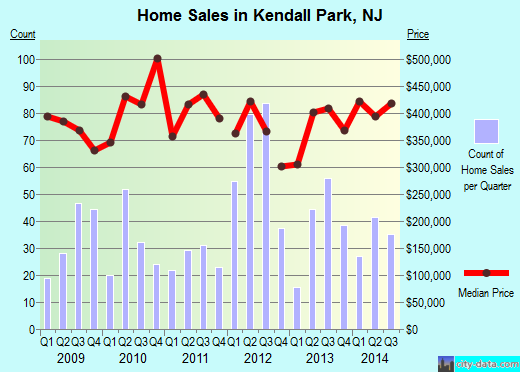
It wasn’t that long ago that houses in Kendall Park — ranch houses like mine — were going for a little more than $400,000. Check out this listing and consider what we are facing economically.
The chart, from city-data.com shows the price fluctuations, with shocking high over the summer, but falling significantly during the third quarter (without know exactly where in Kendall Park — Timber Ponds, Brunswick Acres or the original K.P. development — it’s tough to know why).
The numbers do not look good.