Merging agendas

Maybe the difficult job of crafting a budget for small towns like Hightstown and Bordentown is starting to sway local officials to consider doing more than complaining.

Hightstown is ready to study consolidation with East Windsor and Bordentown is looking at a police merger. Where will these studies lead? It’s too early to know, but the fact that the discussions are happening is a good sign for New Jersey.

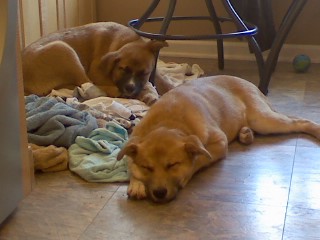
Doggie diary: The story of Rosie and Sophie A nap after training

Sleeping dogs are good dogs. They trained this morning and did well, but now are tired.

This message was sent using the Picture and Video Messaging service from Verizon Wireless!

To learn how you can snap pictures and capture videos with your wireless phone visit www.verizonwireless.com/picture.

Note: To play video messages sent to email, QuickTime� 6.5 or higher is required.

A taxing state budget

As a property tax payer, I can’t say I am happy about this development — though, I can’t say I’m surprised.

Gov. Jon Corzine yesterday confirmed New Jersey’s popular property tax rebate program is among the items that may be cut or curtailed as he tries to balance the upcoming budget.

“Everything is on the table, and that’s where it will stay” until the budget address March 10, Corzine said.

Corzine said a “suspension of the property tax rebates would be a better way to talk about it,” but quickly added, “there’s a purpose to providing property tax rebates.

“Property taxes are a heavy burden. It’s not a gimmick program. It’s meaningful. We’re not anxious about making these decisions,” Corzine said, speaking to reporters at Kean University in Union Township, where he addressed high school students attending a leadership conference.

With diminishing options for cutting the budget, Corzine is preparing plans to severely curtail or eliminate the rebates for the coming year, The Star-Ledger reported yesterday.

The rebate checks to homeowners and tenants, which cost the state about $1.7 billion last year, represent one of the largest remaining nonessential spending items in the budget Corzine will present to the Legislature next month. He has estimated the spending plan at $29 billion, down from the $32.9 billion budget originally passed this year.

“We have to make tough decisions. The people expect us to be prepared to make the tough decisions,” he said.

The property tax rebate program has always existed on somewhat shaky ground, the product of a political compromise that was unsustainable as the state’s budget difficulties ran headlong into the national recession.

The program’s likely dissolution, hopefully, will be an impetus toward real reform, which the rebates never were. The only way to address property taxes, while dealing the state’s budget problems is to change the way we collect and spend money. That means moving toward a broader income tax that covers more services, municipal and school-district consolidation and a complete review of the kind of programs the state and local governments offer. (I’d also consider gutting county government, which is little more than a mechanism to collect massive amounts of campaign contributions and reward contributors with contracts.)

Money for nothing

I like this Paul Krugman take on fears of a nationalized banking system. I heard some of that again today from U.S. Rep. Leonard Lance, who was in to speak with our editorial board (look for audio clips from the discussion next week). Lance said he didn’t believe in nationalization and that that business decisions should be left to private enterprise. To his credit, he is skeptical of the bank bailout — what he called TARP I and TARP II (and Tim Geithner’s Son of TARP, as he called it).

But his attitude misses the point. Here is what Krugman had to say:

We are not talking about fears that leftist radicals will expropriate perfectly good private companies. At least since last fall the major banks — certainly Citi and B of A — have only been able to stay in business because their counterparties believe that there’s an implicit federal guarantee on their obligations. The banks are already, in a fundamental sense, wards of the state.

And the market caps of these banks did not reflect investors’ assessment of the difference in value between their assets and their liabilities. Instead, it largely — and probably totally — reflected the “Geithner put”, the hope that the feds would bail them out in a way that handed a significant windfall gain to stockholders.

What’s happening now is a growing sense that the federal government, in return for rescuing these institutions, will demand the same thing a private-sector white knight would have demanded — namely, ownership.

Basically, the market is afraid that we — the taxpayers — might want something for all the cash we’ve thrown at the system.

A third front?

The news from Pakistan is not good — both because the terrorist networks seem to have deeper roots there than we’d like and because the new president seems willing to widen the war along the Afghanistan/Pakistan border. This is a dangerous gambit that should remind liberals that Barack Obama was never the peace candidate, only the anti-Iraq War candidate.