
Obama’s Afghanistan policy: Different but still the same

Visit msnbc.com for Breaking News, World News, and News about the Economy

There is not a lot to like about President Barack Obama’s newly announced Afghanistan strategy.

First, there will be more troops and advisers. So, war remains the answer in Afghanistan, even if the Obama administration is bulking up diplomatic efforts.

Second, there is the rhetoric — which Rachel Maddow last night showed was similar, sometimes word for word, to the language used by President George W. Bush.

It is true that the strategy is a break from the Bush administration’s, but it is a falsehood to say that the war in Afghanistan was not one of choice as we are hearing from some. Afghanistan may have been the home to Osama bin Laden and al Qaeda, but a full-out war was not necessarily something that had to follow 9/11. A narrower approach was still possible back in October 2001, one that could have resembled a police raid on a drug-manufacturing house — a coordinated effort that would not have resulted in the kind of indiscriminate actions that have poisoned our relationship with the region and now appears to imperil Pakistan.

Tom Hayden is correct:

The Obama plan instead will accelerate any plans Al Qaeda commanders have for attacking targets in the United States or Europe. The alternative for Al Qaeda is to risk complete destruction, an American objective that has not been achieved for eight years. A terrorist attack need not be planned or set in motion from a cave in Waziristan. The cadre could already be underground in Washington or London. The real alternative for President Obama should be to maintain a deterrent posture while immediately accelerating diplomacy to meet legitimate Muslim goals, from a Palestinian state to genuine progress on Kashmir.

Or as another Nation writer, editor Kristina Vanden Heuvel, said not too long ago,

Escalating the occupation will bleed us of the resources needed for economic recovery, further destabilize Pakistan, open a rift with our European allies and negate our improved image in the Muslim world prompted by our withdrawal from Iraq. Escalation will not increase US security or secure a better future for the Afghan people–indeed, more troops will certainly mean more dead civilians.

We need a much greater break with Bush policy than what President Obama is offering.
Doggie diary: The story of Rosie and Sophie The first real damage

I guess it was just a matter of time. Exhaustion takes hold and we miss the signs.

Consider the last couple of days, as we still tried to keep them calm after their surgery, when all of their puppy energy gets pent up without an outlet. They run around the house like crazed and headless chickens on a sugar rush, tumbling maniacally. The result, as I wrote earlier, was a little issue with Rosie’s incision, but nothing major.

They are not listening particularly well, however, which is probably our fault. And we are failing to pick up the signs.

There have been the pee issues of late — Rosie, for some reason, has taken to relieving herself on the rug shortly after coming in from outside. Not that she hasn’t attempted to tell us — she has. It’s just that our frustration and her constant requests to go outside — and her less-than-clear signals (she gets antsy but not in a specific way that distinguishes it from other behavior, unlike Sophie who will ring the bells by the door) — have gotten the better of us.

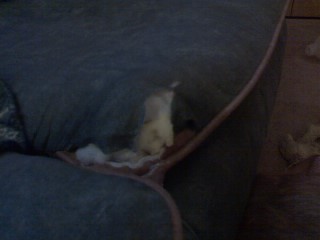
All of this culminated early this morning in the latest damage: a hole in our den couch. Sophie has chewed through a laptop power cord — not great, but not irreplacable. The hole in the couch, however, is a major problem. Our couches are an unusual green with tan piping and a pillow top attached to the main cushion. We can’t just sew it and turn the cushion around or over; we have to get it repaired and/or live with the obvious damage. Who knows what it will cost (laptop cord was $100), but it is money that we do not have.

It happened around 6 or 6:30 — they began bugging us at 4 and Annie let them out. Sometime after that, closer to 6, they began bugging us again. We failed to listen — exhaustion, aggravation — told them to lie down and fell back to sleep. They knocked over the gate that keeps them in the bedroom and hallway and were loose for a while.

Bad dogs, for sure, but bad owners, as well. We’ve now learned a valuable lesson: When they start bugging us like that, we have to get up.

Hightstown grudgingly plays governor’s pension game

Hightstown is going to take advantage of the state pension holiday — but only because the state is holding towns like the borough hostage.

The state has tied the pension deferral to extraordinary aid, the pot of money the state sets aside for cash-strapped towns. The aid is designed as tax relief, but requires towns essentially to exhaust all other means to bring their tax rates down.

The aid, however, functions like an addictive drug that forces them to keep coming back for more every year.

Consider what happens to municipal surplus use. Towns are forced to use 95 percent of their surplus balance as revenue in their budget to qualify for the aid. When towns do that, they often find themselves scrambling the next year if it cannot find enough revenue to offset the amount of surplus used. That forces towns to repeat the mistake, to go back to the state for aid and spend down their surplus again, creating a never-ending downward spiral.

Towns can only reverse this trend by hoping the state provides them with more money than they have received in the past (fat chance) or by experiencing ratable growth. The problem is that many of the towns that seek extraordinary aid are built out like Hightstown or Jamesburg, leaving them with few opportunities to expand their ratable bases.

The pension deferral will only exacerbate this problem next year. Hightstown estimates that the pension deferral will save it $159,000 this year, which then has to be repaid over 15 years at 10 percent interest beginning in 2012. That means the borough is facing a minimum spending increase next year of $159,000 and then another hit in excess of $40,000 in 2012 when repayment of the deferral hits.

That’s a lot of cash, but it is understandable why Hightstown would go down this road. Not doing so would cost the borough $200,000 this year — money that would be impossible to replace in the budget. Plus, Hightstown is not alone. Manville also is deferring its pension payments, primarily for the same reason.

While Plainsboro Mayor Peter Cantu says that, because of the current economic climate the program makes sense, it is just another example of the state’s dysfunction when it comes to budgeting. After nearly four years of criticizing past practices that essentially kicked fiscal problems down the road, the state is doing the same and asking municipalities to join in the fun.

Government-to-government graft

Several years ago, South Brunswick paid consultants to lobby the state and federal governments in an effort to win grants for its SMART bus and to get the widening of Route 1 moving.

The township in 2005 hired Cavarocchi, Ruscio and Dennis of Washington to take advantage of the firm’s influential ties to the power-holders, looking to cut through year’s of indifference by higher-level officials and get the township’s goals accomplished.

The cost was $120,000. The result, money for the bus line and some federal money for Route 1 and state interest in the widening. Money well-spent? Maybe, but only if you consider the issue from the narrowist of perspectives.

Considered more broadly — within the context of a story in today’s Star-Ledger — the money is part of a questionable trend that drains public coffers by privatizing the interaction between government agencies.

The story focuses on a report from the state comptroller that found that 74 government entities spent $3.87 million to lobby state government — a figure that the report acknowledges may understate the amount spent because it only includes self-reported spending and also does not include money paid in dues to organizations like the state League of Municipalities. It also does not take into account money spent to lobby the feds, which cost $1.9 million.

The government agencies included ran the gamut from municipal and county governments to school boards to independent authorities, with some spending as much as $536,000 over the two-year peeriod. And the lobbying issues included both general and specific issues —

The Mercer County Improvement Authority hired a lobbyist (for $136,000) to monitor legislation and work with NJ Transit, while Montgomery paid a lobbyist $17,000 to aid in the purchase of the North Princeton Developmental Center.

The report raises two questions — whether public agencies should be allowed to hire lobbyists and what kind of disclosures are necessary to ensure that citizens know what is going on in their names.

Five states ban the hiring of lobbyists — legislaton on which the comptroller neglects to take a position. Better disclosure, however, is absolutely necessary, he says.

“It makes no sense to permit public entities not to disclose information that private companies are required to provide about the hiring of lobbying firms,” State Comptroller Matthew Boxer said. “Given that we’re talking about a use of taxpayer dollars that some would deem controversial, public entities should in fact be held to a higher standard of transparency than private companies.”

He adds that

the public is certainly entitled to information from government entities hiring lobbying firms as to why such expenditures are necessary, whether steps have been taken to reduce costs and, in the end, what public benefits were derived.”

That’s the least we can expect.