
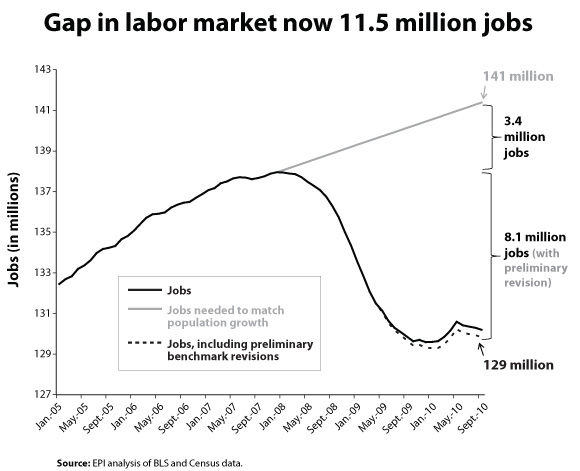
11.5 million is a lot of jobs

The jobs debate this election has boiled down to an argument between two parties who have no interest in discussing what really needs to happen to get enough people back to work to allow the public to feel as though the economy is finally going in the right direction. It is not enough to argue, as the Democrats have done, that it could have been worse. It could have been, but it is pretty bad right now and the numbers prove it. According to the Economic Policy Institute,

the labor market remains an estimated 8.1 million payroll jobs below where it was at the start of the recession in December 2007.  This number includes both the 7.8 million jobs lost in the payroll data as currently published plus the announced preliminary benchmark revision of -366,000 jobs to last March’s employment level.  And even this number understates the size of the gap in the labor market by failing to take into account the fact that simply to keep up with the growth in the working-age population, the labor market should have added around 3.4 million jobs since December 2007.  This means the labor market is now roughly 11.5 million jobs below the level needed to restore the pre-recession unemployment rate (5.0% in December 2007).  To get down to the pre-recession unemployment rate within five years, the labor market would have to add around 300,000 jobs every month for that entire period. In September, excluding changes in temporary Census hiring, the labor market lost 18,000. 

Yes, that’s 11.5 million jobs in an economy that is, at best stagnant on the job front. And yes, it could have been worse — the Labor Department estimates that the stimulus passed in 2009 saved about 5 million jobs. But, as many of us pointed out at the time, it was too small and now we are going to have to deal with the economic effects of a political miscalculation on the part of both the White House and Congresional Republicans for a long time.

  • Send me an e-mail.
  • Read poetry at The Subterranean.
  • Certainties and Uncertainties a chapbook by Hank Kalet, will be published in November by Finishing Line Press. it can be ordered here.
  • Suburban Pastoral, a chapbook by Hank Kalet, available here.

Grassroots: Magical figuring

Budget math and the poor arithmetic abilities of those in Washington — in the most recent Grassroots column at The Progressive Populist.

  • Send me an e-mail.
  • Read poetry at The Subterranean.
  • Certainties and Uncertainties a chapbook by Hank Kalet, will be published in November by Finishing Line Press. it can be ordered here.
  • Suburban Pastoral, a chapbook by Hank Kalet, available here.

Capitalism and democracy are not synonymous

Fang Li-Zhi, a Chinese dissident, reminds us that China’s growing economy means little for its commitment — actually, lack of commitment — to democracy and human rights. Using the occasion of Liu Xiaobo’s winning of the Nobel Peace Prize, Li-Zhi commends the Nobel committee for

challeng(ing) the West to re-examine a dangerous notion that has become prevalent since the 1989 Tiananmen massacre: that economic development will inevitably lead to democracy in China.

Increasingly, throughout the late 1990s and into the new century, this argument gained sway. Some no doubt believed it; others perhaps found it convenient for their business interests. Many trusted the top Chinese policymakers who sought to persuade the outside world that if they continued pouring in their investments without an embarrassing “linkage” to human rights principles, all would get better at China’s own pace.

More than 20 years have passed since Tiananmen. China has officially become the world’s second-largest economy. Yet the hardly radical Liu Xiaobo and thousands of others rot in jail for merely demanding basic rights enshrined by the U.N. and taken for granted by all Western investors in their own countries. Apparently, human rights have not “inevitably” improved despite a soaring economy.

This seemed obvious to those of us critical of mindless globalization (a globalization that eschewed an imposition of international rules). Maybe Xiaobo’s peace prize will wake everyone else up to the idea.

  • Send me an e-mail.
  • Read poetry at The Subterranean.
  • Certainties and Uncertainties a chapbook by Hank Kalet, will be published in November by Finishing Line Press. it can be ordered here.
  • Suburban Pastoral, a chapbook by Hank Kalet, available here.

Public job cuts are not making things better

Isn’t this what we’ve been saying — that slashing government payrolls at a time of high unemployment only worsens the employment picture? Today’s job numbers would have shown growth, except that local and state governments have been forced to eliminate jobs.

Companies added 64,000 jobs last month, after having added 93,000 jobs in August, the Labor Department reported Friday. But over all, the economy shed 95,000 nonfarm jobs in September, the result of a 159,000 decline in government jobs at all levels. Local governments in particular cut jobs at the fastest rate in almost 30 years.

“We need to wake up to the fact that the end of the stimulus has really hit hard on local governments,” said Andrew Stettner, deputy director of the National Employment Law Project. “There is much more of a slide in the job market than what we really need to clearly turn around.”

But the federal government, which can run a deficit, can’t pump money into local budgets to save jobs, which would stabilize other areas of the economy and so on.

  • Send me an e-mail.
  • Read poetry at The Subterranean.
  • Certainties and Uncertainties a chapbook by Hank Kalet, will be published in November by Finishing Line Press. it can be ordered here.
  • Suburban Pastoral, a chapbook by Hank Kalet, available here.

Tunneling into the muck

Leave it to New Jersey to take a flawed project like the Trans-Hudson tunnel and turn it into the kind of fiasco that would make Sarah Palin proud.

I’ve written about the tunnel before, saying that a breather was warranted to give everyone a chance to answer some questions and figure out what the best way to move foward might be. Moving forward, in the end, made sense, though not given the current budget parameters or design.

Killing it, however, just seems too much, especially given the need to create jobs and move commuters into New York.

That’s why I like Mark Di Ionno’s column today in The Star-Ledger. It cuts through the rancor and blame to make the point that our dysfunctional political culture helped kill the tunnerl.

This saga is convoluted, to say the least, and everybody has their own version of why this won’t happen. Cost, cost overruns, empty transportation funds, politics as usual.

There is plenty of blame to go around — a series of compromises that left us with an inadequate plan, a massive recession and the state’s fiscal irresponsibility, a short-sighted and arrogant governor.
The basic problem remains in place. A better solution needs to be sought. And if it can’t be found, we may need to give in and build the tunnel as proposed. But we have to do that work.

  • Send me an e-mail.
  • Read poetry at The Subterranean.
  • Certainties and Uncertainties a chapbook by Hank Kalet, will be published in November by Finishing Line Press. it can be ordered here.
  • Suburban Pastoral, a chapbook by Hank Kalet, available here.