Egypt, the second act

The Egyptian military’s decision back in February to side with protesters and smooth the way for Hosni Mubarak’s exit was a cause for celebration at the time.

But as Egypt makes it’s way from dictatorship to something news, the military has become an impediment, holding power and demanding a central role in creating a new constitution.

For democracy advocates, this leaves Egypt at a crossroads, with the army representing stability and democracy advocates offering the unknown.

The end result is far from certain. Stability, as observers of Russia post-Communism well know, is an attractive option in troubled times. If Egypt is to continue on the road to democracy, it will need commitment from advocates and arms-length support and no interference.

It is tempting to try to turn events to advantage, but doing so nearly always backfires and blowback ensues.

The time is now for marriage equality

My latest Patch columnhttp://southbrunswick.patch.com/articles/marriage-equality-the-time-is-now is on what I hope is a renewed push for marriage equality in New Jersey.

  • Send me an e-mail.
  • Read poetry at The Subterranean.
  • Certainties and Uncertainties a chapbook by Hank Kalet, will be published in November by Finishing Line Press. It can be ordered here.
  • Suburban Pastoral, a chapbook by Hank Kalet, available here.

Money is bad politics

U.S. Rep. Rob Andrews decision to refund about $9,000 to his campaign account to cover money he spent on a family trip to Ireland highlights everything that is wrong with our campaign system. While the congressman insists he has done nothing wrong, the behavior certainly is unseemly and it raises questions about why we allow our elected officials to maintain accounts like these.

Here is the Ledger’s description of what happened:

In June, U.S. Rep. Rob Andrews (D-1st Dist.) and his family visited Edinburgh for a wedding — part of a larger European vacation. There, Andrews, his wife and two teenage daughters stayed at the Balmoral Hotel in the center of town, which bills itself as a “luxury hotel in the true sense of the word.” The price was indeed five-star: Two rooms for three nights cost $7,725.

Nor did they go to Scotland empty-handed. The family bought a $463 china set from Bloomingdale’s as a gift to the newlyweds.

In all, Andrews and his family spent more than $9,000 on the Edinburgh leg of the trip. Rather, his congressional campaign did.

The hotel, wedding gift, and several hundred more dollars for ground transportation, meals and petty cash came not from the family’s pockets, but from Andrews’ campaign fund, according to a Star-Ledger review of his campaign-finance-reports.

Andrews said the expense was legitimate because the wedding was for a donor
and volunteer adviser, allowing him to consider it a political event. Citing privacy concerns, he declined to identify the adviser, who he said helps his campaign with opposition research.

“We have legal advice, and before we make any expenditure like that we listen to legal advice,” said Andrews, pointing out that the rest of the European vacation, including airfare, was paid for with family funds. “We’re convinced this is an appropriate expenditure to thank and support someone who has given us a lot of time and effort.”

Interesting explanation on Andrews’ part, but how many of us can claim access to this kind of political slush fund?

And that’s the problem. There are thousands of politicians with the same kind of cash accounts, full of money given them by the rich and powerful as an incentive to do the bidding of the rich and powerful. It becomes pretty easy to comingle the money — campaign and personal activities becomes conflated and we end up with Camden County politicians taking trips to Ireland and calling them campaign-related.

That this kind of thing is legal is damning in and of itself.

  • Send me an e-mail.Read poetry at The Subterranean.
  • Certainties and Uncertainties a chapbook by Hank Kalet, will be published in November by Finishing Line Press. It can be ordered here.
  • Suburban Pastoral, a chapbook by Hank Kalet, available here.
When a story is not a story

A story in today’s New York Times is likely to raise eyebrows.

According to the paper,

The American Bar Association has secretly declared a significant number of President Obama’s potential judicial nominees “not qualified,” slowing White House efforts to fill vacant judgeships — and nearly all of the prospects given poor ratings were women or members of an ethnic minority group, according to interviews.

The rate, according to the story, is three times the previous two presidencies, which makes it seem as though we are looking at a run of unqualified judicial candidates being nominated.

A closer look, however, makes it clear that there is a lot more smoke than fire to this story:

the association’s judicial vetting committee has opposed 14 of the roughly 185 potential nominees the administration asked it to evaluate, according to a person familiar with the matter. 

That’s 7.5 percent who were opposed by the ABA — or, to put it another way, 92.5 percent approved.

The administration points to a shift in philosophy — the push to appoint more judges with varied backgrounds, including those who have not worked as courtroom lawyers. This could be at odds with the ABA’s apparent preference for courtroom litigators and explain the higher number of rejections.

In any case, it seems like a non-issue, though I have a sneaky feeling that we’ll be hearing from conservatives on this one claiming that Obama is damaging the federal bench with unqualified judges. These, of course, will be the same conservatives who applauded when George W. Bush opted to stop sending nominees to the ABA for review because he felt the organization was ideologically biased.

  • Send me an e-mail.
  • Read poetry at The Subterranean.
  • Certainties and Uncertainties a chapbook by Hank Kalet, will be published in November by Finishing Line Press. It can be ordered here.
  • Suburban Pastoral, a chapbook by Hank Kalet, available here.

Even the crazy and unqualified sometimes have a good idea

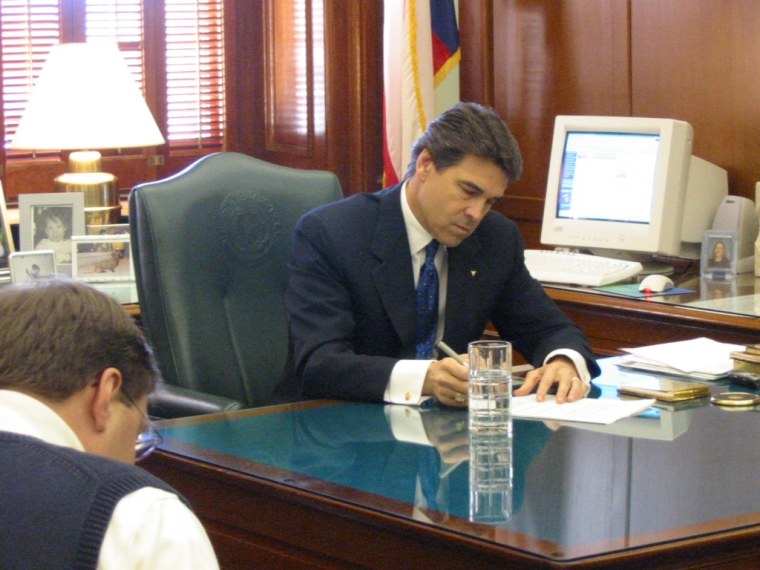
Rick Perry will not be president. That much is certain. And Rick Perry’s ideas — the flat tax, elimination of government agencies, bellicose foreign policy, etc. — deserve to die with his candidacy.

Except for one: The proposal he announced today to impose term limits on federal judges. Since the appointment of the 43-year-old Clarence Thomas by President George H.W. Bush to what is likely to be a 35- 40-year reign on the Supreme Court, it has been clear to me that lifetime appointments come with the potential for disaster.

Perry is proposing an 18-year term, which seems too short to me, but why not limit terms on the federal bench to 25 years, which would guarantee some turnover and give presidents of both parties a chance to influence the work of the bench and could help ensure that changing mores are reflected by the men and women who sit.

It’s jut a thought, but just because Perry is, well, batty doesn’t mean we can’t at least discuss some of what he offers.

  • Send me an e-mail.
  • Read poetry at The Subterranean.
  • Certainties and Uncertainties a chapbook by Hank Kalet, will be published in November by Finishing Line Press. It can be ordered here.
  • Suburban Pastoral, a chapbook by Hank Kalet, available here.