Christie does the right thing

It really appeared to be a no-brainer. The state’s poorer residents would get medical coverage through an expanded Medicaid program, on the federal government’s dime, but the governor was remaining mum on the issue.

He’d already vetoed the creation of a public health-care exchange — another provision of the Affordable Care Act, Obama’s effort at universal health coverage — and conservatives had been hoping Christie would do the same with Medicaid expansion.

In the end, however, Chris Christie made the right call, expanding Medicaid as part of a proposed $32.9 billion state budget unveiled today.  In his budget speech, Christie said:

After considerable discussion and research, I have decided to participate in Medicaid expansion under the Affordable Care Act. While we already have one of the most expansive and generous Medicaid programs in the nation, including the second highest eligibility rate for children, we have an opportunity to ensure that an even greater number of New Jerseyans who are at or near the poverty line will have access to critical health services beginning in January of 2014.

As New Jersey Policy Perspective has been pointing out, Medicaid expansion could provide coverage to more than 300,000 New Jersey residents who currently lack insurance, with federal money — about $2.5 billion on average annually – coming into the state to expand coverage.

The NJPP numbers are similar to those in a study by the Urban Institute and Henry J. Kaiser Family Foundation last year, a report that said expansion would provide new health care coverage to an estimated 291,000 in New Jerssey through 2022.

New Jersey would spend an additional $1.5 billion and receive $15.4 billion from the federal government to finance the expansion during that time period, the report predicted.

Christie is the latest Republican governor to take the federal money, even though the party’s national base remains staunchly opposed to all facets of so-called Obamacare. Christie, in fact, said he still opposes Obama’s health legislation.

I am no fan of the Affordable Care Act. I think it is wrong for New Jersey and for America. I fought against it and believe, in the long run, it will not achieve what it promises. However, it is now the law of the land and I will make all my judgments as governor based on what I believe is best for New Jersey.

His logic — like that of other Republican governors — is faulty. If it is wrong, then leave the money on the table and continue to fight its implementation. But Christie also understands the politics of the situation better than most. He is the popular red governor of a blue state, and leaving federal money — cash designed to help the most vulnerable in New Jersey — on the table while slashing spending would leave an opening that could be exploited by his opponents. So his best option is to move toward the center. But unlike his other “compromise measures” — the minimum wage conditional veto, the counter offer of an expanded earned-income tax credit and his gun study panel — this one is going to have real-world benefits for residents of the state.

That has elicited praise from an array of folks who usually find themselves at odds with the governor.
New Jersey Policy Perspective, which has been very publicly advocating on behalf of the expansion, praised Christie — something that it rarely does. Senior Policy Analyst Raymond Castro said in a written statement:

Despite opposition to the expansion from conservative factions of the national Republican party, Gov. Christie – much like he did in the aftermath of Superstorm Sandy – has demonstrated the leadership and independence of a governor who is willing to place the interests of New Jerseyans above partisan politics by opting to expand Medicaid under the Affordable Care Act.

His commendable decision is truly a win-win-win: it will improve the health of hundreds of thousands of struggling New Jerseyans, boost the state’s ailing economy as a result of the influx of billions of dollars in federal funds, and save the state billions of dollars over the next decade.

And several Democratic Senators — among them Joe Vitale of Middlesex County and Nia Gill of Essex County — expressed support for that portion of the budget. The rest — well, Christie’s spending plan remains anathema to Democrats. (More on that in coming days.)

Send me an e-mail.
ID cards for immigrants

I have a story up on NJ Spotlight this morning on the distribution of ID cards to local residents — including undocumented immigrants. The cards have sparked some criticism from anti-immigration groups like the Federation for American Immigration Reform, who say the cards enable illegals to live normal lives. The criticism is well-founded — but way off the mark. Allowing people whose only interest is to live normal lives a chance to be somewhat normal seems to me a deeply human response on the part of advocates.

Send me an e-mail.

February morning photo gallery

Here are some photos taken this morning in and around New Brunswick.

Near the Robeson homes in New Brunswick,
 on the outskirts of the city
 on an overcast but unseasonably warm February day.

Call this one “Storm clouds in black and white.”

Stoney stairs.

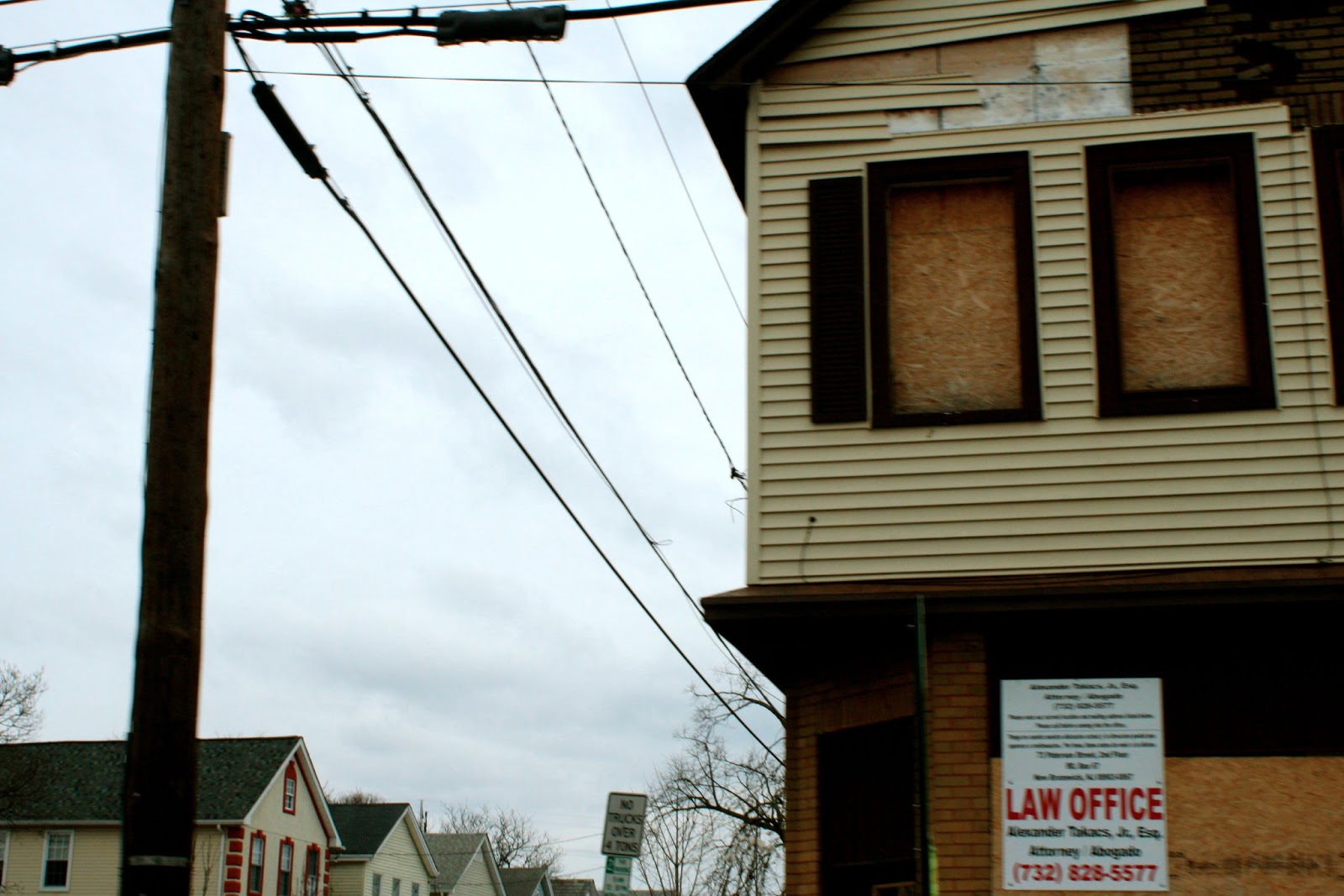
Burned-out building waiting to be reborn as a law office.

Storm clouds.

Missing?

Track-side at the edge of New Brunswick.


Send me an e-mail.

State budget: Playing chess in a house of cards

Gov. Chris Christie is about to unveil his fourth state budget, and if previous spending plans are any indication both sides will be looking to push the pain off into the future.

While the governor has developed a reputation for being someone willing to make the tough decisions, his track record on the budget is spotty at best. He has, as required by law, balanced the budget, but he has not done as promised. He is as guilty as his Democratic predecessors of dipping into the bag of of magic one-shot budget fixes to do so.

Christie fans will demur, but the governor has delayed payments into the pension plan and set unrealistic ally high revenue projections to ensure that the spending plans met constitutional muster.

Despite this, expect to hear him pat himself on the back again for making tough choices. Not that the Democrats have proven any better. The reality is that every governor beginning with Jim Florio has dipped into the trick bag — with help from legislators of both parties — so we really shouldn’t expect much from any of the folks who ply their trade on the floor of the Legislature.

Is there momentum for a minimum wage hike?

New Jersey’s minimum wage battle is going to be decided at the ballot box in November, although if the president is successful that vote won’t have much of an impact on New Jersey workers.

And that’s a good thing, because the president on Tuesday changed the terms of the debate. In his State of the Union speech, President Barack Obama called for a national minimum wage of $9 an hour that would be indexed to inflation — a full 75 cents higher than what is called for by the proposed N.J. Constitutional amendment and 50 cents more than the wage vetoed by Gov. Chris Christie.

The president’s embrace signals both a change in the political calculus — when the president is calling for a hike that will affect all but a handful of jurisdictions and including the indexing provision, you can be pretty sure the political winds are in his favor.

It’s why you haven’t seen an outright veto of the Democratic wage hike by the governor or a full-on attack by state Republicans, despite fervent opposition from business groups to any increase.

And I think it’s why the Democrats have been unwilling to bite on the Governor’s compromise proposal — an incremental increase in the wage totaling $3 over three years — or the carrot of a restoration of the earned income tax increase to 25 percent of the federal credit. They think — rightly, I suspect — that they are going to be able to go over the Governor’s head to the voters on this on.

A January 23 poll from Quinnipiac University found wide support for the wage hike — 82 overall and 67 of Republicans. Maurice Carroll, director of the Quinnipiac polling institute, summed it up this way:

“New Jerseyans are in a generous mood when it comes to raising the minimum wage, with overwhelming support for an increase, even among Republicans.”

Republicans in the Legislature don’t see it that way. Assembly Minority Leader Jon Bramnick (R-Union) called the referendum — according to NJ.com — “an unprecedented misuse of the state’s governing document.“

“So the message we’re sending to the business community is we’re imposing in the New Jersey constitution an automatic rise regardless of the economy, regardless of feelings of the Legislature in the future,” Bramnick said.

But what about the folks who work the minimum wage jobs? If we don’t pass a wage hike, aren’t we saying that their needs are less important — that it is OK for their paltry earnings to atrophy when compared with inflation?

The New Jersey Working Families Alliance finds this thinking abhorrent. In a statement issued after the Assembly vote, the called the constitutional vote “a huge step towards giving half a million hard-working New Jerseyans a meaningful raise.”

New Jersey voters know that you can’t survive on $7.25 an hour and that raising the minimum wage will give the state’s economy a much needed jolt. Raising the minimum wage and tying it to inflation is the right thing to do for working families, the smart thing to do for the state’s economy and we are confident that it in November New Jerseyans will finally get a long-awaited raise.

John Cassidy of The New Yorker raised a similar point Thursday in a blog post:

The first statement we can make without fear of contradiction is that, at $7.25 an hour, the current minimum wage is pretty low. In nominal dollars, it’s gone up quite a bit over the past twenty-five years. In 1978, it was $2.65; in 1991, it was $4.25. But these figures don’t take into account rising prices, which eat away at purchasing power. After adjusting for inflation, the minimum wage is about $3.30 less than it was in 1968. Back then—forty-five years ago—the minimum wage was $10.56 an hour, according to a very useful chart from CNNMoney.

We also know that the U.S. minimum wage is low compared to its counterparts in other advanced countries. In France and Ireland, for example, the minimum remuneration level is more than eleven dollars an hour. Even in Great Britain, which is usually regarded as a country with a flexible, U.S.-style labor market, it is close to ten dollars an hour. Another informative chart, this one from Business Insider, shows that the U.S. minimum wage is comparable to ones in places like Greece, Spain, and Slovenia—countries where G.D.P. per capita and labor productivity are markedly lower than here in the United States. We have an advanced economy but a middle-level minimum wage.

Bramnick’s argument — and that of the business community as a whole — ignores this, while also trafficking in the canard that raising the minimum wage would damage the economy. There are hundreds of studies that can be turned to in an effort to prove either side of this argument. But Cassidy points to some numbers that, at the very least, should banish the “higher minimum wage costs jobs” nonsense:

A second important and (largely) undisputed finding is that there is no obvious link between the minimum wage and the unemployment rate. During the nineteen sixties, when the minimum wage was raised sharply, unemployment rates were sharply lower than they were in the nineteen eighties, when the real value of the minimum wage fell dramatically. If you look across the states, some of which set a minimum wage above the federal minimum, you can’t see any sign of higher rates leading to higher unemployment. In Nevada, where the national minimum of $7.25 an hour applies, the jobless rate is 10.2 per cent. In Vermont, where the minimum wage is $8.60 an hour, the unemployment rate is 5.1 per cent. What these figures tell us is that other factors, such as the overall state of the economy and how local industries are doing, matter a lot more for employment than the level of the minimum wage does.

In many ways, the question of whether to raise the wage is not a purely economic one. It is a moral one, as well. What Bramnick and the business community are arguing is that it’s OK to keep from increasing the pay of those at the bottom of the economic pot — and that’s just not acceptible.

As Assemblyman Tim Eustace (D-Bergen) said, the jobs the state lost in New Jersey in recent years (aside from the public sector ones) “were disproportionately in mid-wage occupations like manufacturing and construction.” The new jobs “are concentrated in low-wage fields like restaurants, retail and home health care.”

As a result, more families are relying on low-wage and minimum wage jobs to make ends meet.

Not that the increase will take the state’s workers very far. The 75-cent increase translates into $30 more a week and $1,500 a year and still leaves minimum wage workers making a little more than $17,000 a year. The Obama wage hike offers a better deal — a $60-a-week and $3,120-a-year increase, pushing their wages to $18,700 for the year — but the chances of the wage hike getting through the Republican Congress remain slim.

But New Jersey is going to get its chance in November, no matter what happens in Washington.