
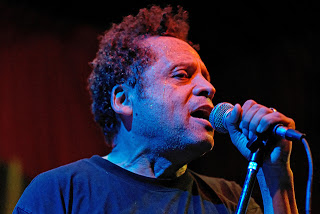
What I’m Listening to: Garland Jeffreys

Garland Jeffreys in Houston (garlandjeffreys.com)

This is the first of what likely will be a sporadic take on the music that moves me. On tap today, the Garland Jeffreys catalogue, which is playing while I work on some news pieces.

For many, Brooklyn’s Garland Jeffreys is little more than a footnote to rock ‘n’ roll history. And that’s a shame, because he was, for a four-year period at the end of the ’70s and beginning of the ’80s, among the best singer-songwriters around.

He was a touchstone for me, mixing politics and urban realism in his lyrics, fusing a punk attitude with his own Brooklyn brand of pub rock. His songwriting influenced not only my taste in music — he was of a piece with the New York punk and Springsteen albums I was listening to — but also my very early efforts at writing poetry and fiction. I appreciated the details and, though nearly everything I wrote at the time probably should be burned, I think he taught me something.

I first heard Jeffreys on WNEW during summer break singing a cover of ? and the Mysterians’ “99 Tears.” I ran out immediately to get the album — Escape Artist — and played the hell out of it (I still have the vinyl, though it is pretty worn). It became apparent immediately that “99 Tears” — and the other single, “R.O.C.K.” — were not exactly representative of who Jeffreys was as a singer or a songwriter. The album also contained songs like “Christine” and “Modern Lovers,” brilliant bits of reggae-tinged pop, along with “Mystery Kids,” a harder-edged rocker. There also was a bonus EP included called Escapades that includes Jeffreys’ terrifying recounting of a Miami race riot, “Miami Beach,” a song that may best be described as the American version of the Specials’ “Ghost Town.” That was 1981 and, unfortunately, it was nearing the end of Jeffreys’ breakthrough into the American conscience.

Jeffreys first received attention as a member of the band Grinderswitch and then went solo, releasing his self-titled debut 40 years ago in 1973. The album was solid, but barely hinted at the four gritty, brilliant hybrids — the last of which, Escape Artist, I mention above — that he would release a few years down the road.

First, as Allmusic.com points out, Jeffreys releases the two-sided single “Wild in the Streets” / “35 Millimeter Dreams.” The songs remain among Jeffreys’ best and are important cogs in his 1977 effort, Ghost Writer. Ghost Writer, nearly four years in the making, showcases all of Jeffreys’ talents — the gritty imagery, the pub-rock affections, the New York attitude, the tenderness he brings to a love song or a story well told. One-Eyed Jack, the follow-up, was solid, but not nearly as satisfying and probably hampered by expectations. The reality, as All Music says, is that the album “probably couldn’t have lived up to its predecessor, and it doesn’t, but it is further evidence of a songwriting talent (not to mention a singing ability that mixes Dion with Mick Jagger) deserving of more notice than it has gotten so far.”

The two albums that followed, however, did live up to Ghost Writer. American Boy and Girl (with its street-wise lyrics and stories and the beautiful “Matador” and “If Mao Can See Me Now”) and Escape Artist.

A very good live album — Rock and Roll Adult — and an overproduced attempt to hit the pop charts — Guts for Love — followed, but Jeffreys’ career ran out of steam. His output has been sporadic — just three albums, all very good and bordering on exceptional, with 1992’s Don’t Call Me Buckwheat possibly being the strongest of his career.

As I said, that is a shame. Jeffreys deserves more attention than he has gotten.

Send me an e-mail.

Businesses weigh in on minimum wage

A study released the other day by a business lobbying group has found that the state could lose thousands of jobs if the minimum wage is increased and indexed to inflation — a claim wage-hike supporters say is misleading.

What the business groups who funded the study argue is that the wage hike will increase costs to businesses and that businesses, in turn, will cut back on hours and jobs.

There is a certain logic to this — except that the studies are not conclusive on this and, despite what the business lobby says, indicate that the cutbacks rarely happen.

Part of the reason for this, supporters say, is that putting money in the pockets of low-income workers ends up putting money back into businesses, which offsets the increased cost of manpower. Again, the studies are not conclusive.

What is conclusive, it seems to me, is that it is impossible to live on the current minimum wage in New Jersey and, while a $1 an hour increase will only offer nominal help, it will add a bit more of a cushion to the income of the men and women who are working at or near the minimum wage. The issue, as I see it, is one of fairness and the economic arguments are only a side show.

Here is my story in NJ Spotlight on the study and the debate.

Send me an e-mail.

On marriage-equality: Time to take the governor up on his challenge

I think we would call this doubling down. We’d also call it hypocrisy — which is what he accuses (perhaps accurately) New Jersey Democrats of.

Gov. Chris Christie accused the court of overstepping its bounds on the gay-marriage issue and Justice Kennedy of being unduly harsh in his criticism of the Defense of Marriage Act. Forget for a second some of the names the governor has called his opponents or the way he often substitutes bluster and vitriol for reasoned argument. The Kennedy ruling was a rather measured and legitimate critique of a discriminatory federal law that needed to be relegated to the dustbins of history — unlike the Voting Rights Act, which the conservative justices, including Kennedy, eviscerated and about which the governor has yet to comment.

Christie again challenged the Democrats to go to the ballot box on the issue and, while I generally do not believe that rights should have to be won through referendum or even through legislative or executive fiat, it may be time to take him up on the challenge. Given the polling — two thirds of New Jerseyans support marriage equality in recent polls, which is the highest figure among states that have not explicitly legalized or banned gay marriage — and Christie’s continued opposition, maybe it’s time for the Democratic leadership to put it on the ballot and let voters do an end-around the governor.

Send me an e-mail.

Court gets it right on marriage

One day after issuing a ruling that effectively removed federal oversight of state election laws and opened the doors to new restrictions on voting by minorities, the U.S. Supreme Court reversed course, expanding the rights of gays and lesbians to marry.

The historic rulings — which allowed a lower court decision invalidating California’s ban on gay marriage to stand and found the federal Defense of Marriage Act unconstitutional — appear to have altered the marriage landscape to ensure that gay and lesbian couples have the same rights as the rest of us.

I say appear, because we still have not seen the actual California ruling, so it remains unclear how far of a reach the ruling will have.

California would be the 12th state where same-sex marriage is legal; 30 states have specific legal bans and eight others — including New Jersey — do not allow it, but do not have specific language banning it. The state Legislature here has passed legislation that would make same-sex marriage legal, but it was vetoed by Gov. Chris Christie. An override vote is not likely before November and there is talk of November ballot initiative, though it lacks support of legislative leadership.

Today’s ruling hopefully will lend momentum for change in the Garden State, though I doubt we will see movement on Assemblyman Reed Gusciora’s efforts to place marriage equality on the ballot.

Here is the statement from Senate President Stephen Sweeney and Sen. Loretta Weinberg — two of the strongest supporters of marriage equality in the state:

“It is fantastic and truly historic that the Court has invalidated DOMA. That law went against what all of us know to be true: that people are entitled to marry the person they love regardless of gender. By striking down DOMA, the Court sent a message that inequality will not be tolerated in our country.”

“This decision marks significant progress in the ongoing fight for civil rights for all Americans. It is a shame that New Jersey stands so far behind the rest of the country and now the Supreme Court on this issue. It is time to finally establish marriage equality here in New Jersey and for those who have worked to obstruct true equality to get out of the way.”

Strong words, but nothing that indicates a shift. The ball, remember, remains in the Legislature’s court — either it needs to post an override or place the question on the ballot. We know where Christie stands.