Sit down I think I love you

The House of Representatives is not usually associated with civil disobedience. But Democratic House members have decided that civil disobedience may be the only way to force their chamber to act on the issue of gun violence.

Democrats have engaged in a day-long sit-in on the House floor, which started at about noon on Wednesday, demanding votes on two gun measures opposed by Republican Congressmen and the National Rifle Association.

As The Huffington Post reported, Democratic

efforts to achieve this goal continued throughout the night, even after the Republican lawmakers snuck into the chamber at 2:30 a.m. and voted to adjourn the session until Jul. 5.

It was an incredible scene. Throughout the day, Democrats clogged the House floor, holding the printed names of gun victims over their heads and loudly chanting “No Bill, No Break.” Democrats were protesting the Republicans’ refusal to take up the so-called No Fly, No Buy legislation, which would bar people on the terrorist watch list from purchasing guns.

Speaker Paul Ryan (R-Wis.) gaveled the House back into session, nearly 11 hours after the Democratic sit-in began. He read a prepared script to set up a procedural vote, as if the House was in order and that Democrats weren’t breaking rules.

When Ryan stepped down from the podium, Democrats chanted “Shame!”

It is an unprecedented move — Rachel Maddow said repeatedly last night that there had never been a sit-in in the House in its history — that has the potential to shift debate in a more sane direction on guns.

The specific legislation in play here — banning people on the no-fly list from gaining access to weapons — is popular with the American public, but badly conceived and problematic from a civil liberties standpoint. The no-fly list lacks transparency and invest far too much authority in the hands of the executive branch — almost anyone can be placed on the list without being told and those who end up designated as potential threats have little recourse. If I were in Congress, I’d vote against the “No Fly, No Buy” legislation on civil liberties grounds.

But this sit-in is about more than this bill — or it needs to be. As we saw earlier this week when four gun-reform bills were defeated, the gun issue is not taken seriously by the legislative branch. Republicans, for the most part, equate any discussion of gun regulations with confiscation, an argument that fails the simplest tests of logic, and one that is inconsistent with the way we treat other constitutional rights.

The First Amendment is subjected to a variety of regulatory schemes, including limits on commercial speech and the kind of speech that can be broadcast over the public airwaves, restrictions on where houses of worship might be constructed, and the like. Restrictions on speech and religious practice must meet a higher bar than other limits, but the courts have consistently ruled that the public good can trump individual rights in narrow circumstances.

The same approach is needed when dealing with guns. There are a host of potential regulations we can put in place that would improve public safety without infringing on the ultimate rights of gun owners. None are perfect — anyone who thinks we can eliminate gun violence completely is fooling themselves, just as anyone who thinks that gun-control measures will do nothing is either lying or deluding themselves. But that doesn’t mean we shouldn’t try.

First, we not treat access to guns the same way we treat driving privileges? We can requiring background checks, safety training and testing, and liability insurance for anyone who wants to own a gun. Remember, we do not hand a gun to a cop and say have at it. We require officers and soldiers to be certified, to practice and pass tests, before we entrust them with their weapons.

Second, we should acknowledge that we have the right to draw some lines when it comes to what weapons should be available to the general public. It is not an issue of whether the line should be drawn, but where. We already do this — RPGs, machine guns and bazookas are heavily regulated (the NRA opposes these regulations), explosive devices are banned, and so on. We have the ability to determine where the line should be placed, balancing the public good against the right of the individual — which is the same standard we apply to the First Amendment.

The NRA might argue that the Second Amendment is different — it calls gun ownership, absurdly, our “first freedom.” At best it is our sixth, given that it is placed in the Bill of Rights behind the five freedoms outlined in the First Amendment.

But there is no rational reason to treat these rights differently — but this is a digression. My point, ultimately, is that we need to have these discussions, that debates and votes are necessary, that they are an integral component of how our system of government is supposed to function. If the sit-in reminds us that so-called gun rights are not exempt from the legislative process, then the sit-in will have been a success.

Send me an e-mail.
Ten notes on Vinyl

I finally finished watching season 1 of Vinyl, HBO’s series focusing on the music scene in New York, circa early-/mid-’70s. It arrived with a lot hype — much of which has proven to be undeserved. In the end, it probably was better than its reviews. (Updated: HBO cancels Vinyl.)
Here are my thoughts:
1. Vinyl is visually and aurally alluring, but ultimately empty. Even as its nods to grassroots musical movements of the early ’70s, it has more in common with the bloated stadium rock the punk, disco and other underground movements were reacting to.
2. The name-dropping is ineffective and undercuts efforts at creating something more than just a period piece. I get that the producers, directors and writers are seeking authenticity, but the constant mention of rock’s pantheon (and others famous at the time) has the same effect that your uncle’s boasting that he knows a guy has — go ahead, roll your eyes.
3. When the show opts to include the famous in the narrative as characters — David Bowie, Robert Plant, Andy Warhol — it suspends our suspension of disbelief.
4. It traffics too much in nostalgia. See 2 and 3. The terrible ABC comedy, The Goldbergs, uses a concept it calls ’80-something to create a sensibility and collapse an entire decade into a single moment — a tactic that does nothing more than cast a complicated decade simplistically as the sum of the clothing, music and film loved by teen America. This is what I mean by nostalgia — collapsing complexities into a simple narrative that connects with a rosy sense of a time in our past.
Vinyl does this, even as it portrays the flawed hedonism of the time, even as it rolls out examples of the darkness within.
5. It glorifies drug abuse. I’m not being prudish — I support most legalization and decriminalization efforts — but the excesses that left a trail of bodies across the decade are not given a weight equivalent to the excitement of hedonistic libertinism.
6. Too much Richie, which leaves some truly interesting personalities struggling for air. More focus needed to be given to Lester, Zak, Jamie and Devon.
7. The female characters are either underused (see 6) or caricatures. Andrea’s strong woman is portrayed one-sidedly as a ball-buster without humanity — which may have been a role strong women had to play at the time, at least publicly, but it also lacks nuance and is pure stereotype.
8. There are too many stretches of what is best called “masturbatory filmmaking” — or visual flourishes that lack function. This contributes to pacing issues and some boring stretches.
9. The murder narrative feels tacked on.
10. And yet, it was oddly compelling. Maybe I’m just a sucker for the music, or maybe it’s just the equivalent of rubbernecking a car crash, but I can’t say for sure that I won’t return for season two.

Old poems never die

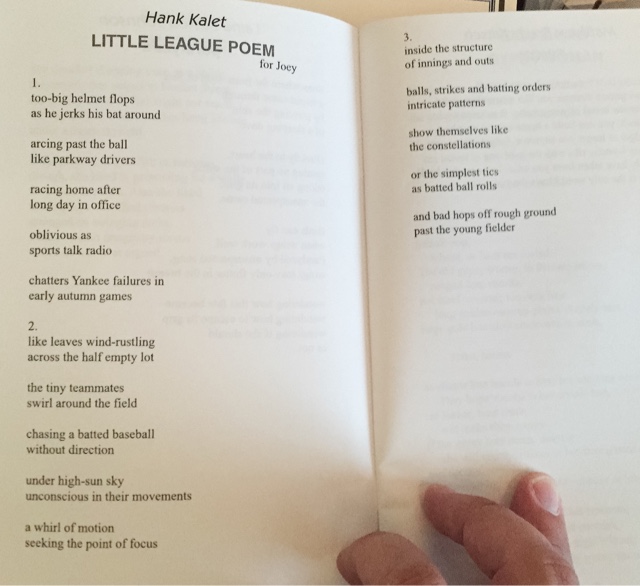
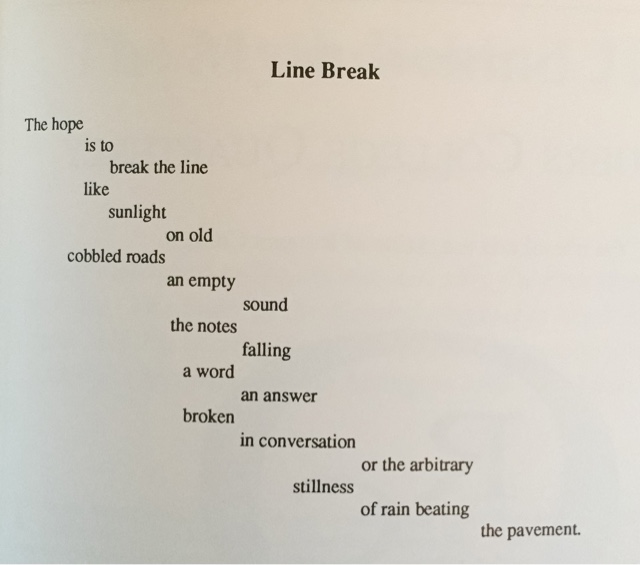
I’m reviewing recent and older work as I attempt to put together a book manuscript. In doing so I came across these three pieces:

This one ran in the Rutgers College Quarterly in 1988 — my senior year — and stood as a manifesto of sorts on my approach to the poetic line.
This ran in an anthology called Off the Cuffs, which was writing by and about police. It’s from the mid- to late-1990s.
This ran about 10 years ago in the Edison Literary Review and was written after watching my nephew Joe’s youth baseball team.
All three are deeply flawed poems, I think, but capture some element of my current approach, whether in terms of craft, style, or theme.
I don’t know that any of the three deserve placement in a new book, but I thought I’d share.

An attack, first and foremost, on LGBTQ+ people of color

I want to share this piece on the Orlando shooting, which makes the case that this is first and foremost an attack on the LGBTQ+ community, especially on LGBTQ+ of color — and that attempts to portray it as a generic terrorist attack on random Americans erases the victims. I don’t have much to add and suggest that everyone give this a read.

Thanks Charlie Bondhus for posting this to Facebook, where it first caught my attention.

Prisoners of Fear: NJ’s Undocumented Immigrants

I spent several months researching this piece, talking with immigrants and advocates to get a sense of their concerns. The debate over immigration — and not only because of Donald Trump — has been dangerously divisive and divorced from the reality that many in the immigrant community face. They do not get to vote, but they deserve a voice.

Prisoners of Fear: NJ’s Undocumented Immigrants

Recent roundups and immigration police activity have locals afraid to leave their houses to shop, work, or take kids to school

Despite New Jersey’s standing as a state sympathetic to undocumented immigrants, many locals are now living in desperate fear of deportation. That’s causing them to keep children home from school; avoid openly looking for work; steer clear of restaurants and public spaces; and even shy away from walking the streets.

Unlike the typical feeling of vulnerability caused by a lack of legal status, this heightened anxiety has been triggered by recent enforcement actions around the state and increased raids by the Immigration Customs Enforcement (ICE) agency throughout the country. They are expected to continue at least through this month if not through the year.

ICE insists these raids are focused on suspected criminals, very recent immigrants who have crossed the border illegally or have been ordered removed by an immigration court. But locals believe these actions are meant to indiscriminately round up all suspected undocumented residents, breaking up families that have built lives in New Jersey.

“Everybody is afraid of immigration, of ICE,” said Jose Avila, an undocumented immigrant from Peru. “We are afraid to even go walking.”

Read the full story here.

Send me an e-mail.