Art, appropriation, Marvin Gaye and morality

Questions of appropriation and copyright are in the air.

Sam Smith and his co-songwriters will have to pay Tom Petty royalties for “Stay With Me,” his Grammy-winning song, because of its melodic similarity to Petty’s “I Won’t Back Down.”

And the estate of Marvin Gaye was awarded $7.3 million by a jury in litigation over Robin Thicke’s “Blurred Lines” and its similarities to Gaye’s “Got to Give It Up.” As the Times points out, the award is one of the largest in the history of copyright law — or it is believed to be — and it does not come without its critics, myself included.

My tweet was a bit flip, to be sure. The songs have similar sounds, though I do not believe they share as much DNA as the jury found. And, more significantly, I believe the award ignores how the creative process actually works and how we internalize the art that is in the ether and what role appropriation plays in the creation of new art.

Think about T.S. Eliot’s “The Waste Land,” or William Carlos Williams’ Paterson. Both make use of secondary sources, weaving other voices and texts into the larger artwork to create something new.  Think about W.D. Snodgrass’ “After Experience Taught Me,” which alternates couples written by Snodgrass with quotatons from Spinoza, formatted as couplets, and which lacks the kind of footnoting or attribution one might expect to find in an academic paper.

Artists make use of whatever materials are available. (This is, in part, at the center of the controversy over Kenneth Goldsmith’s recent reading of the Michael Brown autopsy as a conceptual poem — see the debate on my Facebook page and on Ron Silliman’s. There are other issues in play on this one, including race and whether the art produced was worthwhile.)

The Recording Academy of America weighed in on the issue — sort of — by not including Petty and co-writer Jeff Lynne on Smith’s Grammy award because, as Bill Freimuth of the Recording Academy told CNN, “Lynne and Petty didn’t do any new writing for this work.”

(W)e are considering their original work to have been interpolated by Napier, Phillips and Smith for ‘Stay With Me,’ ” said Freimuth, the Senior Vice President, Awards. “Lynne and Petty will not be considered nominees nor will they be considered Grammy recipients, should the song win. Rather, they would be given certificates to honor their participation in the work, just as any other writers of sampled or interpolated work.”

Interpolated — I think that is a good word. I interpolate often in my work — quoting material from a variety of sources, from documents and interviews and song lyrics and TV shows and films and news reports and so on. I make an effort to note these “interpolations” in each case, though the attachment of notes to poems in literary journals is at best spotty.

My concern is outlined nicely by Noah Feldman in a Chicago Tribune op-ed. Feldman says the case focused on what he called “the moral theory of copyright,” which “focuses on the inherent right of a creator to control the thing created,” rather than on “social utility” or actual harm (i.e., the question of whether “Blurred Lines” interfered with the Gaye estate’s ability to sell the Gaye song and earn money from it).

The problem with the “moral theory,” Feldman says, is that “it has perverse effects on artistic creation.”

The permanent control over the author’s work sounds appealing — except for the fact that we don’t actually control our children in perpetuity. In fact, nothing we create belongs to us forever, particularly if we choose to sell it.

What’s more, future artists need to make art that refers to the works of their predecessors. If you don’t think Thicke is much of an artist, the same can’t be said of Williams, who according to Thicke’s testimony at the trial, actually wrote the song. I’m not saying Williams is anywhere near the level of Gaye, but he’s certainly a creative artist, with a varied oeuvre of songs written for himself and others. Williams and his songwriter colleagues, like all artists and authors, work by incorporating, commenting on and transforming earlier works.

The goal of copyright, he says, “should be to maximize the creation of valuable works of art.” The Thicke song, he says, does not infringe on that.

Would Gaye have written “Got to Give It Up” in 1977 even knowing that its bass line might be ripped off in 2013? Of course he would have. He and his heirs have had 38 years of opportunity to profit from the song’s proceeds.

Indeed, “Blurred Lines” probably had the effect of increasing sales of Gaye’s work, not functioning as a market substitute for them. Williams and Thicke (and yes, Ratajkowski) were effectively referring knowing listeners back to the Gaye tradition, where they might download songs and even buy albums.

“Blurred Lines” therefore increased artistic creation.

Ultimately, he says, “the finding against the song will inhibit future artists who want to produce work inspired by earlier music,” which “will be a cost to artistic creation.”

Timothy Wu, a first amendment lawyer, makes similar points in his appearance on The Brian Lehrer Show yesterday. He said “the case became a case about whether people thought Robin Thicke was … a buffoon and everybody agreed that he was a buffoon.” But whatever appropriation occurred was one of style and not enough of substance — i.e., the use of specific notes tied to the sheet music (Gaye’s family, according to reports, only owned the written music and not the recording rights). It is not enough to borrow a style, Wu says.

Artists are always borrowing from each other, and not only in the musical arts. Picasso and Georges Braque borrowed each other’s styles and everyone else who wanted to be a Pointilist borrowed that style, the Impressionists, you name it. Authors will write in the style of Hemingway, in the style of genre writers. Stylistic borrowing is what we call creativity.

It is not new, he adds, “this has been since the Jurrassic times.”

The point is that creativity presents itself in multiple ways. Mark Levisohn, one of Gaye’s attorneys, was wrong when he said on Lehrer that we start every work as a blank slate, that there is never the intention to copy. Artists engage in conversations with the past by using the past both critically and as homage. We can’t escape the past or the fact that past art is, as I said, in the ether. There is a larger cultural consciousness from which we borrow and to which we add, and the danger of these cases is that they could leave artists looking over their shoulders for the lawyers rather than looking back to see how they fit in to the broader traditions.

Send me an e-mail.
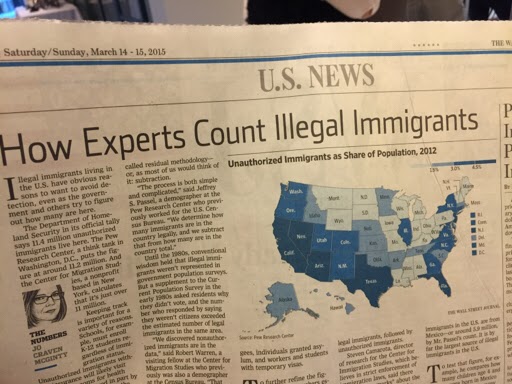
WSJ, others, still use ‘illegal immigrants’

The Associated Press stopped using the term “illegal immigrants” in April 2013 to refer to immigrants here without authorization. The wire service reasoned — rightly, I think — that we should strive to describe and label actions, rather than people.

The change makes sense, though not every news organization has followed suit, as today’s Wall Street Journal headline shows.

The debate has two main strands: the discussion over accuracy and simplicity, and the ideological one (which most organizations refuse to acknowledge).

The first strand is essentially one of balance: What is more important, describing the immigrant quickly in a way most people get, or describing him or her with precision? This is more difficult than most non-writers probably realize.

The ideological strand — which is tied to this question of precision — is really one of creating meaning. One of the reasons that immigration advocates have been pushing to end the use of “illegal immigrants” or “illegals” is that the phrase carries negative connotations (or worse), which sends the signal to the hearer that the immigrant in question is a hardened criminal. He or she is “illegal,” after all, a lawbreaker on a par with a burglar or bank robber. Words are not just representative; they are generative, as well, when it comes to interpretation. They not only describe the world but tell the reader how to understand it.

That’s why AP ultimately opted to reserve the word “illegal” for specific actions and not for people. I’m hopeful that the rest of the news business follows suit.

Why I think the email ‘scandal’ matters

The Hillary Clinton email saga continues.

On one level, this is an overblown scandal — an excuse for the press to continue with its decades-long fascination with all things Clinton and all things awry in the Clintons’ world. That is the argument that Paul Waldman makes here, which is cited by another journalist in this tweet:

I agree the coverage has been “bungled,” but there is something much greater at stake, something that goes beyond the specifics of this controversy and cuts to the core of what democratic and open government might mean.

This is about transparency. It is about the way new technologies affect old rules governing government records, and about crafting new rules going forward, and it is about how candidates for the nation’s highest office (it’s about more than Clinton) view transparency and what their commitment to the concept may be.

That’s why I haven’t been able to let the conversation drop.

Here is a response I offered on Facebook to a friend who pointed out that this was not an Iran-Contra moment — there is no Ollie North shredding documents — and that there is nothing we can do about the past. Here is what I said (I’ve added paragraph breaks for ease of reading). I think it sums my thinking up on this and why I believe this needs to spark a national conversation:

(A)sking why it happened the way it happened is realistic and necessary. I agree that covering this as a “Clinton scandal” is short-sighted and overly reductive. But reviewing what happened in the past, looking at what the use of a private email server might mean for access to public records, is key to creating better safeguards going forward.

It also is important to understand what the presumptive Democratic candidate believes about transparency and access. Why use a private server? How did she ensure the protection of government-related emails? Who vetted the private emails before they were deleted? Who decided what could be released and when? You are right that we can’t go back and fix what happened in the past, but we need to understand the past to create new rules and to judge the person who is likely to be the next president.

The fact is, there are multiple laws in place governing federal correspondence — not just the email rule that came on line at the end of her tenure in office. The archives act likely covers the correspondence, for instance. And the Freedom of Information Act, which is the focus of a suit by the AP, certainly does. 

In the suit, the AP is alleging State dragged its heels on requests for records, and it is requesting a wide range of documents — now including those from the private server. There is some question as to how the use of the server may have affected FOIA requests in the past — when someone asked for correspondence on an issue, for instance, did State include anything from the private server? Why not? Again, this goes to the heart of why it existed in the first place. Here is a quotation from the AP report on the suit:

The AP had sought Clinton-related correspondence before her use of a personal email account was publicly known, although Wednesday’s court filing alleges that the State Department is responsible for including emails from that account in any public records request.
 

“State’s failure to ensure that Secretary Clinton’s governmental emails were retained and preserved by the agency, and its failure timely to seek out and search those emails in response to AP’s requests, indicate at the very least that State has not engaged in the diligent, good-faith search that FOIA requires,” says AP’s legal filing. 

Specifically, AP is seeking copies of Clinton’s full schedules and calendars from her four years as secretary of state; documents related to her department’s decision to grant a special position to longtime aide Huma Abedin; related correspondence from advisers Philippe Reines and Cheryl Mills, who, like Abedin, are likely to play central roles in a Clinton presidential campaign; documents related to Clinton’s and the agency’s roles in the bin Laden raid and NSA surveillance practices; and documents related to her role overseeing a major Defense Department contractor.

The AP made most of its requests in the summer of 2013, although one was filed in March 2010.

The issue here is transparency. We can pretend that we can move forward without understanding what happened in the past– that the past is the past and we have no choice but to move on — but we would be setting ourselves up for failure and allowing not only Clinton, but all of the candidates off the hook. Everyone of them should be answering questions about their commitment to transparency.

I’m including the full Facebook thread below:

Send me an e-mail.

NY Times ‘Cropgate’: The photo conspiracy that isn’t

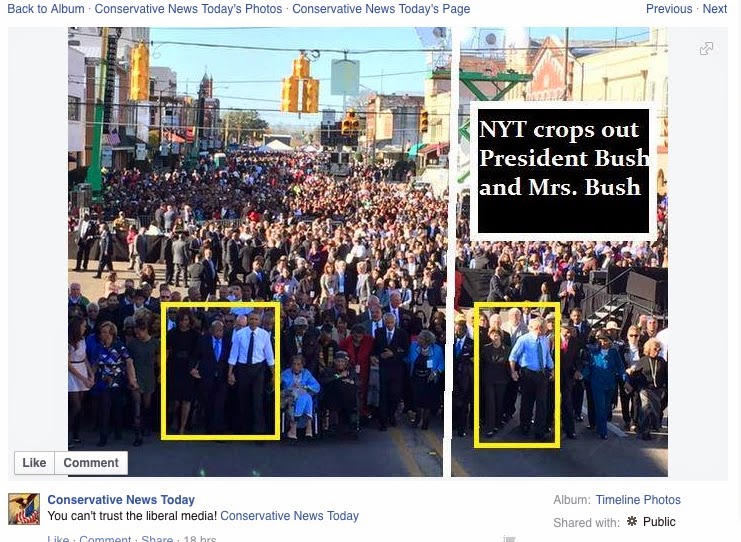
The following photo has been making its way around the Web over the last two days, purporting to prove anti-Bush or anti-conservative bias on the part of The New York Times:

The photo — from Conservative News Today — allegedly shows the original Times photo from Saturday’s march and how it was cropped. But was it. How do we know, for instance, that the Conservative News Daily photo is actually the photo the Times cropped? Where did this website get the photo?

The Times’ public editor, Margaret Sullivan, weighed in on the “crop” this morning:

I asked The Times’s ranking photo editor, Michele McNally, about the photo this morning.
“There was no crop,” she said. “This was the photo as we received it.”

She added that the broader photo, which was not sent to the Times until after the photo ran on Sunday, was technically inferior:

Ms. McNally showed me the photograph taken with the wide-angle lens that Mr. Mills sent to the photo desk on Sunday after the protests began.
“Technically, it’s a bad picture, and he didn’t even send it,” she said. President Bush “was totally overexposed,” she said. The photograph that was published is compositionally strong and “it has impact.”
The explanation and reasoning by Mr. Mills and Ms. McNally make sense to me.
While it would have been moving and worthwhile to see both presidents in a front-page photograph, I see no evidence of politics in the handling or presentation of the photo.

But don’t take her word for it. Look at the two photos one after the other, Times first and then the “cropped” version:

First, notice the angles. They are different — meaning the photos were not taken from the same vantage point, meaning that they are not the same photo. Or that’s my reading of it anyway. Feel free to prove me wrong
.

Send me an e-mail.