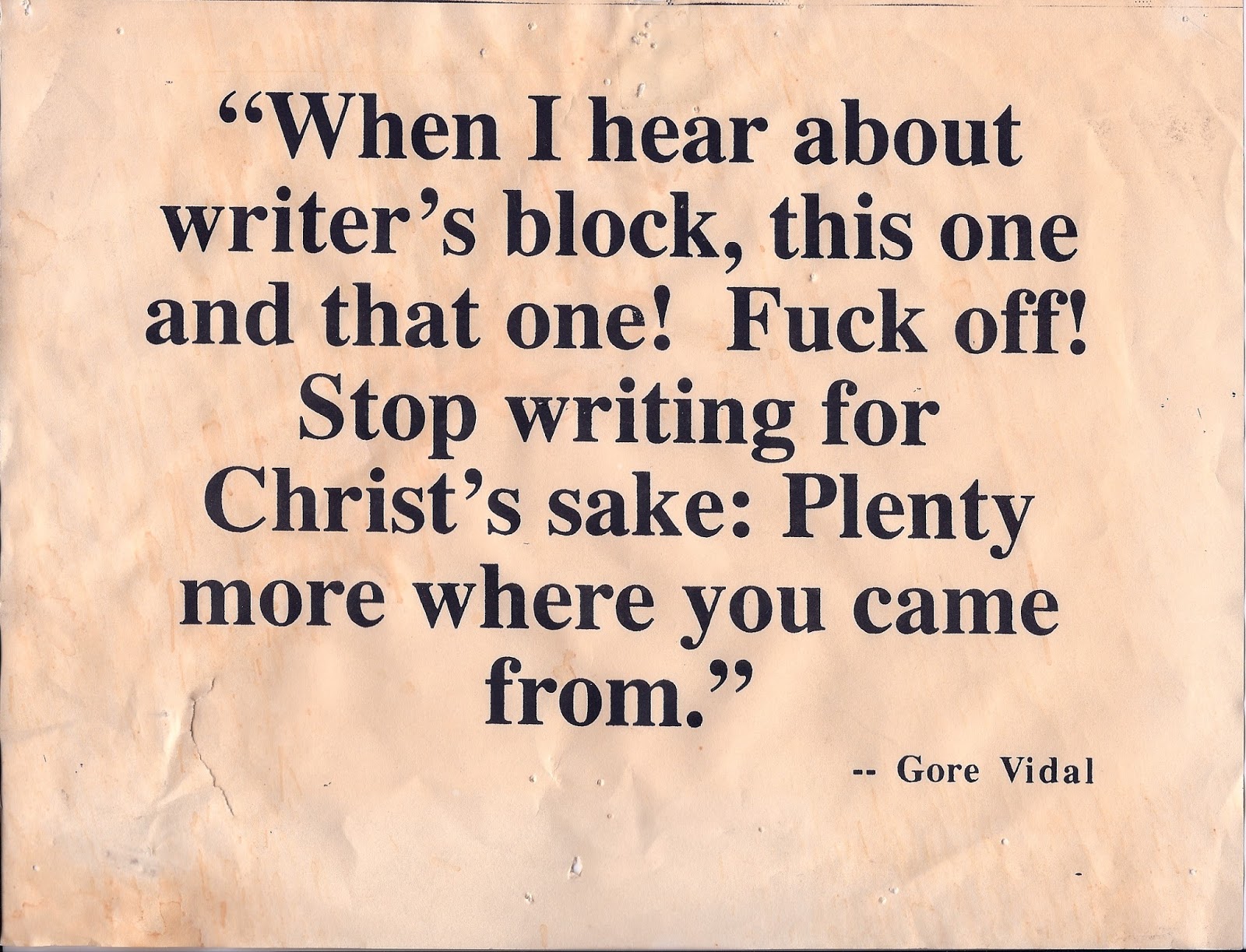
I used to keep this quotation above my desk when I was at The Princeton Packet. It got tucked away in a box when I left, but I found it this weekend. It goes back above my computer today.
Send me an e-mail.

I used to keep this quotation above my desk when I was at The Princeton Packet. It got tucked away in a box when I left, but I found it this weekend. It goes back above my computer today.
Send me an e-mail.
Pittsburgh Post-Gazette columnist Jennifer Graham is under fire for saying some nasty things about Caitlyn Jenner.
As the indespensible journalism blog, Romenesko, describes it:
“Strong reactions” came in quickly after the column was published last Thursday. “Defamatory,” one person tweeted; “shockingly anti-transgender,” tweeted another. The Human Rights Campaign told P-G executive editor David Shribman that “Ms. Graham has no business serving as a columnist at a publication with a reputation as sterling like yours.”
There apparently was a near revolt in the newsroom, as well — “‘a shitstorm,’ according to one reporter.”
“The rank and file in the PG newsroom were incensed. There were murmurings of a byline strike by the Newspaper Guild until Graham was fired.”
The Pittsburgh Newspaper Guild wanted no part of it — rightly, I think. As Guild president Michael Fuoco says on Romenesko:
“Many in the staff were outraged, as you can imagine,” but “I informed people individually that the Guild would not take any action because we shouldn’t be in a position to feel we should vote up or down on every cartoon, editorial or comment.”
I don’t agree with the argument or the language used by Graham, who used her perch at the paper to trot out all the old nonsense conservatives have been flinging at the transgender community for years. And I understand the reader response. But as a long-time columnist who has come under fire in the past — for support of gay rights, criticism of police, and opposition to the Iraq war — I disagree with calls to have her fired or have her column canceled.
The question we have to ask is this: Where do we draw the line on political columns? I think using profanity or specific pejorative terms — the n-word, for instance — is out of bounds. Strongly worded opinion that is critical of both Jenner and the new cultural acceptance, even when it relies on tired tropes and arguments, does not cross this line.
Was Graham’s column mean? Yes. Was it disrespectful? Yes. Was it possibly cruel? Yes. Is it profane and does it cross the line? I don’t think so. Should her column go without response? No, and that’s the key. The PG ran letters in response, according to Romenesko, and critics of Graham took to Twitter and other social media outlets. Suppressing Graham’s views will do nothing more than grant conservatives another example of intolerable lefties and political correctness (overblown as a phenomenon, to be sure), contributing to polarization on this issue.
Send me an e-mail.
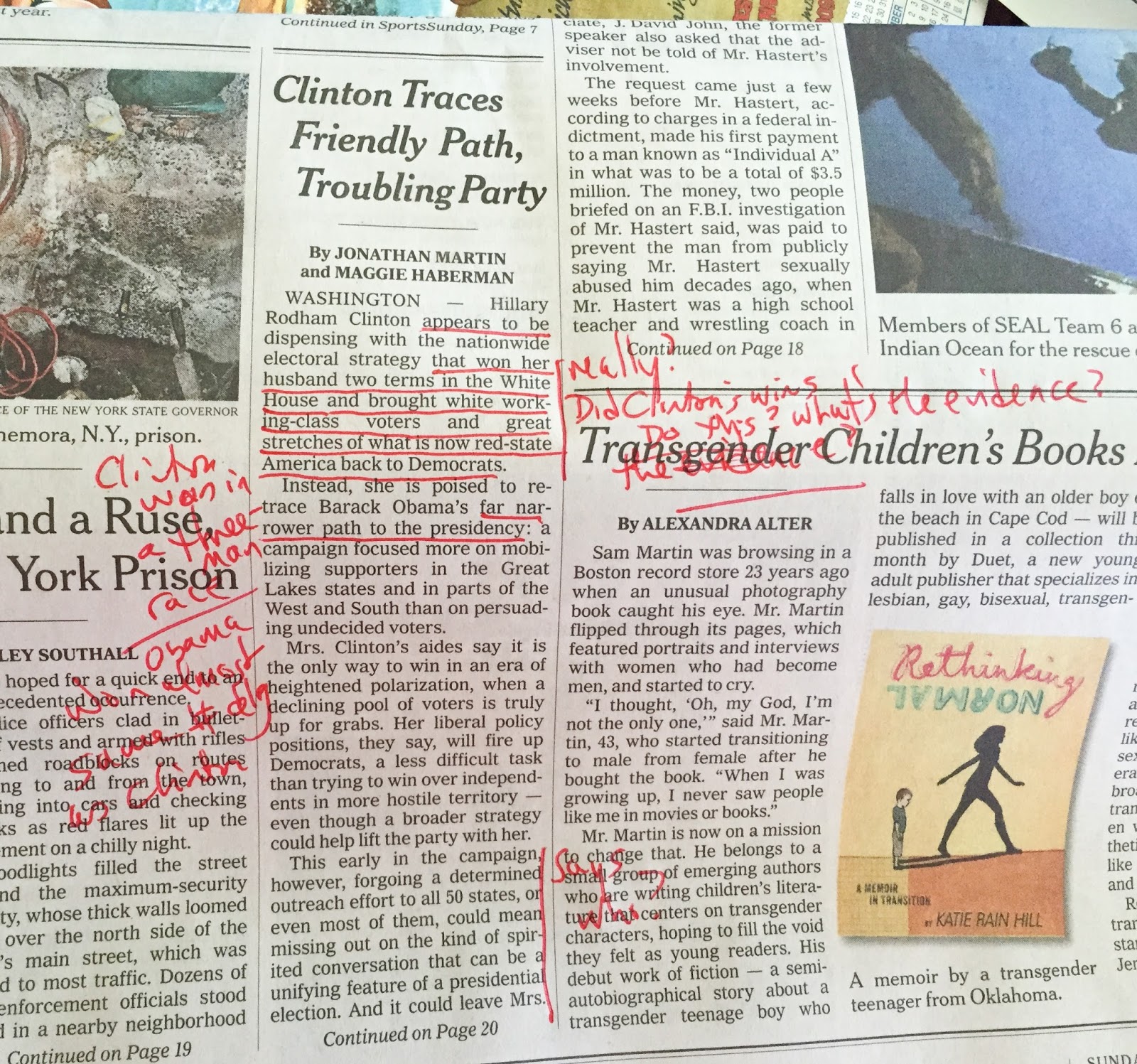
This kind of story makes me nuts. It is cast as unbiased reporting, but really is closer to opinion than a straight explanation of what is happening. As Jay Rosen, the press critic pointed out, it is so maddening that it deserves a response:
This story may finally get me to try press-criticism-as-annotation, a method I have been meaning to attempt. http://t.co/3lPD3EKmXu— Jay Rosen (@jayrosen_nyu) June 7, 2015
I thought annotation was worthwhile, too (see above), and it led me to the brief analysis that follows.
The key point I want to make is this: The unattributed statements in the first few paragraphs are meant to cast conventional wisdom as fact, which then recasts recent history in an alternative universe, painting the Clinton years as qualitatively different in terms of partisanship than what we have experienced during the Obama years. Of course, the story doesn’t overtly make that claim, but the implication is pretty clear from the way it chooses to describe Bill Clinton’s
Let’s look at the first four paragaphs (see the photo above of my red-penned mark-up). It starts with a conditional claim, that Clinton “appears to be dispensing with” with Bill Clinton’s approach — a phrase designed to distance the story from its main thesis, that Hillary Clinton has decided that she can’t win “white working-class voters and great stretches of what is now red-state America” and that, in doing so, she will be foregoing an opportunity to use her campaign to unite voters and politicians. This assumes, of course, that Bill Clinton was a unifying figure in American politics — a rather absurd claim given that the Democrats lost the House for the first time in 40 or so years while he was in office, and that the ’90s were marked by the same kind of partisan gamesmanship we have been witnessing during the Obama era.
The writers, however, double-down, claiming that her apparent decision to “retrace Barack Obama’s far narrower path to the presidency” may be “a less difficult task than trying to win over independents in more hostile territory.” according to Democrats, “even though a broader strategy could help lift the party with her” (unattributed comment — i.e., the writers’ opinion).
This early in the campaign, however, forgoing a determined outreach effort to all 50 states, or even most of them, could mean missing out on the kind of spirited conversation that can be a unifying feature of a presidential election. And it could leave Mrs. Clinton, if she wins, with the same difficulties Mr. Obama has faced in governing with a Republican-controlled Congress.
Bill Clinton, of course, did not have the “same difficulties” with the Republican Congress, or so the writers’ rather confused memory would have us believe. Clinton did manage to get some things through Congress — mostly the kind of dismantling of the safety net usually associated with Republicans — but the reality is that his eight years in office offered a permanent state of investigation of his administration, a government shut down and an impeachment.
Clinton’s broadbased election strategy, the story says, resulted in Democrats winning back the white working class. Again, this is at odds with reality. Exit polling showed that Bob Dole, the Republican candidate, won the white male and Protestant votes by significant margins — something that Republicans have continued to do in the intervening years.
In addition, it is important to remember that Clinton won both of his elections without crossing the 50 percent popular vote threshold, and it could be argued that his electoral college landslides occurred because Ross Perot siphoned off just enough conservative votes to keep several states out of the Republican column. (He won Kentucky and Nevada by about 1 percentage point each and Arizona and Tennessee by less than 3 percent each.)
This is pure speculation, of course — who knows what may have happened had Perot not run. This is why I turn to so-called “weasel words” like “could be argued.” I’m not saying he would have lost those states, but saying Bill Clinton was a unifying political force bears no relation to the decade of partisan warfare that I remember.
The story is, as Rosen pointed out on Twitter last night, a case bias without self awareness:
I wouldn’t mind these things if the reporters showed just a bit of awareness that THEY prefer centrism and “middle.” http://t.co/3lPD3EKmXu— Jay Rosen (@jayrosen_nyu) June 7, 2015
The conventional wisdom in Washington is that there is some reasonable middle and that anything that deviates from it, any politician who claims a political philosophy or boldly stands up for a constituency, contributes to paralysis.
Send me an e-mail.
I posted this to my Facebook account and thought it worth sharing. Feel free to comment on the Facebook thread, or here:
I worry #journalism climate puts 2 much focus on flash, not on nuts&bolts. Need balance. http://t.co/f2hFgtXo4F @Dorissays @jayrosen_nyu
Posted by Hank Kalet on Friday, June 5, 2015
I will update this with Twitter responses as (if) they come in.
Send me an e-mail.
A four-year old video from Louisiana has been making the rounds on Facebook again — and it is difficult to know why. I saw it on the page of someone who usually posts generically patriotic material, so I have to assume he was offering this as an example of how “real Americans” deal with internal critics, but I can’t be sure. What I can say is that the video — which shows students at Louisiana State University reacting in anger to a protest by a handful of protesters planning to burn an American flag — shows that we continue to revile dissent in this country and that the rights of conscience outlined in the First Amendment to the Constitution mean little to far too many people.
Here is the video:
The thing that bothers me here is not the counter-protest — that is completely appropriate. You meet speech you dislike with more speech; you meet protests you disagree with with more protest. What bothers me is the efforts at intimidation, the way the crowd moves in on the silent protester, the need for police to protect him, the up-in-your-face verbal assault by the uniform-clad member of the military and the tossing of what I assume are water balloons (can’t be sure) at the protester.
The police escorted the protester away and ended the protest, to protect his safety, so it never descended into outright violence. But projectiles were being thrown. Counter-protesters were getting ansty and aggressive. One has to wonder what would have happened had the police not intervened.
And this raises an interesting question: How different is this than what we saw happen in Baltimore or Ferguson, where anger did spill over into violence? Would we have seen the same kind of gleeful dismissal of the protesters we witnessed after Baltimore and Ferguson, especially from conservatives who used the violence as an occasion to call into question “ghetto culture” and the like? Would they, in particular, have used this flag protest to liken the counter-protesters to Nazi Brown-shirts, or attack Southern patriots as a somehow lesser race of people?
My guess is no. My guess is that the folks at Fox News and throughout conservative media would have hailed the counter-protests and patriotic Americans and would have blamed the handful of lefties who planned the initial protest for any violence that might have occurred. My guess is that, rather than the “no-excuse-for-violence-there-is-a-right-way-to-protest” line they have been pushing over the last month, we would have heard some variation of Goldwater’s “extremism in the defense of liberty is no vice” — conveniently ignoring the second half of his quote in which he says “moderation in the pursuit of justice is no virtue.” (The line echoes Martin Luther King Jr.’s defense of protest and “extremism” in “Letter from Birmingham Jail.”)
As I said, there are differences between what we see on this video and what occurred in Baltimore and Ferguson that go beyond the descent into actual violence. On the one side, we have a crowd representing a majority point of view, a largely (if not completely) white crowd using intimidation to enforce political conformity, seeking to silence dissent, and essentially sacralizing the flag. On the other, we have a people who live in some of the worst poverty conditions in the United States, in a city that has been gutted by political and economic systems that have no use for the city’s residents, a people who have been beat down and denied not just their rights but any sense of their humanity for hundreds of years and who still deal daily with the kinds of sleights and assaults that white Americans do not have to endure. One side’s patriotism and sense of entitlement are being challenged, the other side’s very existence.
Even if we do not tie this video to what has happened more recently in Baltimore and Ferguson, we should be offended by what takes place in this video — and not by the flag-burner.
Flag burning is a provocative act, a symbolic act designed to underscore our national failings. By burning the flag — our national symbol — the flag-burner raises questions about American provenance, about American exceptionalism, about our role in the world and our inaction at home. It is a symbolic assault. It is extreme, to be sure, but it is extreme in the way Goldwater and King use the phrase — an action designed to wrench us from complacency so that we can see our own failings. (Whether it works, in a pragmatic way, is another discussion.)
As such, the burning of a symbol like the flag is protected speech and protected protest. You don’t have to like it. You don’t have to agree, but we live in a country in which this is allowed — as is art work like “Piss Christ,” as are cartoons of the Prophet Muhammed (whether presented in satirical publications like Charlie Hebdo or by avowed Islamaphobes and racists like Pamela Geller).
What is offensive and scary to me, in the end, is not the counter-protest itself, but the form it takes, the intimidation and the sense that it is OK to berate (and possibly beat) people into silence, and that this sort of violence in the cause of the status quo seems OK to too many.
Send me an e-mail.
 Hank Kalet