Meme wars

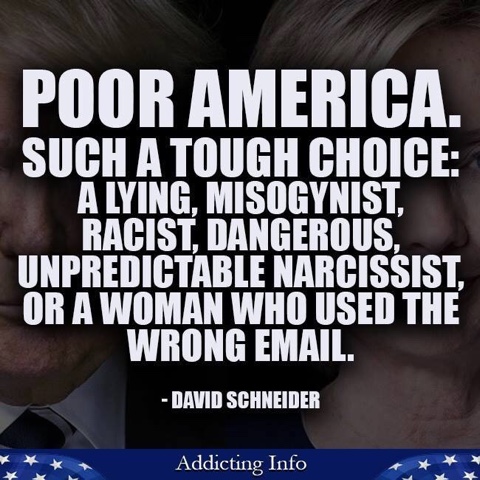
There has been a meme going around Facebook that purports to settle the Trump-Clinton battle — but just leaves me shaking my head. The argument here is that we have, on the one hand, a dangerous disaster of a candidate while on the other we have someone whose only flaw is this email thing.

I can buy the first part. Donald J. Trump is exactly what this meme says he is, and probably worse. But Trump’s absolute horribleness should not obscure the fact that Hillary Clinton is far from a perfect candidate. It’s not just the email, and pretending it is will set progressives up for some rough times during a Clinton administration.
Let’s be clear: I will voting for Hillary Clinton. Without reservations — she’s no worse than most mainstream Democrats, and better than many. But I’ll be doing so without enthusiasm. She is the best option we have available, and keeping Trump away from the White House should be the goal, but we should not have any illusions. As I wrote in a recent column for The Progressive Populist:
She is a hawk. We know she’s a hawk, and the fact that she’s surrounding herself with like-minded hawks should be of great concern. She’s also a corporatist and, while I think concerns about her honesty are overblown, she does not inspire confidence.
I know that’s not exactly an endorsement but, as I wrote in the same column, my goal is not to endorse her. “Clinton, in this election, is a means to an end, a defensive vote.”

I want to offer something that the journalist Jeff Sharlet wrote on his Facebook page (see full Facebook post below) that I think sums up how we should be approaching this election. Sharlet is a long-time Clinton critic (as am I), who is “very critical of Clinton’s corporate centrism, cronyism, elitism, and militarism,” which he outlines in some detail.

My track record as a critic of Hillary and Clintonism in general is pretty good. In 2007, Kathryn Joyce and I teamed up to write a sharply critical story on Clinton’s deep-rooted corporatism and affiliations with a fundamentalist movement known as The Fellowship. She wouldn’t speak to us — her infamous press secretary, Philippe Reines, cursed and screamed at me just for asking, the most unpleasant encounter I’ve had in my years of Washington reporting — but we interviewed many significant figures from her life, read nearly every published thing she ever wrote, and reviewed the entire history. The portrait that emerged was about what most critics would expect — lip service for progressivism combined with a penchant for “compromises” nobody but the far right asked her to make. Most telling, to me, was her collaboration with then-Senator Sam Brownback, as conservative as they come, and the late ideologue Chuck Colson on an effort to unnecessarily water down a human trafficking bill to suit the demands of the religious right — to the extent that many NGOs and activists in the field saw the bill as an attack on their work. Bad stuff.
I teamed up with Kathryn again to write a piece for Religion Dispatches on Hillary’s surprising backroom dealing on abortion — again, what’s sometimes described as “centrist” seemed to reflect the kind of purely political triangulation that has always made Clintonism antagonistic to the left. I followed that up with an expansion on the two articles for my bestselling book The Family. The work got some attention: NBC Nightly News did a lead segment on it in 2008, and much of the progressive press picked up on it, while conservatives — and Hillary partisans — attacked Kathryn and I for suggesting that she’s anything less than the reincarnation of Dorothy Day.
And yet, Sharlet is not just planning to vote for her. His rational is simple: Trumpism must be stopped. He doesn’t define Trumpism, so I will: It essentially boils down to a politics of resentment merged with a proto-fascist longing for a strong man to right the nation’s wrongs. Some of its grievances are legitimate; as Gary Younge, in The Nation, points out, “the fact that the messenger is deranged doesn’t mean the message itself contains no significant truths.” The anger over trade deals, for instance, is based on workers (or at least their concerns) not being at the table, and the collapse in confidence in institutions is based at least in part on a bipartisan consensus that has given us NAFTA and GATT, the Iraq War, Simpson-Bowles, austerity, college debt, and so on.

The viability of Trump’s candidacy owes as much to economic anxiety as it does to racism. Trump. Younge says, “identified (what) remains a politically salient fault line that doesn’t just go away if Clinton wins. If these problems are not tended to, a less erratic and more focused right-wing populist than Trump could easily exploit them.”

This brings me back to the meme above and its seeming insistence that the only baggage Clinton carries is an over-hyped email controversy — and, yes, the email issue is overhyped, and much of the more extreme stuff (murder accusations, etc) being tossed at her by both the right and the left is garbage. We need to be honest about who Clinton is — a status quo Democrat, a centrist who is progressive on some issues, a hawk on foreign policy, a deal-cutter, a wonk. But we also need to acknowledge that she does have some progressive instincts and, as the Sanders challenge in the primaries proved, she can be moved in a more progressive direction. It’ll take work — protests and activism, intellectual challenges, etc. — but it is necessary work, work the left failed to do during eight years of Obama. If we go in to a Clinton administration admitting her flaws, we won’t be caught sitting on our hands.

Here is Sharlet’s Facebook post:

Send me an e-mail.


Tent City excerpt

An excerpt from As an Alien in a Land of Promise is posted today at The Literary Review website. TLR is an international literary publication, produced by Fairleigh Dickinson University and is considered one of the more prestigious journals on the market.

Read the excerpt here.

To buy As an Alien in a Land of Promise, click on the Buy Books by Hank Kalet link.

Send me an e-mail.

How not to cover poverty

I wanted to share a good resource on poverty coverage from On the Media. Most journalists fail in their coverage, for a variety of reasons, which OTM does a good job detailing in their Breaking News Consumer Handbook.

Listenn here:

This is part of a five-part series on poverty from OTM, which is worth listening to in its entirety.

Send me an e-mail.

Perhaps, perhaps, perhaps

The New York Times is not known for being hyperbolic — at least among moderate readers. But its story today on early voting should raise eyebrows.

Hillary Clinton has established a slim edge over Donald J. Trump in early-voter turnout in several vital swing states, pressing her longstanding advantages in state-level organization and potentially mitigating the fallout from her campaign’s latest scrap with the F.B.I.

While this may be true, it is not something we can actually know based on the information available — which the fourth paragraph makes clear, or sort of.

At least 21 million people have voted so far across the country. In the states that are most likely to decide the election — among them Florida, Colorado and Nevada — close to a quarter of the electorate has already cast ballots. While their votes will not be counted until Election Day, registered Democrats are outperforming Republicans in key demographics and urban areas there and in North Carolina, where extensive in-person voting began late last week and which has emerged as one of the most closely contested battlegrounds for the White House and control of the Senate.

Essentially, what this Times story has done is conflate voters’ party registration with their ultimate voting preference. Democratic voters are Clinton voters, in this formulation, and Republican voters are Trump voters — even though the narrative is not quite so neat.

I’m not saying that the actual vote count will prove this lede to be false. That’s not the issue. The votes have not been counted and the only real information we have is that more registered Democrats have voted than registered Republicans and the lede should not have said anything more than that.

There is Power in a Union

I wrote this essay two years ago, but it was never published. I think it still works, though it may be more optimistic in tone than is warranted.

THERE IS POWER IN A UNION

By Hank Kalet

The setting is the work floor of a textile manufacturer in North Carolina. Workers cram the room, watching as votes are counted. It is the penultimate scene of Norman Ritts’ Norma Rae, and the audience waits with the workers, unsure of the outcome. Final tally: 373 against the union, 427 for. Tension broken, the workers erupt in cheers and chants.

It is the film’s iconic moment, a demonstration that collective action can succeed. Norma Rae was released in March 1979 – 35 years ago – and I remember rising to my feet when the final vote was announced.

There hasn’t been much to cheer since then on the labor front. In just the past few months, employees rejected a union at a Tennessee Volkswagen plant despite support from management, buying into Republican anti-union propaganda, while workers at a Washington Boeing plant caved on a contract laced with givebacks. Both votes followed job-loss threats – Tennessee politicians said a union would damage the plant’s future, while Boeing threatened to move from Washington – and are indicative of legal and global trends that have unions on the defensive.

“The competition fostered by globalization and public policy that is less oriented toward creating stability for workers are making it difficult to wall off and protect workers the way unions did before,” said David Bensman, labor historian at Rutgers University.

Yet, there is evidence of a revival. The 2011 Occupy protests and organizing by fast-food, Walmart and undocumented workers has forced wage and workplace issues onto the table – including calls for a more robust living wage, protections against wage theft and municipal rules forcing companies to provide paid sick leave.

“My overall view is that this is a time of crisis and a time of renewal,” Cesar Pink, a visual artist with the Brooklyn-based Arete Living Arts Foundation, said. He is making a six-part documentary on the history of the labor movement called Strength in Union that he hopes will be released later this year.

“The best thing that happened to labor was the Occupy protests,” he said. “It got ’99 percent v. 1 percent’ into everybody’s mind. Everybody knows it is an issue facing the country and labor is at the front line of that.”

The labor movement’s struggles matter. Union membership as a percentage of the workforce, according to federal estimates, has been in decline since the 1950s. Today, just one in 10 workers belong to a union, compared with a historic high of one in three in the ‘50s. This drop-off has consequences. According to the Economic Policy Institute, union workers earn 13.6 percent more than their non-union counterparts, receive better health benefits and are more likely to have retirement plans. Therefore, as the unionized workforce shrinks, inequality grows – hence the need for a strong labor movement.

But first, big labor may have to get out of its own way. The AFL-CIO, at its 2013 national convention, endorsed greater ties to other community and social-justice groups. This came over the objection of some unions seeking to defend a model of unionism – one tied to individual contracts and workplaces — that succeeded in the past.

“As long as (unions) were able to negotiate contracts and achieve steady gains, that model was fine,” said Roland Zullo, research scientist with the University of Michigan Institute of Labor and Industrial Relations. “But we are now in an era where that is hard to do. The law has changed, quite radically because of Supreme Court decisions, but also because the economy is more global.”

The right-to-work movement, historically strong in the South but now spreading to the Rust Belt, is part of the shift in the legal environment, Zullo said. Michigan passed a right-to-work law as part of a budget bill at the end of 2012, on the heels of a similar Indiana vote. These bills allow workers to opt out of unions in their workplace, but to receive union benefits (negotiated salaries, disciplinary protections), and are designed to strip unions of operating cash. This has three effects: making it harder to negotiate and administer contracts; bleeding strike funds and weakening the leverage the strike threat provides; and making unions less likely to engage in political behavior, out of fear that support for progressive politicians and causes might lead members to opt out.

“This is about making it more difficult for the labor movement to politically support progressive politicians in (Michigan),” he said. Because of this, he said, the impact goes beyond individual unions. “It is about workplace safety, the minimum wage – those things, too, are affected by the right-to-work law.”

That is because unions aggregate workers and equalize power between employer and employee. The demands of individual workers are easily dismissed, but the demands of a united workforce are harder to ignore.

Consider Norma Rae. As the film opens, Norma – played by Sally Fields, who won an Oscar for the roll – complains to management about her mother’s temporary hearing loss. She is rebuffed, clearly not the first time management has ignored a worker complaint. It is only the threat of the union – triggered by the arrival of an organizer from New York — that changes the dynamic.

Norma Rae, as a film, is a flawed vehicle for a union argument. It boils much of the narrative down to a personal-growth story. But the lesson at its core – that collective action matters — should not be forgotten.

Workers understand this, which is why we are witnessing another rebirth of worker-focused organizing and political activity with the as organizing of low-wage work – the fast-food industry, Walmart, home-health aides – and the passage of local sick-time requirements and state minimum wage hikes gathering momentum.

“Unions are recognizing that the situation has changed fundamentally and that they have to change their strategy fundamentally,” Bensman said. “They are trying to reach out to unorganized workers and tying to find ways of creating strength and solidarity.”

Zullo says the efforts are not unusual – “unions have always done both” contract negotiations and organizing – but that impediments to “bargain(ing) in the workplace” have made “it is so difficult to form a union today to help workers through private bargaining” that it “is forcing them to become more political and to raise their base outside of unions.”

Pink said unions had become complacent, focusing more on contracts than movement building. The Occupy protests, which started in New York City in 2011 and spread to other cities, altered the debate. It injected income inequality and class division into the national dialogue far more effectively than anyone had in recent memory.

And they demonstrated the need for collective action to counter industry as it chases profits. That’s the key argument made by Reuben Warshawsky, the labor organizer played by Ron Liebman in Norma Rae. He tells textile workers that an un-unionized textile industry is “free to exploit you, to lie to you, to cheat you, and to take away from you what is rightfully yours. Your health. A decent wage. A fit place to work.”

Warshawsky is talking about unions, but also more broadly about the need for collective action. He easily could be talking to the thousands of low-paid fast-food workers and part-time Walmart employees agitating for higher wages and lending new energy to the labor movement. And that is Pink’s point.

“People feel strongest about unions when they are in a struggle,” he said. “The fast food workers and the Walmart workers, they are struggling for representation.”

Send me an e-mail.