I have a poem in the inaugural issue of the Sourland Mountain Review. You can download it here for free.

I have a poem in the inaugural issue of the Sourland Mountain Review. You can download it here for free.

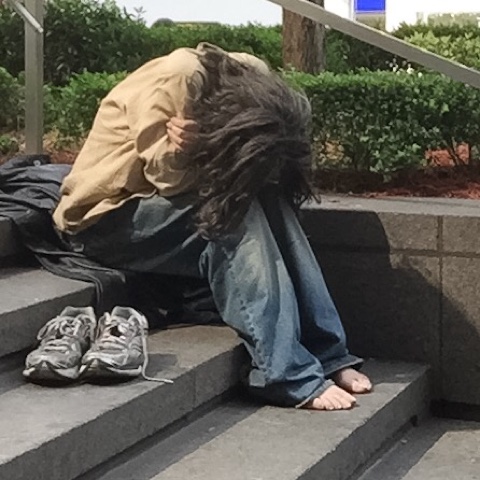
Hank Kalet’s As an Alien in a Land of Promise is a book-length mediation on homelessness and American capitalism. Interspersed with Sherry Rubel’s black-and-white photos, the hybrid work of poetry and journalism tells the stories of those living in a now-defunct homeless camp in central New Jersey, asking why our economic system turns people into refuse.
Based on a year of interviews and research in the former Tent City in Lakewood, Kalet tells the stories of people like Angelo, who lost his job in the crash of 2008, and the musician Michael. Interspersed with their voices – and those of “the pastor,” are writers like Jonathan Kozol and Michael Harrington, whose earlier research informs Kalet’s work.
The poet Eliot Katz, a former advocate for the homeless in New Brunswick, calls the book an “inventive mix of objectivist-influenced, journalistic poems and moving photographs” that “brings real, often-ignored human stories, statistics, and local geographies to life.”
B.J. Ward, author of Jackleg Opera, says Kalet “works in the poetic traditions of the inspired and observant narrator in Whitman’s ‘The Sleepers’ and, with his sense of lineation, Williams’ image-emphasis.”
Kalet is a journalist, essayist and poet, whose work appears regularly in NJ Spotlight and has been published by The Progressive, In These Times, The Progressive Populist, Main Street Rag, Lips, The Journal of New Jersey Poets and elsewhere. He is the auther of Stealing Copper, Certainties and Uncertainties, and Suburban Pastoral.
The book is published by the independent Piscataway House Press.
For more, see asanalieninalandofpromise.wordpress.com/ The book can be ordered at channel-surfing.blogspot.com/p/buy-books-by-hank-kalet.html, from Piscataway House, or Amazon. For press information, contact Hank Kalet at hankkalet@gmail.com. Press kit available upon request.
Send me an e-mail.
Here is a poem from Bob Hicock at the Rise Up Review. I think we need more of this in our lives.
Send me an e-mail.
Error corrected below. (1/13)
Mike Pence, the vice-president-elect, said during his introduction of Trump that he believed in free speech but that, “with freedom comes responsibility.”
We are entering day three of a media firestorm that began with publication of a story by CNN alleging the existence of a memo alleging that Russia had collected compromising information on Trump, followed by publication by BuzzFeed of the full contents of the memo.
The trajectory of this story — one organization and reporter jumping in with a story, most reporting on the reaction, some reporting on the alleged contents of the dossier, none verifying the information contained in the document — is indicative of modern journalism’s shifting incentives. And yet, it is of a piece with the history of a profession that always has valued speed and being first above most other factors.
The comedy The Front Page — in all its wonderful incarnations — is as much about the chase for the scoop and what journalists are willing to do to get them as it is about the friendship/love between editor and reporter. Charles Foster Kane in Citizen Kane builds his media empire on an idea that has held provenance throughout the history of American journalism: “if it bleeds, it leads.” The Saturday Night Live send up of the movie brings all of this into clearer view.
Citizen Kane II from Wellesnet on Vimeo.
But these are just films — though cultural products do tell us a lot about what we view as acceptable. We have a long list of examples of media companies running with partially or totally unvetted material in an effort to be first, to offer something no one else had — stories that named rape victims, damaged political careers, have kept baseball players out of the Hall of Fame, and so on.
Often the stories run first in the less savory publications: the National Enquirer broke the story of John Edwards’ affair and love child and found proof of Gary Hart’s womanizing, forcing him out of the 1988 presidential race. The stories then get picked up by the Bigfoot publications, who find ways to finagle around the more lascivious elements by writing about the ensuing scandal.
Will Oremus, who wrote about the BuzzFeed scoop yesterday at Slate, told Brooke Gladstone of On the Media that it lowers the threshold for what’s worth reporting as the “fact that people are talking about it becomes news in itself.”
As I said, this is not a new phenomenon — I t’s just been updated for contemporary use: if it’s salacious (or features cats), it will generate clicks. And clicks, like subscribers, mean revenue.
So, given that the dossier exists, it should surprise no one that someone chose to publish its contents. It is, therefore, a bit disingenuous for us media types to bash BuzzFeed for doing what the media always has done.
But was BuzzFeed acting “responsibly,” to use Mike Pence’s word? I think it’s the wrong question, and not only because the use of the word “responsibility” is meant to frame the discussion on narrow grounds. Pence, in his formulation of responsibility, essentially has defined it as being careful or circumspect. But his pithy line — a useless cliche, really — elides what responsibility means.
I’d frame it as a question of ethical action, which requires us to balance the myriad competing interests and stakeholders. Oremus told On the Media that
anybody who sees this as cut and dried, that BuzzFeed was obviously right or obviously wrong, is not considering all the pros and cons here.
Ethically, he said, BuzzFeed and Slate may have made the wrong decision, but
there (are) some cases in which putting information out there can have positive consequences for the world that sort of transcend narrow questions of journalism ethics. I think that is why journalists in general are taught to have a bias in favor of publishing information.
This is a necessary bias — Oremus says it is the counterweight to the secrecy-bias of politicians and bureaucrats. But it is only one factor among many that good editors consider — or should consider — before deciding to publish.
I’ve been asking myself what I would have done and I honestly can’t say. I know the questions I’d ask:
I can’t answer these questions — I’m not privy to the process used by either organization. But here is CNN’s response yesterday:
CNN’s decision to publish carefully sourced reporting about the operations of our government is vastly different than Buzzfeed’s decision to publish unsubstantiated memos. The Trump team knows this. They are using Buzzfeed’s decision to deflect from CNN’s reporting, which has been matched by the other major news organizations
We are fully confident in our reporting. It represents the core of what the First Amendment protects, informing the people of the inner workings of their government; in this case, briefing materials prepared for President Obama and President-elect Trump last week.We made it clear that we were not publishing any of the details of the 35-page document because we have not corroborated the report’s allegations. Given that members of the Trump transition team have so vocally criticized our reporting, we encourage them to identify, specifically, what they believe to be inaccurate.
And Ben Smith’s tweet explaining BuzzFeed’s decision:
Here’s the note I sent to @buzzfeednews staff this evening pic.twitter.com/OcAloWzVzb— Ben Smith (@BuzzFeedBen) January 11, 2017
I leave you to make up your own mind. Send me an e-mail.
 Hank Kalet