Christie vetoes anti-poverty measures

Gov. Chris Christie speaks at a press conference on employment and the economy Thursday in North Brunswick. (Governor’s Office/Tim Larsen)

Gov. Chris Chris Christie vetoed two bills that would have increased benefits for New Jerseyans on the state’s welfare program, saying they would have “substantial budgetary impacts.”

The bills, as I reported in NJ Spotlight last week would increase benefit levels for the state’s Work First recipients by 30 percent over three years and eliminate a cap on family sizes created during the 1990s.
Assembly Bill A-31 passed the Assembly 48-24 with two abstentions and the Senate 26-14 — short of a veto-proof majority. (It takes 54 votes in the Assembly and 27 in the Senate to override a gubernatorial veto). Benefit levels under the bill rise from the current $424 per month for a family of three to $466 a month in the first year, $509 the second year, and $551 in the third. Benefits would then increase annually at the same rate that Social Security benefits increase.
Assembly Bill A-33 passed 51-20, with three abstentions, and 22-14. It ends a 25-year practice of capping family sizes under Work First. Under current law, payments are tied to the size of a family when it enrolls in the program, meaning a family of three would not see an increase in benefits if the mother had another child.
Christie cited “Responsible governance” in his veto message, saying that “any increase to program benefits be determined on an annual basis and in consideration of the costs associated with all State programs.”

Such a contemplative approach facilitates the identification of the State’s fiscal priorities and ensures that the State will meet its constitutional mandate of a balanced budget.

He said Work First is just On of numerous programs that help the state’s poor, which also include housing and food aid.
New Jersey Policy Perspective issued a statement critical of the governor, calling his action “beyond cruel.”
“These bills would’ve help to lift families and kids out of poverty, mend New Jersey’s seriously tattered safety net, and ensure that New Jersey’s poor families aren’t being left behind,” said Jon Whiten, New Jersey Policy Perspective Vice President.
According to the Office of Legislative Services, the bill would have cost an additional $10.9 million during fiscal 2018, $20.7 million in fiscal 2019, and $29.4 million in fiscal 2020. The fiscal year runs July 1 to June 30. It has been 30 years since benefits were increased under Work First.

I thought I was a beat, but I was just a boy, part 4

I thought I was a beat, but I was just a boy 
Notes on Re-Reading Kerouac in my 50s

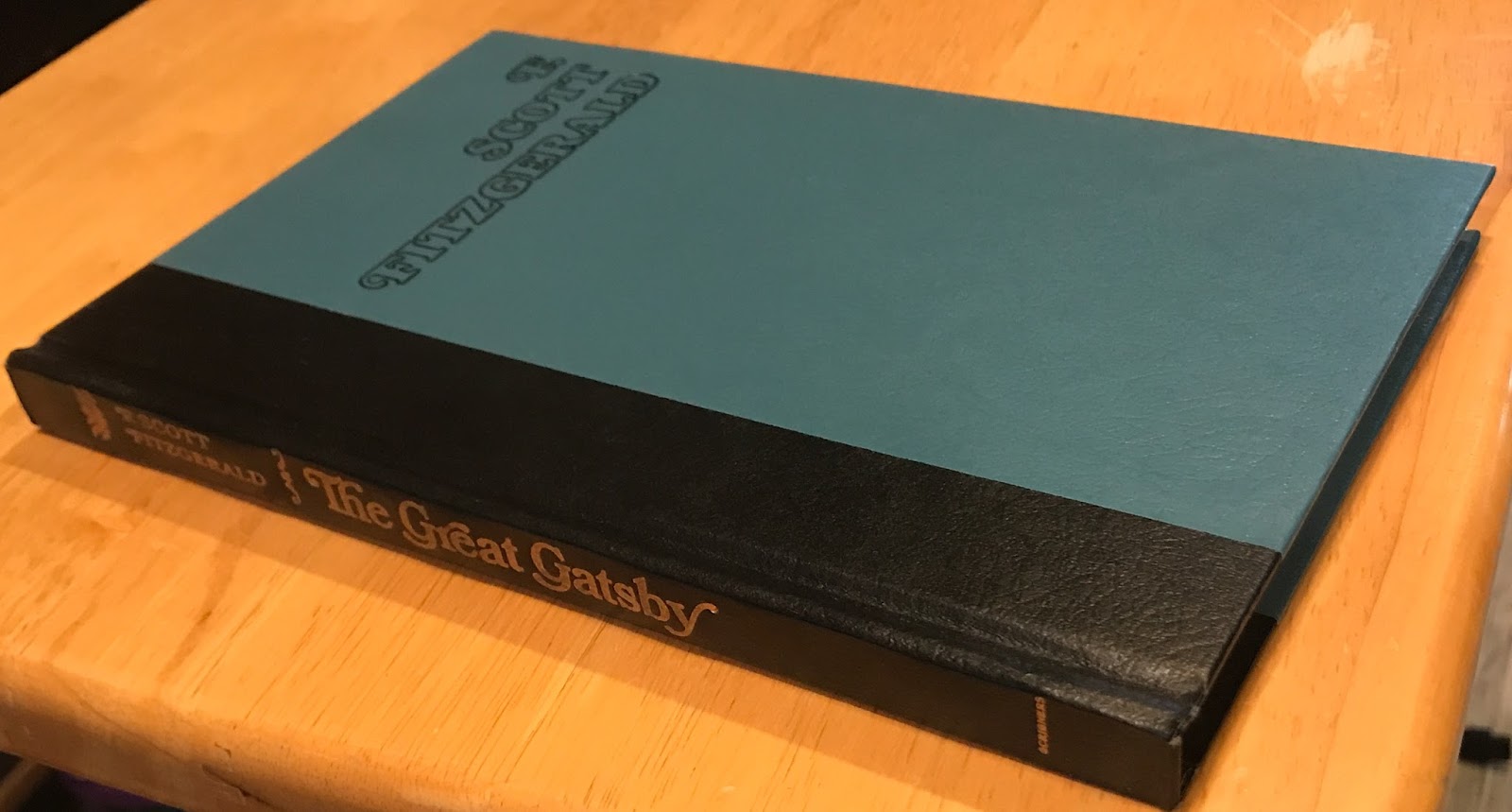
I was listening to a public radio program on The Great Gatsby, which features readings from the book by Scott Shepherd. Gatsby is taught in high schools and colleges, has been made into film (neither fully capturing its resonance), and is regarded today as not just iconic but an important step in the development of American literature.

Gatsby is a romance of America, of a moment in American history. It is the Jazz Age — a time of extreme wealth for some, of hedonism for the young and not so young. Gin flowed freely, even as Prohibition drove it underground. American was fast moving toward a finance-driven economy — a trend that would be interrupted by the Great Depression and World War II but would pick up again in the late 1960s.

Gatsby predates publication of On the Road by 30 years, the events of both novels are separated by about 25 years. Yet, they share a common bloodline, and not only because both have attained iconic status or because their authors seem to share a psychic connection. Both novels are unflinchingly American — Gatsby in its use of the Horacio Alger trope, which Fitzgerald dismantles as the novel’s greed and hedonism moves toward failure and depression (and the nation does the same).

Gatsby‘s critique is up front. From it’s beginning, there is a mix of fascination and revulsion, its narrator both a part of the scene and standing outside. It is Nick Carroway’s novel, written in the first person. It is Nick’s voice throughout, and Nick is both transfixed by and suspicious of the mysterious Jay Gatsby, his desire for the married Daisy, and the excesses their wealth and desires generate. Gatsby is a dark vision of he American Dream and of the first stages of the transformation from agrarian nation to urban/suburban one, at least as it concerns what we now call the 1 percent, and uses the romantic mythology Americans already had developed about ourselves as ironic counterpoint to the ultimate emptiness that Gatsby finds in his life. This irony gives the slim book — which critics originally viewed as lacking substance — real heft, and it’s why I think it still resonates even as the hedonism at its core makes it seem of a piece with On the Road as a young man’s novel.

On the Road lacks the ironic counterpoint and, while great sadness is a thread throughout he novel, it is a personal sadness, as opposed to a more broadly cultural one. Kerouac through Sal — it is important to note here that conflating writer and character is usually dangerous, but not in Kerouac’s novels, which are thinly veiled memoirs — remains in thrall to an American night, a “complete night that blesses the earth,” even as we can’t know what the world has in store.

It is a different vision, to be sure, than the one with which Nick leaves us, a dream already in the past, “somewhere back in that vast obscurity beyond the city, where the dark fields of the republic rolled on under the night” (159).

Send me an e-mail.

I thought I was a beat, but I was just a boy, part 3

I thought I was a beat, but I was just a boy 
Notes on Re-Reading Kerouac in my 50s
Part 3
( Read Part 2 here and Part 1 here.)

Kerouac’s hand-drawn map, posted from Pinterest (https://www.pinterest.com/pin/275845545900879627/)
I’m looking backward.

Jim had a convertible, a classic Camaro. It was a spring day, early spring. He took it out, Joe and I along for a the ride. And what a ride. Tooling around the farm roads and highways that circled the State College campus, top down, Joe and I stoned, taking turns standing and leaning into the wind. It was crazy, but the breeze was bracing. I felt like Sal. I’d just read the book, first time. Not yet 19, riding in the open air.

Several days later, Jim taxis us out to Route 80. Joe and I, back packs filled with a couple days of clothes, my notebooks tucked in with a couple of books, and such. We were heading east to spend the weekend at my house in Jersey and we were going to thumb it.

The goal on its face was Jersey, a four-plus-hour drive, but deep down I envisioned Kerouacian adventures. A disastrous first year at Penn State was coming to a close, and a summer working in a Trenton factory loomed — along with an array of concerts and a chance to hang with he guys. I needed it, I bought, a chance to put the miserable class work behind, to reconnect. School had started off well — I got A’s and B’s — but quickly saw my GPA crater. Class and class work ceased to be important. I was writing for the first time — not the journalism I did in high school, but terrible poetry and short stories. I was spending more and more time at the radio station, and bumming around State College’s record stores and head shops.

I had self-consciously gone bohemian, without really understanding what that meant, which is when I read On the Road for the first time. Something clicked, something about the book helped explain a disconnect I was feeling more and more regarding who I thought I was in high school.
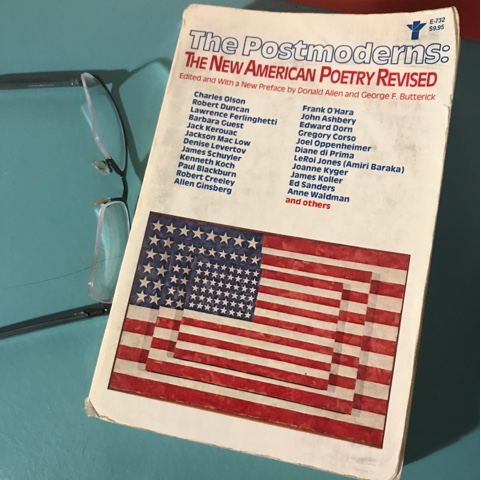
It’s too easy to say On the Road expanded my mind. It didn’t, though I think it’s fair to say it was part of a bigger intellectual awakening that included not only the Beats and an immersion in jazz, but books by Hemingway, Sherwood Anderson, the French poets (of which I feigned an understanding), Sartre and Camus, and a poetry anthology called The Postmoderns: The New American Poetry Revised that I still own and still read.

On the Road, however, did leave me with a romantic impression of the open road, which led me to suggest to Joe that we hitchhike. And the book, I think, colors my impressions of that day, which must have featured a lot of walking, a few rides, and much conversation. I honestly remember little of it, aside from two rides: One was a priest that, in my mind, has become a Russian Orthodox priest with a big beard and booming voice who told us of his congregation and his thoughts on he promiscuity of the younger generation. I want to write “great Russian priest” in the Kerouacian manner, implying a thick accent outline Boris and Natasha from of Rocky and Bullwinkle, but that seems unlikely, and in any case I remember little else from that ride. The other ride was from a hippie couple in a pickup. The let us ride in the bed in the open air with their German shepherd Cocaine, who had a Zen-like calm that neither Joe or I could muster. It was obvious the dog had ridden back their before, while the two of us were subjected to the wind ripping past as the truck burned east on Route 80 probably doing 80-plus. I remember us being exhilarated by the ride, and I’m sure that’s true, but memory is a tricky thing, especially 35-plus years later.

We hitched back, against my dad’s demands. He did drive us up to the Water Gap, which gave us a head start. The return trip was uneventful until we got off Route 80 near Penn State. Traffic died down and we did a lot of walking. It was growing dark. I walked and played harmonica, probably the one or two blues riffs I knew. I wasn’t very good, and I suspect that Joe was annoyed, but he never said a word. We eventually got a ride and made it back to the dorms, adventure over.

I hitched that route several times after, and also hitched South to the West Virginia University with a girl named Eileen. She was just a friend, but like me infatuated with the Beat/hippie ethos. Our friend Rusty and another girl (I don’t remember her name, though she and Rusty ended up a couple after our trip) also made the trip, racing us down by a different route.

I don’t remember much about the trip except that Morgantown was in the West Virginia mountains, was unbelievably hilly and the streets were lined with older houses. There were parties and a girl and the weekend was a blur and I felt as though I were inside On the Road, running around Central City in a manic state. It was all very romantic and so long ago.

I soon left school, carrying a 1.7 GPA, with few prospects, assuming I’d write my way to riches. Young and dumb and mostly too stoned to realize it. I thought I would find enlightenment through the holy grail of “kicks,” but I was wrong. Enlightenment is elusive and I’m not sure it’s truly obtainable. What I do know now is that we only come close to realizing a personal nirvana, to borrow the Buddhist term, through human connection and deep commitment. I only learned that by experiencing it, by finding ways to keep love’s flame burning across multiple decades, through challenges both big and small.
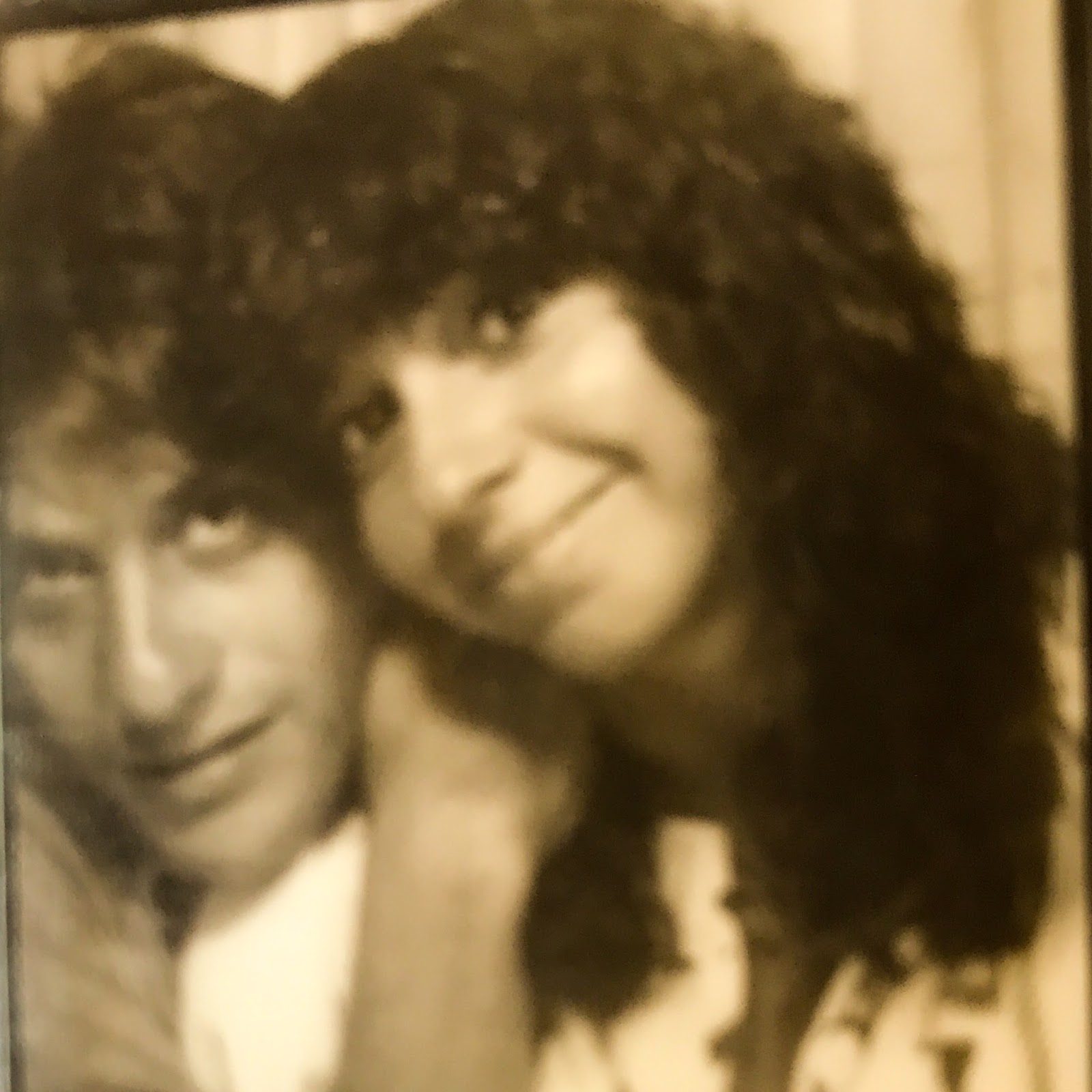
Annie and I, circa 1982.

It’s not that Annie and I are one, that our lives are perfect. We are not and our lives are not. We are individuals who are better together than apart, who are better able to battle through life’s imperfections together.


Sal has trouble seeing this in On the Road — or maybe it’s not that he can’t see it, but that his vision of nirvana involves seeking an ideal that is inconsistent with his tortured combination of hedonism and asceticism.


I thought I was a beat, but I was just a boy, part 2

I thought I was a beat, but I was just a boy 
Notes on Re-Reading Kerouac in my 50s

Let’s talk about the mad ones.

Kerouac, in what is probably the book’s most famous passage, writes that he “shambled after” Marx and Moriarty
as I’ve been doing all my life after people who interest me, because the only people for me are the mad ones, the ones who are mad to live, to talk, mad to be saved, desirous of everything at the same time, the ones who never yawn, or say a commonplace thing, but burn, burn, burn like fabulous yellow roman candles exploding like spiders across the stars and in the middle you see the blue centerlight pop and everybody goes “Awww!” (Kerouac 8)
The thrill of his writing, when he is on, is here in the passage. It’s built on a seemingly endless run of prepositional phrases that heighten the extremes of emotion with which he often is overcome. It presages the ’60s in its implicit critique of normative society, while also hinting at the shortcomings of the hedonist philosophy that drove the decade into excess and solipsism.

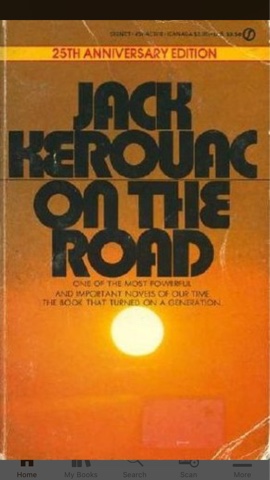
The cover of my 1st edition.
It’s important to keep in mind the placement of this passage, early in the book, before Sal heads out on his various adventures, finds exhilaration and disappointment, before the weight of it all settles on his shoulders. I think it’s fair to ask why this passage remains the one most people remember and quote. The answer is two-fold, I think: First, it is consistent with the mythology that surrounds the book; second, it stands, even after 300-plus pages, as Kerouac’s theme, that one must seek the extreme even as the narrator is always a step behind, always finding his thrills, his joys, to be temporary. To “burn, burn, burn like fabulous yellow roman candles exploding like spiders across the stars” is also to burn out spectacularly. “Live fast, die young, have a good looking corpse,” as the mobster in Knock on Any Door says.

This ethos, though, is limiting. James Dean. Janis Joplin. Kurt Cobain. All died too soon, robbing us of the kind of art they might have grown into. “Grow old along with me / The best is yet to be,” as Browning writes.

On the Road aggrandizes youth and motion, but also traffics in a kind of nostalgic mythology. It is critical both implicitly and explicitly of the adult and what might be called the square world, yet somehow viewing certain mythologized traditions as noble or worth preserving.

Consider his short stay in Cheyenne — again, early in the book. He and his crew of beatified hobos arrives in the Wyoming capital during Wild West Days, when the old town section of the city is remade into an old-fashioned western town from the movies. Sal is bemused and dismissive. He gets the economic imperative — towns using a mythologized representation of their history to attract visitors — but he finds the whole thing ridiculous and his critique is framed with a physical stereotype: “Big crowds of businessmen, fat businessmen in boots and ten-gallon hats,  with their hefty wives in cowgirl attire, bustled and whooped on the wooden sidewalks of Old Cheyenne” (33). This is a kind of cartoon essentialism that robs the people he targets of depth, transforms them into the broadest of stereotypes — something he does through out the book with African Americans, Mexican, workers, the poor, etc.

It’s an attitude that animated elements of ’60s youth culture — and which was critiqued in dystopic films like Wild in the Streets and Logan’s Run, films that presented a vision of youth power run amok.

And yet, Sal is not entirely off base. The Cheyenne event glorifies the past. Its nostalgiac take on “The Wild West” is about money, first, but also about looking backward and, as such, it presages much of our political dysfunction. The Trump phenomenon is about looking backward, is built on the kind of narrative gymnastics we’ve performed in creating the story of American exceptionalism. The past offers respite from the present, seems better, and may be for some. But for others, those excluded from the mythic narrative, the past is better left in the past. Nostalgia, as a political mode, is reactionary and potentially dangerous. Sal, in Cheyenne and throughout the book, is caught between his urge to make it new, to avoid the commonplace, and his tendency to lionize certain traditions, to look backward himself.


I thought I was a beat, but I was just a boy, part 1

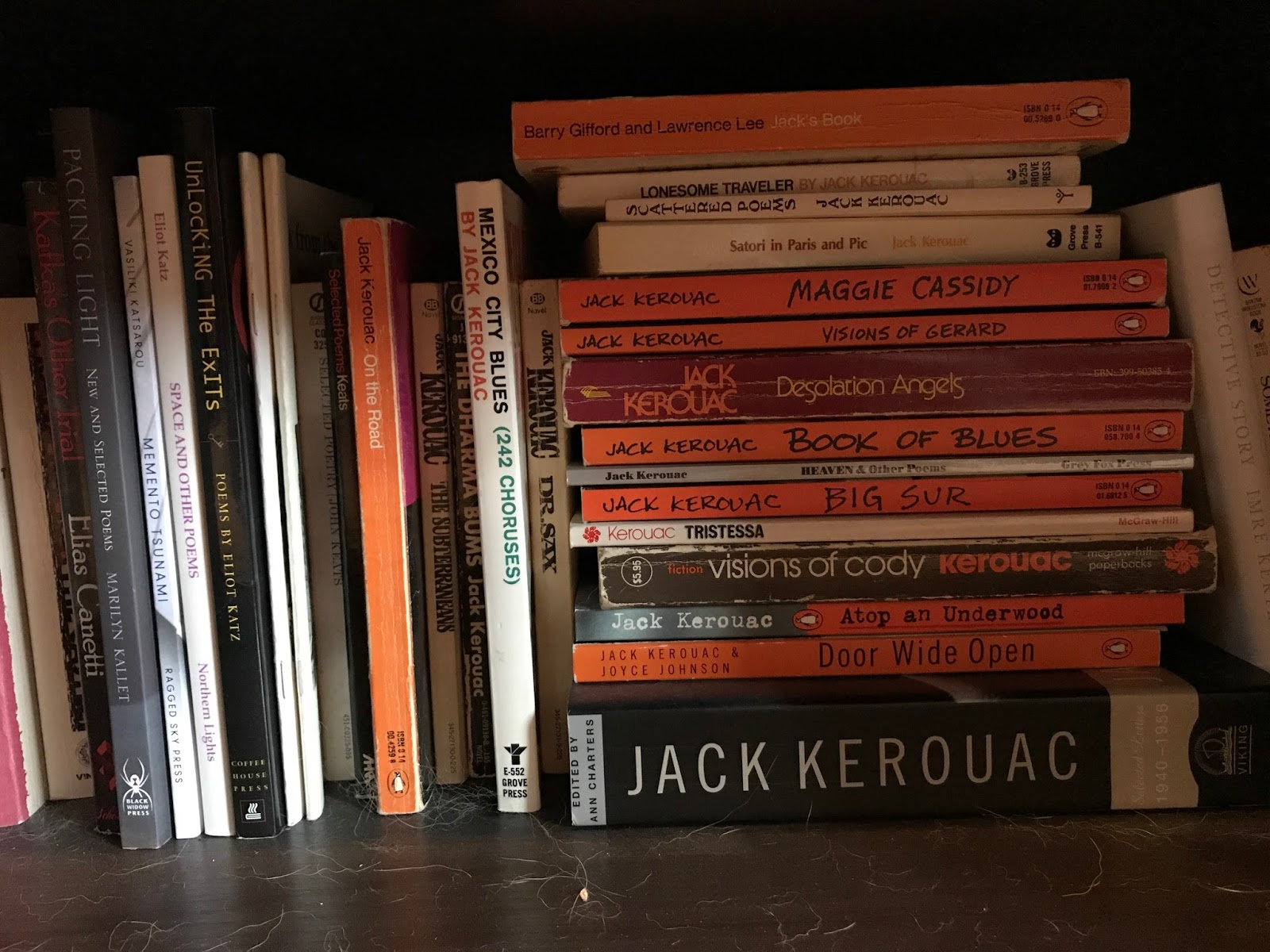
What follows is my initial reflections as I set out to re-read Jack Kerouac’s On the Road for the first time in at least  a decade. i won’t say much now, but I’ll be posting updated entries as I go with the intention, down the road, of pulling together an essay.

My Keroauc collection.

I thought I was a beat, but I was just a boy
Notes on Re-Reading Kerouac in my 50s
It was probably 1981, the spring, the end of the second trimester or beginning of the third of my first year at Penn State I dropped out after two years, partly because I thought I would be the next Kerouac). I must’ve read an article in Rolling Stone, or that’s what my imagination, mining the frayed edges of memory from a distant time and place, of another me, is telling me. I can’t be sure. It could’ve been Creem. Or The Aquarian. Or Crawdaddy. I was addicted to music journalism, to music — punk and new wave, the blues, jazz. Freed from the constraints of a self imposed high school conformity, I took it all in.

Perhaps it was Jim Carroll’s Basketball Diaries that turned me on to Jack Kerouac, or his Living at the Movies, which contains a poem for the beat legend written upon his death, “Highway Report”:
Kerouac is dead at 47
                                      on radio
and McCartney alive

                         (we lost).           and

tragedy’s just that and what to do but keep on going all in one line (Carroll 67)
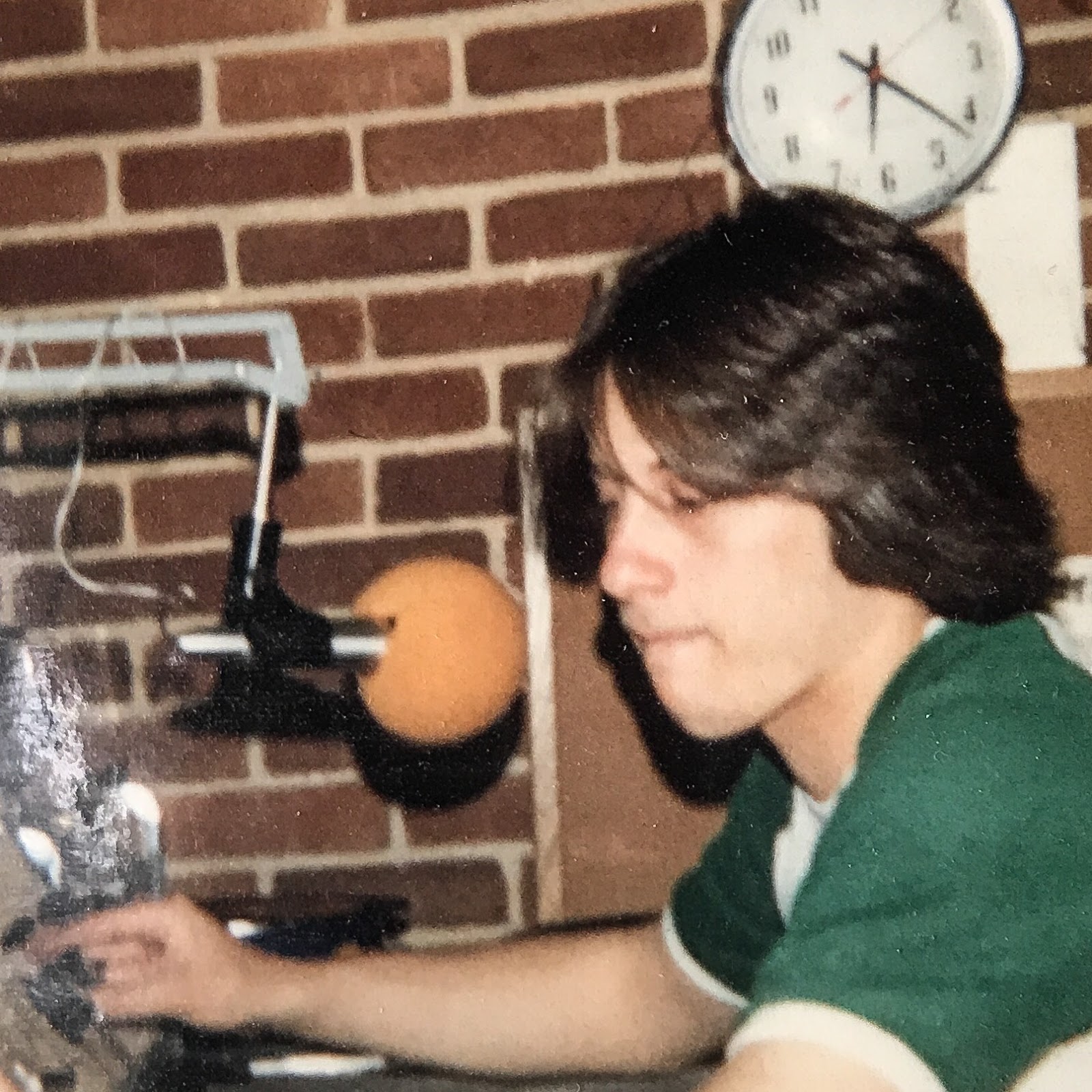
Me, circa 1981, when I was spinning records at WEHR.

I want o say that the impetus behind my reading Kerouac for the first time doesn’t matter, that I came to On the Road with the freshest of eyes, but I’ve come to realize that just isn’t possible. On the Road is an iconic text, and it has been for much of the 60 years since it’s initial publication. As much as any other book, it is credited with helping to create the 1960s counterculture — one that reveled in nonconformity, that kicked the staid ’50s to the curb in pursuit of sex, drugs and rock and roll, spiritual growth, political and personal freedom, much of which proved unsustainable.


Kerouac abhorred this connection — by the time the counterculture was in full flower, his underlying conservativism came to dominate and he spent the final years of his life railing in reaction against what he saw as a communist-inspired and morally bankrupt ethos.

I didn’t know about the reactionary Kerouac when I first picked up On the Road. At not-quite-nineteen, I had become obsessed with the ’60s. I grew my hair long, smoked dope and took acid. I skipped class. I read voraciously — music bios and periodicals, poetry, . At one point, I took to wearing a blue wool knit cap — a winter cap — like Bruce Springsteen, who’d become my idol, or Nicholson in One Flew Over the Cuckoo’s Nest. I caromed back and forth between styles and movements — punk to hippie, beat to working-class chic. I played guitar (badly) and started fiddling with songs and poems. I took creative writing and lit classes, passed some, failed most. I was adrift, seeking an intellectual anchor. Enter Kerouac.

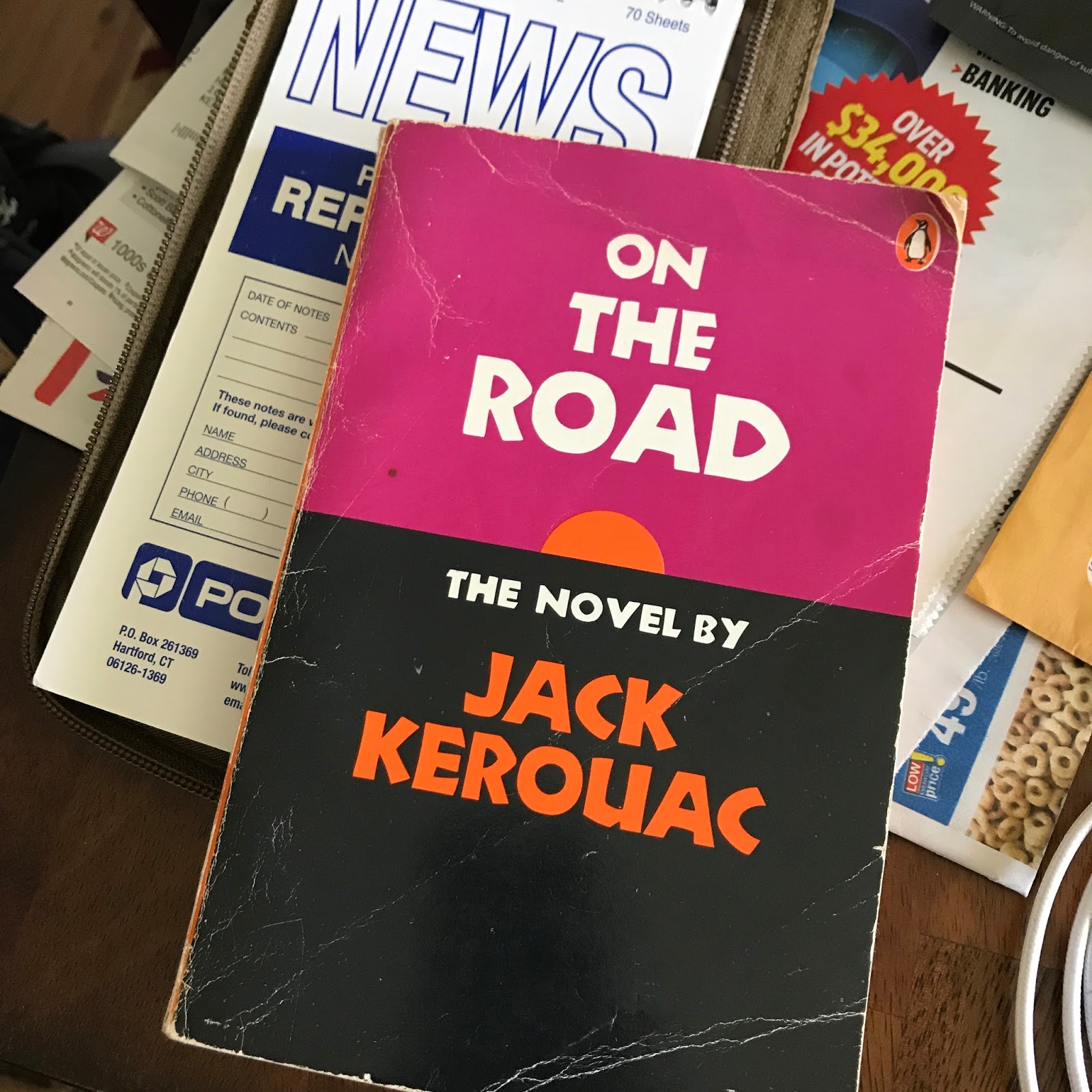
My copy of the book.

As I said, I don’t remember how I came upon On  the Road, but I am sure the dual 

myths surrounding book and author led me to the cheap paper pack that ended up in my possession. That copy — dog-eared after multiple readings, pages falling out, underlined with notes jotted in the margins — is long gone. I think I gave it to a writer friend when I returned to college after three years away. The trade copy of the book — $4.95 from Penguin published in the early ’80s. — has held up better, mostly because I’ve moved on. I do not return to it the way I did when I was 20 or 22. In fact, it’s probably been more than a decade since I’ve read it, and for good reason. It is a young man’s book, and I emphasize both “young” and “man.” It is, at its core, a romantic Bildungsroman, the story of a restless seeker who never really finds what he’s searching for, because he never figures out what that might be. It is romantic in that even it’s most downwardly cast or even depressing sections are presented as part of a heroic quest. Sal Paradise, Kerouac’s alter ego in On the Road, shares with Christian from Bunyan’s Pilgrim’s Progress a desire to escape, Sal from a life of boredom and the cultural sin of conformity, Christian from his hometown of Destruction and an underlying sense of permanent sinfulness. But, whereas Christian’s quest is a moral one, Sal’s remains unformed and selfish. He is seeking enlightenment, but in the form of kicks. His foils — Dean Moriarty, Carlo Marx and others, all based on famous and not-so-famous Beat writers, intellectuals and hangers-on — often present different approaches and alternate narratives that Sal dabbles with, but to which he cannot commit.

And this aspect of the story, this failed commitment, the narrator’s youthful wandering — and the romanticization of this restlessness — is what makes it a young man’s read.

***
I’ll have more as I reread, but I am curious what other readers think of the book today, especially if their first reads were 20, 30, 40 years ago. Post your thoughts in the comments.