I thought I was a beat, but I was just a boy, part 11

I thought I was a beat, but I was just a boy 

Notes on Re-Reading Kerouac in my 50sPart  11

“The car belonged to a tall, thin fag” (206). I hadn’t noticed this before, Sal describing a man they met at the travel bureau in San Francisco, using what remains a nasty slur against gays to describe a character with which he obviously has little sympathy.

He lacks a name, “wore dark glasses and drove with extreme care.” His car was a “fag Plymouth,” an “effeminate car,” with “no real power.”

Sal and Dean are heading east, escaping a San Francisco that had become repressive, where the women in Dean’s life — and the lives of his friends — were weighing them down, cutting into their freedom. They visit the travel bureau, which matches passengers willing to cover fuel costs with drivers seeking the companionship and help with expenses.

They catch a ride with “the fag,” along with a “couple, typical halfway tourist,” who are the epitome of square America. Sal and Dean ignore the three, talking in the back seat for the trip’s first leg, talking like new lovers, excitedly, passionately, conspiratorially.

We were telling these things and both sweating. We had completely forgotten the people up front who had begun to wonder what was going on in the back seat. At one point the driver said, “For God’s sakes, you’re rocking the boat back there.” Actually we were; the car was swaying as Dean and I both swayed to the rhythm and the IT of our final excited joy in talking and living to the blank trances end of all innumerable riotous angelic particulars that had been lurking in our souls all our lives. (208)
The juxtaposition of this love-like relationship in the back seat of the Plymouth with the description of the driver is instructive. It has the feel of a man over-compensating for his own 

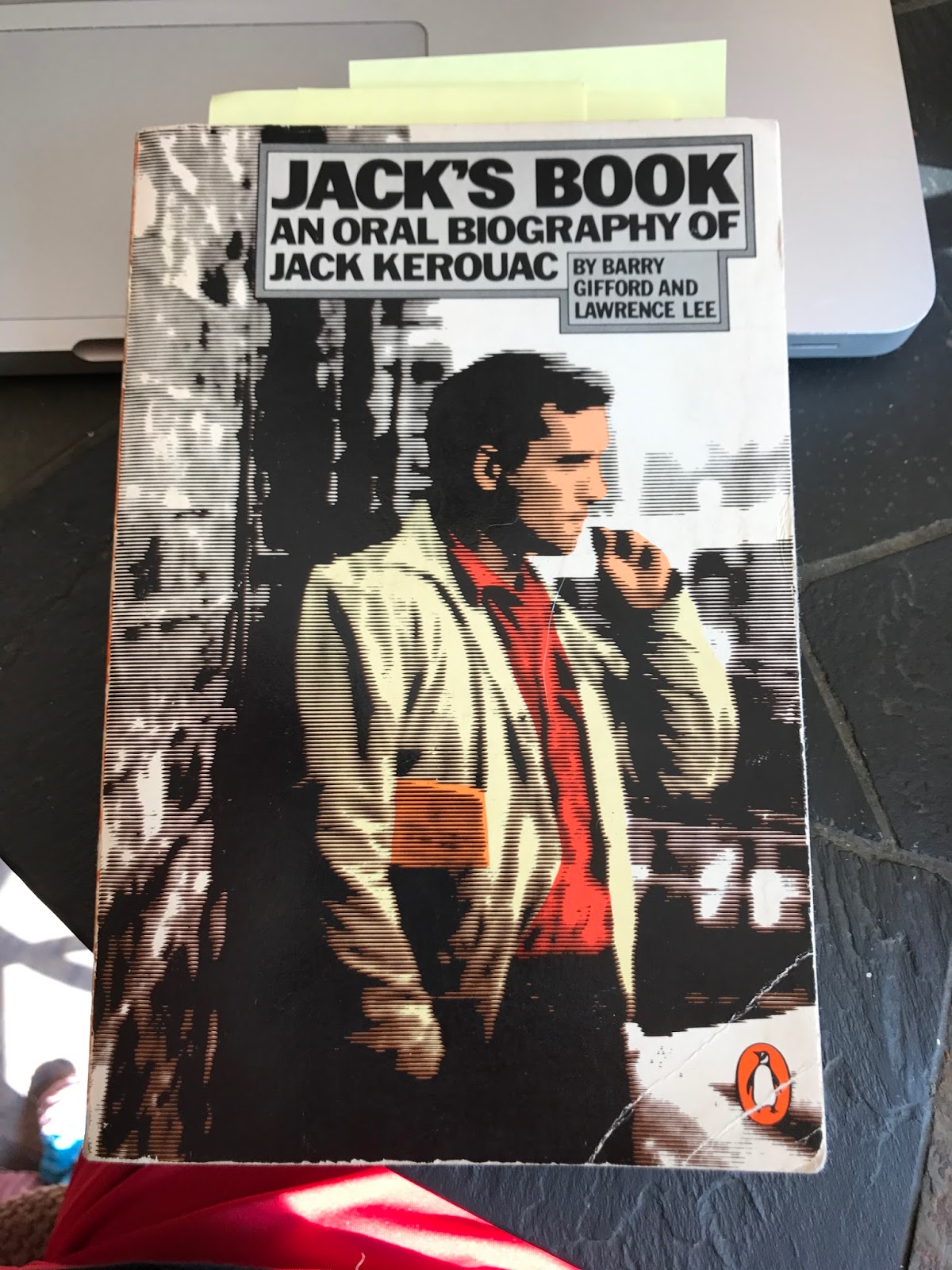
Kerouac had gay friends — Allen Ginsberg, William S. Burroughs, Gore Vidal. In fact, he slept with Vidal (see Vidal’s discussion of this in Jack’s Book: An Oral Biography of Jack Kerouac, 182-184), who described Kerouac as bisexual and not afraid to use his it when it benefited him. Kerouac’s use of anti-gay slurs, then, could be an example of a public homophobia compensating for repressed homosexual urges. This, of course, is just pop-psychology, though some recent studies would appear at least to lend credence to the theory.

Consider this article from Scientific American, which describes an academic study that purports to link homophobia both to this repression and to authoritarian parents who harbor similar views.
The research, published in the April 2012 issue of the Journal of Personality and Social Psychology, reveals the nuances of prejudices like homophobia, which can ultimately have dire consequences.

“Sometimes people are threatened by gays and lesbians because they are fearing their own impulses, in a sense they ‘doth protest too much,'” Ryan told LiveScience. “In addition, it appears that sometimes those who would oppress others have been oppressed themselves, and we can have some compassion for them too, they may be unaccepting of others because they cannot be accepting of themselves.”
Keep in mind that these possibilities are couched in conditional language — “may,” “”could,” “it appears” — because our emotions and prejudices do not run in a straight line. Jesse Marczyk, writing in Psychology Today, disputes that a link exists at all, saying there is no research that supports it. That seems too simple, too easily reductive. Homophobia has a lot of causes, which very well may include repressed feelings.

Whether this is the case with Kerouac, we can only make assumptions based on his reduction of this poor traveler to the single slur, “fag,” reinforced by language that shows an obvious disdain — and what others have said about his personal life.

As Barry Gifford and Lawrence Lee write in Jack’s Book: An Oral Biography of Jack Kerouac, there have long been theories about Kerouac’s — and Neal Cassidy’s — sexuality.

Because Ginsberg, Burroughs, Huncke and others in the circle are homosexuals, it has become fashionable to assume Jack and Neal were gay men too repressed to act out their love for each other openly, a theory ratified by the fact that both men, on occasion, sleep with other men. There is no evidence, documentary or otherwise, to support the notion. (88)
And yet, a Kerouac’s editing of his relations with other men — with Vidal’s alter ego in The Subterranean most famously — to remove the sex, along with his willingness to turn to slurs like fag, raise serious questions and should not be elides as we attempt to reconsider On the Road.

In my 20s, I didn’t notice this use of language. Dismissing gays and lesbians, targeting them with vitriol (or worse) and making them the butt of humor was the norm. It wasn’t just the anti gay Reagan administration or conservatives who did this. The stereotypes were everywhere. Gays were nearly always portrayed as unabashed queens, over-the-top and limp-wristed, or as painfully closeted individuals. They were never just characters who happened to be gay; they always had to be the gay character. Even a comedian as open-minded and friendly to the LGBTQ community as Robin Williams made the crude stereotypes of lisping and prancing gays the target of his jokes. It was OK to laugh at the fags at this time.

We’ve moved away from this to a degree. The gay pedophile character remains a trope of American cop shows, while the flamboyant queer and butch lesbian continue to be used for comic relief and the butt of jokes. See the movie and musical versions of Legally Blonde, in which a cardboard lesbian character is presented as completely humorless and the gay pool boy is reprises the flames stereotype. Both characters are meant to be laughed at — rather than with — because they are gay.

Thankfully, other pop-culture presentations do a better job of fleshing out their gay characters so that we laugh with them — Modern Family’s Mitch and Cam, for instance, engender laughter because of their individual quirks and not because of broad stereotypes (though they have been desexualized for much of the show’s run). Saul and Robert on Grace and Frankie are incredibly detailed characterizations of two gay men who came out late in life. 

The fight for marriage equality and full citizenship and rights and protections for members of the LGBTQ community have also changed the conversation and allowed many of us to see Kerouac’s nasty portrayal of the “tall, thin fag,” as the homophobic rant it is.

Kerouac writes this during the ’40s and ’50s, when it was common and accepted, when police raided parks looking for pervs, and well before the Stonewall uprising. Some might give him a pass for it — and I do believe it is hard to judge someone outside of our times. He was not unusual for his times, but he also was not he brave trailblazer he could have been.

More significantly, while the book was published in 1957, I am reading it today, with today’s eyes and belief system. One reason for me reading this book now, as I approach 55, is to gauge how my thinking has evolved. I was never a homophobe, but neither was I particularly enlightened, despite having a close friend come out to me. At 20 or so, I probably viewed gay subculture through a romanticized lens, as a leading edge of the avant-garde to which I thought I belonged. It was cool to know gays and lesbians, read their work, listen to their music. To idealize them. I have to admit, though, that this elevation — like Kerouac’s idealizing of African Americans — turned real people and a real communities into objects.

I mentioned this in an earlier post, and it bears repeating: Even the most progressive of us, those with the best intentions, can fall prey to racist or LGBTQ-ist thought. I won’t go so far as to say homophobic thought, because the suffix -phone implies hatred or distaste; this is more about robbing individuals of their identity and turning the into stock figures and stereotypes, which doesn’t require animus.

I’m not looking to rewrite the history of On the Road — it is too much a part of my personal iconography — but it is clear that on so many fronts it has not aged well. It is an artifact, which does not preclude it being read or seen as important literature (there is great debate about this, on which I come down on both sides). The canon is full of writing that should make us squeamish today — Conrad and Kipling, Harriett Beecher Stowe, Fitzgerald and his ugly Jewish stereotyping. We still read and should continue to read these works — but we have to identify and respond to the prejudices of the time and ask how we should respond today.

Literature is a conversation. Novels, poems, and essays talk to and comment on the novels, poems, and essays that came before. This does not necessarily happen in an overt fashion. It often is more subtle, with writers consuming and internalizing the work of their literary ancestors. It is a component of the fuel that drives creativity and commands us to work on our craft.

So, we read Kerouac’s slurs — his caricaturing of women, blacks, Mexicans — and we respond with shock, dismay, and anger. We do this because we have to, and how we express our responses says as much about us as readers as it does about Kerouac.

I thought I was a beat, but I was just a boy, part 10

I thought I was a beat, but I was just a boy  
Notes on Re-Reading Kerouac in my 50s
Part  10

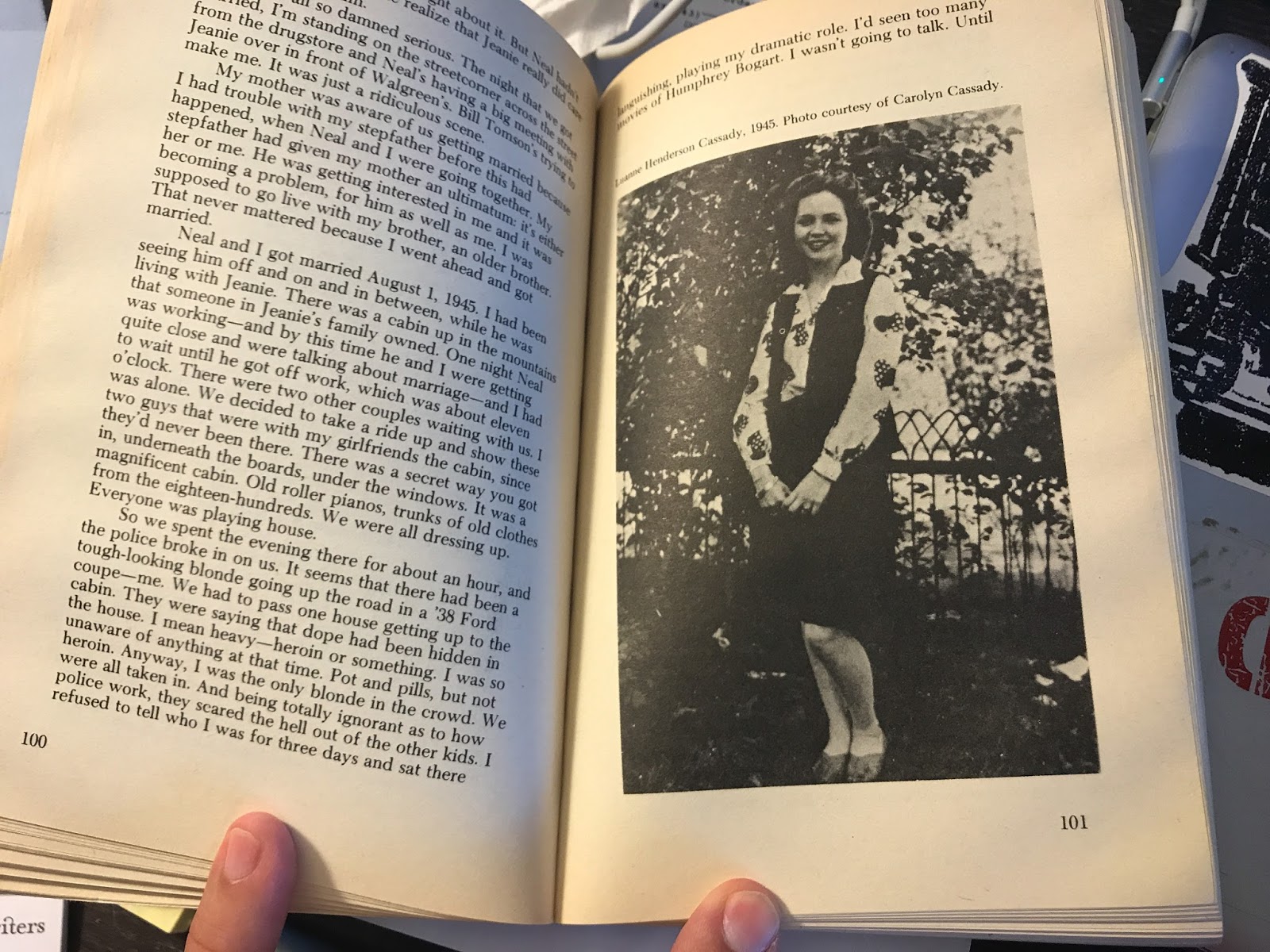
Luanne Henderson, the model for Marylou.


I call On the Road a young man’s novel, and it’s important to make it clear that the emphasis is both on young and on man.

Consider this description of Lee Ann, his friend Remi’s girl:

She was a fetching hunk, a honey-colored creature, but there was hate in her eyes for both of us. Her ambition was to marry a rich man. She came from a small town in Oregon. She rued the day she ever took up with Remi. On one of his big show off weekends he spent a hundred dollars on her and she thought she’d found an heir. Instead she was hung-up in this shack, and for lack of anything else she had to stay there. She had a job in Frisco; she had to take Greyhound bus at the crossroads and go in every day. She never forgave Remi for it.

Lee Ann is the gold-digger shrew. She is out for the money, hooks up with Remi, thinking him rich,  and targets Remi and anyone connected with Remi with a deep resentment. Or so we are led to believe. Remember, On the Road is written in the first person. Everything we see, every bit of information, is filtered through Sal, and it is fair to ask whether this description is accurate.

I’d argue that it’s more complicated, that Sal — and Kerouac himself — can’t see the nuances because his view of the world is constrained by an ingrained sexism. Every female character is placed within one of a set of categories or archetypes.

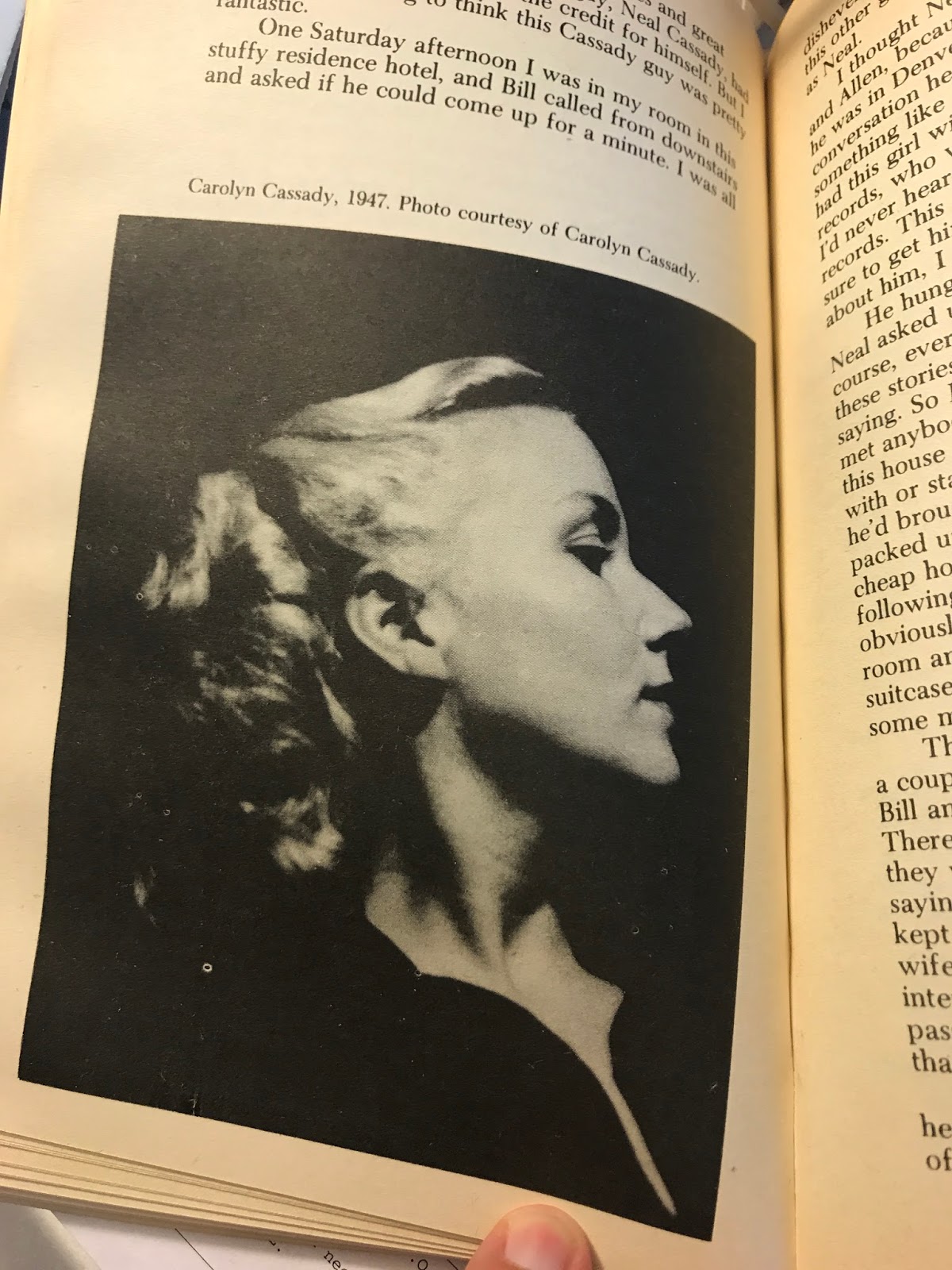
Carolyn Cassidy — Camille.

Lee Ann — along with Dean Moriarty’s girls Marylou and Camille — serves as shrew, as ball and chain, as weight around her man’s neck. She is a fairly typical archetype in literature and one of the boxes in which Kerouac traps his women characters.


Babe Rawlins is the “beautiful blonde,” “a tennis-playing, surf-riding doll of the West,” an “enterprising blonde” whose utility in the novel is limited to helping the men, facilitating their kicks or smiling as they go off and do their man things.

The unnamed wife of Walter, an African American that Sal and Dean meet in a bar in San Francisco, fits this same stereotype. The trio goes back to Walter’s tenement flat, where his wife was sleeping. The apartment had only a single bulb, and the men needed the light in the kitchen, where they sat to drink and talk. It was late, of course, and the bulb was above the wife’s bed; Dean climbs up and removes the light and, then, again to plug in the extension chord. the unnamed misses just “smiled and smiled. She never asked Walter where he’d been, what time it was, nothing” (203). When it was time to leave, they “repeated the insane thing all over again. She never said a word.”

And this sums up the book’s relationship to and views about women. As Dean says after they leave Walter’s:

“Now you see, man, there’s a real woman for you. Never a harsh word, never a complaint, or modified; her old man can come in any hour of the night with anybody and have talks in the kitchen and drink the beer and leave any old time. This is a man, and that’s his castle” (203).

Galatea Dunkel is both shrew and enabler. Galatea enters the story as ghost, as hearsay, and reappears periodically. Galatea is Ed Dunkel’s wife; Dunkel is Dean’s Denver pal, a Moriarty acolyte. Galatea is described as sniffing around after Ed, who ultimately marries her so she can pay the costs of a cross-country trip. Dean, Marylou and Ed ditch her in New Mexico, She’s described simultaneously as angry but needy; she blames Dean but desperately wants Ed back. In this way she is both Marylou and Babe, both Camille and Walter’s wife.

Only two women get extended treatments — the Mexican Terry that Sal hooks up with and Mary Lou, who goes on a mad cross-country car trip with Sal and Dean.

http://www.dailymail.co.uk/news/article-2397641/Inspiration-Jack-Kerouacs-On-The-Road-Beatrice-Kozera-dies-aged-92.html
Bea Kozera, Terry, and a friend the year she met Kerouac.

The figure of Terry is an interesting one. It is probably the tenderest portrait drawn by Kerouac, the one least bogged down by the mythology of his bias. There is real affection in Sal’s words, a sense that he has found something to which he can commit. But not completely. The world hangs over him — the need for money, in particular, but also a general sense of foreboding. After being hooted at by carloads of teens on a dark road outside Arcadia, he offers an internal monologue in which he explains how he “hated everyone of them” (88).


Who did they think they were, yaahing at somebody on the road just because they were little high-school punks and their parents carved roast beef on Sunday afternoons? Who did they think they were, making fun of a girl reduced to poor circumstances with a man who wanted to belove? 

The teens pass, and Sal and Terry make their way to “high-school soda fountain,” the only place open, where they come across the teens again. The teens remembered them, and realized that “Terry was Mexican, a Pacheco wildcat; and that her boy was worse than that” (88-89). This is one of the few passages in the book that acknowledges strong current of racism in the United States, a recognition undercut by his needing to refocus the eye on himself.  This is white privilege before it had a name, but also evidence of Sal/Jack’s emotional narrowness, his inability to fully get outside of himself.

But the lovers leave — she leading “with her pretty nose in the air, and they wander along the highway. This is still early in their relationship, and one might expect it to create an unbreakable bond, but Sal cannot make that kind of commitment. It is not in his emotional DNA. 

Consider his inability later in the novel to commit to Lucille: “She wanted him to be her way” (125). He was 

willing to marry her and take her baby daughter and all if she divorced the husband, but there wasn’t even enough money to get a divorce and the whole thing was hopeless, besides which Lucille would never understand me because I like too many things and get all confused and hung-up running from one falling star to another until I drop. This is the night, what it does to you. I had nothing to offer anybody except my own confusion (125-126).

The divorce argument is nothing more than justification; even if Lucille could extricate herself from her marriage, Sal would find other reasons not to stick around. His fatalism and restlessness ultimately doom his relationships, which no woman can understand — save Terry, who promises to follow him east knowing full well it will never happen. She has a restless soul, as well, and so she understands him and that understanding is presented as a willingness to let him walk.

Terry is the one female character who is given agency, though it is limited both by the patriarchal society of America after the war and Kerouac’s limited gender imagination. She is generally described in sympathetic terms, but both as child — a naive, angelic presence — and as a wise, almost Buddha-like presence. She is strong, but also a child, independent yet dependent on family. Her complications deserve an entire book, but we get just a sketch, and she ultimately stands as an example of the minor roles women are given in the beat world.

Marylou, Dean’s sometime-girlfriend-sometime-wife, gets more ink, but is no more fleshed out. Traveling with Dean across country to pick up Sal and then making the trek back west, we are presented with a woman who has many of the same appetites as Dean and Sal, but is painted as a more dangerous presence, as a schemer and, at times, a brake on the men’s adventures. Marylou has ulterior motives, as described by Sal, pits Sal and Dean against each other, seeks to make other women jealous.

But her presence is limited and, in the end, she is drawn with a little more detail, but lacks the shading, the color, of any of the men in the book. She’s two-dimensional, often an after thought like all women in the novel except for Terry. There is a scene in New Orleans that typifies this attitude: Sal, Dean and Ed run across rail tracks in New Orleans so Dean could show Sal his brakeman moves; they leave “Marylou and Galatea were waiting in the car” (155), unconcerned about what they might do or whether they OK with this temporary abandonment — they were out for a drive as a group, after all. Then, when the men get “back to the girls an hour late,” the girls “of course … were mad” (155). He writes this matter-of-faculty, as though it was just the price men pay for their attraction to women, for letting them tag along. Marylou, Camille, Dorothy Johnson — they present as obstacles, impediments, not real fleshed-out characters, not partners in loving relationships, but as objects.


Jessica Mendoza and the privilege of the booth

Jessica Mendoza when she was on the United States Olympic softball team in 2008. She is now ESPN’s first female baseball analyst. Credit Al Bello/Getty Images

The outdated assumption that there are men’s realms and women’s realms has been a stubborn one to eradicate. It infects much of our cultural and political discourse, is at least partially responsible for the way people react to women politicians like Hillary Clinton, and have kept women from fully entering some areas — sports writing and broadcasting, for instance.

Doug Glanville addresses this in The New York Times, focusing on the sexist response to ESPN broadcaster Jessica Mendoza. Mendoza is a solid commentator, probably the best on a bad booth team, and makes a strong effort to get past the shallowness that diminishes the national approach to the game — specially when compared with the outstanding Mets’ broadcast team, and probably many other locals that live each day, each game with the teams they cover.

 Criticizing Mendoza — or any color commentator, or anyone, really — is fair. There are things she does well and things she does not. But focusing on her gender, assuming that she is disqualified from doing a good job based on her being a woman, that’s where the sexism comes in. We’ve seen this in other areas: Comics, video games, politics, television roles. The geeks — and by geeks I mean the passionate ones (anyone who thinks that hardcore sports fans are not geeks is lying to themselves) — have invested a lot of time in “things as they’ve always been”; male geeks, in particular, tend to respond as though their very passion and existence is being threatened.

The impact on politics is particularly dangerous, or course, because it re-enforces gender and race biases, grants legitimacy to the kind of ranting BS we hear from Donald Trump and his most avid supporters. They will claim that it is not about race or gender, but Trump’s language always comes back to racial and gender stereotypes, often framed as a threat, and his fans/supporters react as though these changes represent existential threats to their own lives.

But this is not about a threat to existence. It is about privilege, about defending “things as they’ve always been,” about power and who gets to claim it.

Send me an e-mail.
I thought I was a beat, but I was just a boy, part 9

I thought I was a beat, but I was just a boy  
Notes on Re-Reading Kerouac in my 50s  Part 9


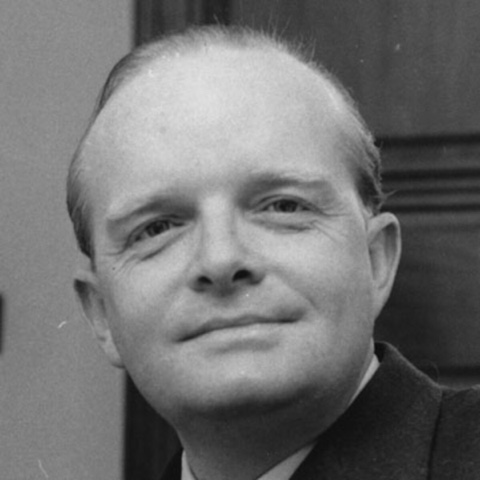
When I started posting these entries as a public journal to my blog, Truman Capote’s name came up thanks to his famous quip about Jack Kerouac. The comment takes various forms and may not have been directed at Kerouac but at the loose group of writers identified as Beat. Essentially, the various versions can be summed this way: “That’s not writing, it’s typing.”
It’s certainly a pithy remark, though I’m not sure it’s entirely fair. A writer’s style is personal, an extension of his personality. Ernest Hemingway’s terse, almost matter-of-fact syntax has been described as muscular and masculine. I’m not sure how a prose style can take on alleged gender qualities, but it does match his persona and the reticence of his characters. John Cheever writes with what can be called an urbane delivery, fitting his stories of upper class New York.
And Capote, in Breakfast at Tiffany’s and other novels, writes with a precision that reminds me most of Edith Wharton — each detail signaling something small to the reader, something perhaps imperceptible until the details accumulate. This approach serves his stories well, but slows them down, dampens the pace.
Kerouac’s style was all his own, as well, a kind of breathless lack of specificity that matched the manicness of his adventures — as if he had to rush to get it all down. This manic element reminds me most of Walt Whitman, whose long lines build from lists of nouns and accretions of prepositional phrases, something new at the time, lending a sense of bigness and inclusiveness to his poetry. Whitman read aloud becomes a race against breath, a sometimes futile effort to get each line and all of its information out in a single breath.
Kerouac’s manic episodes function the same way, though not syntactically. He builds this momentum through the use of open-ended adjectives and repetition — it’s all mad and gone and holy,  and if he stops to be more precise, well, he just might miss it. His approach to writing is similar to his attitude about jazz in that he views the act of getting everything down as being as important or even more important than the final product. And he views this act through a religious lens, as though the experiences and their recounting function as revelation. Mad. Holy. Angelic.
His depressive episodes have the same feel; they are descents into self-doubt that shift his focus — and some of his language — away from the ecstatic toward a similarly indefinite descriptive architecture that also has a religious feel.
“And for the moment,” he writes as a trip to San Francisco crashes on the rocks,
I had treacherous the point of ecstasy that I always wanted to reach, which was the complete step across chronological time into timeless shadows, and wonderment in the bleakness of the mortal realm, and the sensation of death kicking at my heels to move on, with a phantom digging it’s own heels, and myself hurrying to a void of uncreated emptiness, the potent and inconceivable radiancies shining in bright Mind Essence, innumerable lotus lands falling open in the magic mothswarm of heaven. (173)
One sentence rushing forward, no, falling into an abyss. This sounds heavier than it is, but it does give a glimpse into a mind struggling in the darkness. He tingles with bliss, as he considers the stability of what he calls “the intrinsic Mind” that created the space in which “birth and death took place.” Sal says he’d “died and had been reborn numberless times,” couldn’t remember the transitions between. They’re “so ghostly easy, a magical action for naught” — because it doesn’t matter. It’s out of our hands.
I though I ways going to die the very next moment. But I didn’t die, and walked four miles and picked up ten long butts and took them back to Marylou’s hotel room and poured their tobacco in my old pipe and lit up. I was too young to know what had happened.
And he gets lost in the food smells of the city, receding deeper into himself. It is not quite stream of consciousness, but it is crafted to have that feel. And that’s why I think Capote was not being fair. Style, in this case, matches the substance, the improvisational feel matches the argument Sal is making, matches his sense that he lives in the moment, matches the energy of the protagonists.
I’m not arguing that Sal/Kerouac’s pseudo-religiosity/philosophizing is complex or particularly well thought out. It’s a mashup of elements of his Catholicism and the Buddhism he had been dabbling in; but he’s not really getting below the surface.
That doesn’t matter. It’s the energy that matters — especially to the 20-year-olds who have long been this book’s primary audience.