I really can’t add much to this column by Dan Froomkin in The Washington Post today.
South Brunswick Post, The Cranbury Press
The Blog of South Brunswick

I really can’t add much to this column by Dan Froomkin in The Washington Post today.
South Brunswick Post, The Cranbury Press
The Blog of South Brunswick
John Barr, in an essay in the current edition of Poetry, pretty much sums up my own feelings about the insular nature of the “poetry industry” in the United States and the pathetic navel gazing of too many lyric poets.
South Brunswick Post, The Cranbury Press
The Blog of South Brunswick
I can’t believe it’s been 20 years since I wrote this poem for my grandfather, who is dead now almost 30 years. But I thought it would serve well as my thoughts on Labor Day:
WINDOW WASHER
for my grandfatherNew York 1924, a man looks with fresh eyes at the city; boundless opportunity awaits. “In America, a man can be President,” he says. But he sees the throngs of the faceless, the stampede of eyes in the street and feels lost. Alien streets and strange faces — “In America, a man can be president,” he says.
He is perched precariously from the dead face of a New York high-rise. He squeegees the glass and with a dirty rag wipes it down. He stares into the window, sees his reflection — “A good job, yes?”
Grandma is home, TV on, tuned to Dragnet and Adam 12, the dour scent of cabbage boiling, a glass of tea, a cigarette — “I remember I remember,” she’d say, and tell me stories my mother said were never true.
His belt, the one he used to hang above the city, sits before me. I can see where it was splashed by ammonia and grime and where it soaked in his sweat. I remember his arms, lean and muscular, the creases at the corner of his mouth, his heavy lids.
“In America, a man can be president,” Grandpa tells me, the faint smell of Ballantine Ale on his breath. “he can be anything he wants.” I am sitting on his lap. “You go to school and learn. Learning is good.” I nod, I am only five. “You be president.” He smiles and watches the wrestlers on the tube.
Sour candy Grandma hands me, gives me paper, a pencil, and watches as I draw — cars and cats and men with guns. She sips her tea and smiles as if she’s someplace else.
His clean shaven face stares at me from the sepia tones of his wedding photo; Grandma too has half a smile. My family, one-half my gene-pool, they stare solemn, black suits and ashen eyes. . . . Years later, I find my grandmother searching lost streets looking for him. “Grandma, come home please.” She eyes me, “Harry? Harry?” “No grandma, he’s been dead a long time. Please come home.” And I guide her home and set her to bed sobbing, “Harry Harry Harry. . . . .”
South Brunswick Post, The Cranbury Press
The Blog of South Brunswick
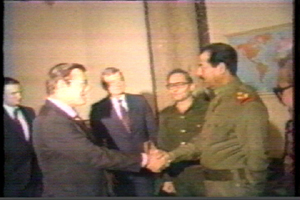
It’s hard to imagine a more hypocritical attack than the one leveled by Defense Secretary Donald Rumsfeld against opponents of the Iraq War. Comparing them to Neville Chamberlain by calling them appeasers, the defense secretary is hoping to smash dissent.
Frank Rich — as he often does — offers the best rejoinder to this:
Here’s how brazen Mr. Rumsfeld was when he invoked Hitler’s appeasers to score his cheap points: Since Hitler was photographed warmly shaking Neville Chamberlain’s hand at Munich in 1938, the only image that comes close to matching it in epochal obsequiousness is the December 1983 photograph of Mr. Rumsfeld himself in Baghdad, warmly shaking the hand of Saddam Hussein in full fascist regalia. Is the defense secretary so self-deluded that he thought no one would remember a picture so easily Googled on the Web? Or worse, is he just too shameless to care?
Mr. Rumsfeld didn’t go to Baghdad in 1983 to tour the museum. Then a private citizen, he had been dispatched as an emissary by the Reagan administration, which sought to align itself with Iraq in the Iran-Iraq war. Saddam was already a notorious thug. Well before Mr. Rumsfeld’s trip, Amnesty International had reported the dictator’s use of torture — “beating, burning, sexual abuse and the infliction of electric shocks” — on hundreds of political prisoners. Dozens more had been summarily executed or had “disappeared.” American intelligence agencies knew that Saddam had used chemical weapons to gas both Iraqi Kurds and Iranians.
According to declassified State Department memos detailing Mr. Rumsfeld’s Baghdad meetings, the American visitor never raised the subject of these crimes with his host. (Mr. Rumsfeld has since claimed otherwise, but that is not supported by the documents, which can be viewed online at George Washington University’s National Security Archive.) Within a year of his visit, the American mission was accomplished: Iraq and the United States resumed diplomatic relations for the first time since Iraq had severed them in 1967 in protest of American backing of Israel in the Six-Day War.
I don’t want to read too much into this, aside from pointing out that both parties have been prone to getting into the dirt with dictators and tyrants. Iran was the chief bogeyman back then, which explains the photo, but then the secretary and his minions (and the president) want us to forget our willingness to make nice with the bad boys and to believe that we only ever take the side of the angels.
South Brunswick Post, The Cranbury Press
The Blog of South Brunswick
The problem with government in New Jersey is manifold. On the one hand, there is too much of it; but on the other, there are too many areas that are undermanned and have not been able to keep up with growth.
The plight of the state Department of Environmental Protection is an example of how state government has failed New Jersey’s citizens. As The Record of Bergen County points out:
Staff cuts during the Whitman administration weakened the DEP’s enforcement power, critics say. Despite hopes that the McGreevey administration would change course, environmental activists complain that staffing levels remained consistent.
The agency has just 175 caseworkers to oversee 16,000 contaminated sites.
Bradley M. Campbell, the DEP commissioner from 2002 to 2005, said he tried to make the agency run effectively without using understaffing as an excuse. But he said the staff was so overwhelmed that it was impossible to even pinpoint the number of contaminated sites and accurately chart the agency’s progress in dealing with them.
“The fact is that there was a hodgepodge of hazardous site lists, a jumble of information that made it impossible to get hold of what was out there,” Campbell said.
“Many of the problems have existed for decades,” he said. “Overhauling is not going to take overnight.”
In a recent embarrassment, it was discovered that the DEP had removed more than 1,800 sites — including 300 in North Jersey — from their list of contaminated sites last year because the properties had no case managers. The sites left out included the old Kingsland Landfill in Lyndhurst, which harbors a stew of industrial and household waste, a toxic goop that accumulated during a half-century of unregulated dumping.
At the same time, there is an abundance of unnecessary employees elsewhere. The Star-Ledger, in a telling editorial, offers some numbers:
From 1990 to 2000, government employment nationally grew 13 percent but only 2 percent in New Jersey. From 2000 to 2005, however, government payrolls across the country rose by 4.9 percent but 9 percent in New Jersey, with no corresponding population increase to justify the jump.
From December 2000 until now, New Jersey’s private sector lost about 3,000 jobs, but government added 53,000, each with generous health benefits and pensions.
In the first quarter of this year, 25,000 public-sector jobs were created throughout the nation. Since New Jersey ac counts for 3 percent of the national work force, it should have added 750 government jobs. Instead, it put 4,800 more people on the public payroll.
A review of the data leads to an unavoidable conclusion: Any significant, sustained property tax relief is contingent on shrinking government.
But it is not likely to be as easy as it might sound. Gov. Whitman slashed government spending and in the process gutted the DEP, but that approach has come back to haunt the state as several high-profile contamination cases in North Jersey show. The McGreevey administration, on the other hand, was a bastion of patronage and unnecessary government growth — boosting the state’s payroll without improving its provision of services.
Both approaches were failures and now the state is facing a fiscal implosion that, because of the competing layers of government, inefficiencies and the state’s culture of legal corruption could lead to a property tax revolt.
The real answer is to work smarter, to eliminate patronage and double-dipping while consolidating and reconfiguring local and county governments to ensure that there are enough local police and teachers, but not an overabundance of administrative positions.
Taxpayers want property taxes lowered, but not if it means boosting other taxes. Basically, they want better and more efficient government.
South Brunswick Post, The Cranbury Press
The Blog of South Brunswick
 Hank Kalet