
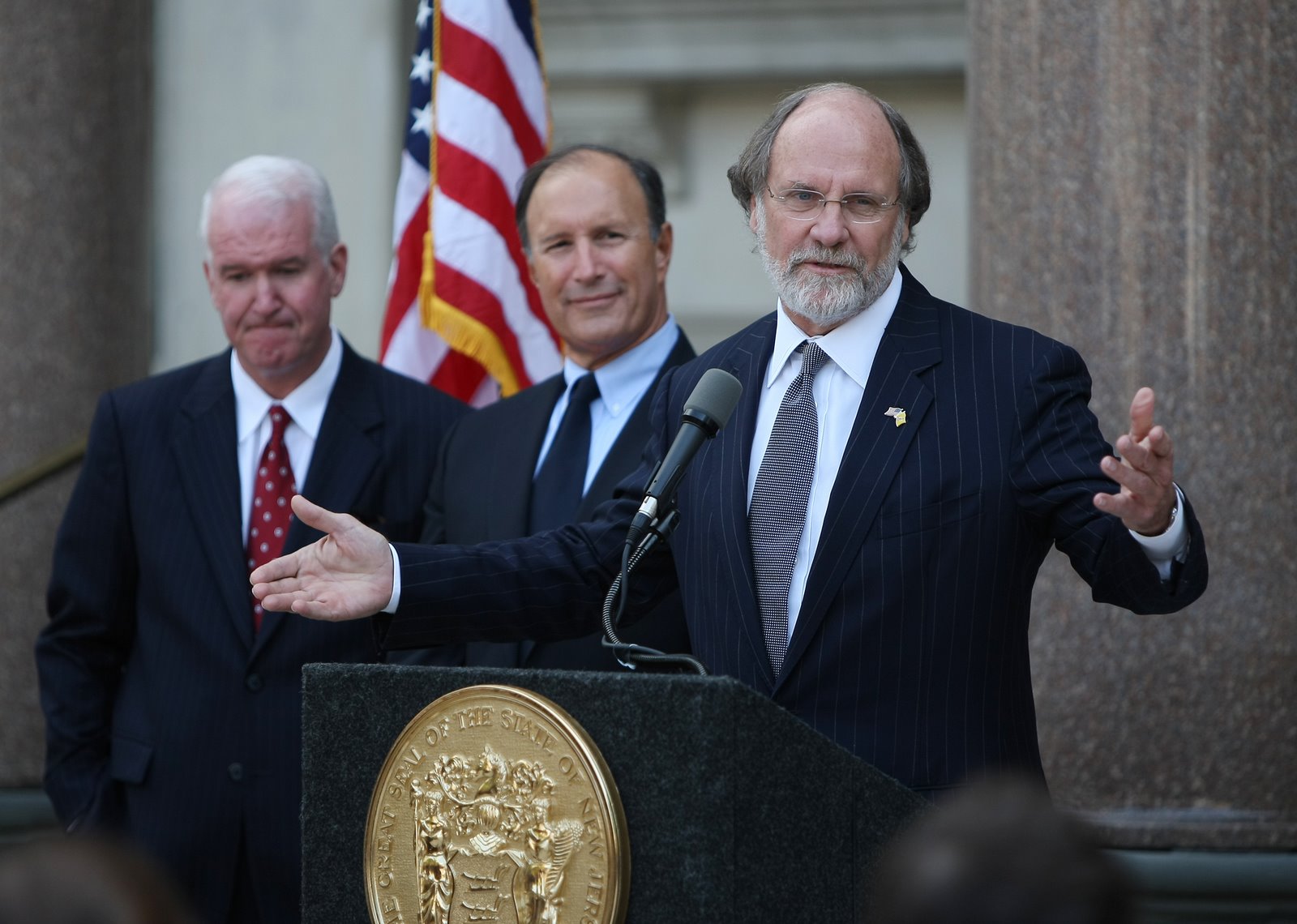
Corzine’s cleanup plan


I wrote the other day about Gov. Corzine’s new ethics reform package, which includes rather strict bans on pay-to-play and wheeling (the practice of passing campaign contributions from committee to committee). I just finished a telephone press conference with the governor during which he outlined his plans and offered a sense of how important he views these reforms:

There is a need for greater transparency and public accountability in government, he said, and it is important that new rules be put in place to give the state’s residents confidence that elected and appointed officials are working in the public’s interest.

“We’re trying to, through ethics reform, deal with financial responsibility to make sure we are not spending money we don’t have to be spending,” he said. “And we are taking actions that would give people greater sense that the mix of money in politics is not determining the direction of public policy.”

The governor is using a two-pronged attack — enacting some reforms by executive order and pushing a number through the legislative process. In the end, he is hoping for comprehensive controls on pay-to-play that will be in force at all levels of New Jersey government.

Prior to the governor’s Sept. 24 executive order, only state contracts were covered under state rules (towns like Monroe and South Brunswick have their own pay-to-play restrictions in place). Businesses or their principles — those owning at least 10 percent of the business — were ineligible for public contracts worth at least $17,500 if they made reportable campaign contributions (more than $300) to a candidate committee and/or election fund of any gubernatorial candidate, or to any state or county political party committee within the previous 18 months.

In addition to the earlier rules, enacted by executive order under Gov. Jim McGreevey, Corzine has placed restrictions on contributions to local candidates and local party committees for firms seeking state contracts. He also removed the 10 percent requirement, meaning that all partners, no matter how small a stake they may have in a company, are now on the restricted list.

The governor said he would like to see a more comprehensive ban on pay-to-play at the local level, and he is encouraging the Legislature as part of his reform package to cover local contracting, as well.

He said “there are a number of municipalities that have been proactive in moving forward on (pay-to-play bans), but it is very uneven across the state.”

“I think there are only 60 of the 566 municipalities in New Jersey that have taken up these rules,” he said. “We’re asking for uniformnity on that so that the public can have the confidence that money in political contributions does not determine where contracts go.”

At the same time, he does not want state law to pre-empt stronger local laws, but “set a floor for every municipality.”

The wheeling ban may be more significant, because it should limit the ability of individual legislators or county freeholders to act as power brokers outside of their geographical regions.

“We want money raised in Bergen to stay in Bergen and money raised at the local level to stay at the local level — within limits,” he said.

On a related note, I asked him about the recent decision regarding Arizona’s clean elections law, in which its rescue money provision was deemed unconstitutional, a decision that has tabled the New Jersey clean elections experiment for the time being. The Arizona decision was based on a New York ruling over the summer that found unconstitutional a provision of federal rules altering contribution limits when candidates face self-funded opponents.

He says he remains committed to clean elections. He would “like to continue to expand its operation in the state” and was “disappointed in (the courts) its most recent negative interpretation” of the law.

“I am hearing legal advice that there has been an overreading of how much (the earlier New York decision) it affects clean elections,” he said.

“The more we can move in that direction, the better we can be served by reducing the role of political contributions as the basis on which candidates are chosen and elections are decided,” he said.

Thinking local as a way to survive

Amboy National Bank is building a new branch here in South Brunswick at a time when the American financial system is in turmoil.

Amboy’s success — like that of Magyar, First Constitution other local banks — stands in stark contrast to the bigger banks, but also demonstrates that lending institutions that avoid overreach also avoid over taxing their resources will not only survive or thrive.

System failures

Yippee. They did it. Congressional leaders from both parties and members of the Bush administration have agreed on a plan to bailout the financial system.

The plan, according to President George W. Bush, is “bold” and designed to “make clear that the United States is serious about restoring stability and confidence in our system.”

At $700 billion, it better be.

While the plan (a synopsis from The New York Times is pictured at the right) addresses some of the basic concerns raised by both conservatives and liberals, it essentially remains a dangerous gambit. In propping up the financial system, the federal government is hoping to ensure that credit continues to flow and that the economy will avoid a meltdown.

At the same time, however, it “looks like another of those shell games that Wall Street has honed to a fine art,” as Joseph Stiglitz points out.

Wall Street has always made money by slicing, dicing and recombining risk. This “cure” is another one of these rearrangements: somehow, by stripping out the bad assets from the banks and paying fair market value for them, the value of the banks will soar.

Just as importantly, he says, the bailout is just another in a long line of rewards for the bad behavior exhibited by corporate America. Wall Street is celebrating the plan, he says, because

the banks realized that they were about to get a free ride at taxpayers’
expense. No private firm was willing to buy these toxic mortgages at what the
seller thought was a reasonable price; they finally had found a sucker who would
take them off their hands–called the American taxpayer.

And while there are strings — limits on CEO compensation — it leaves homeowners who are facing foreclosure at the mercy of mortgage holders who sold them on dangerous mortgages and does nothing to address the basic reasons we are in this mess in the first place.

There are four fundamental problems with our financial system, and the Paulson proposal addresses only one. The first is that the financial institutions have all these toxic products–which they created–and since no one trusts anyone about their value, no one is willing to lend to anyone else. The Paulson approach solves this by passing the risk to us, the taxpayer–and for no return. The second problem is that there is a big and increasing hole in bank balance sheets–banks lent money to people beyond their ability to repay–and no financial alchemy will fix that. If, as Paulson claims, banks get paid fairly for their lousy mortgages and the complex products in which they are embedded, the hole in their balance sheet will remain. What is needed is a transparent equity injection, not the non-transparent ruse that the administration is proposing.

The third problem is that our economy has been supercharged by a housing bubble which has now burst. The best experts believe that prices still have a way to fall before the return to normal, and that means there will be more foreclosures. No amount of talking up the market is going to change that. The hidden agenda here may be taking large amounts of real estate off the market–and letting it deteriorate at taxpayers’ expense.

The fourth problem is a lack of trust, a credibility gap. Regrettably, the way the entire financial crisis has been handled has only made that gap larger.

Stiglitz says “There are alternatives.”

Warren Buffet showed the way, in providing equity to Goldman Sachs. The Scandinavian countries showed the way, almost two decades ago. By issuing preferred shares with warrants (options), one reduces the public’s downside risk and insures that they participate in some of the upside potential. This approach is not only proven, it provides both incentives and wherewithal to resume lending. It furthermore avoids the hopeless task of trying to value millions of complex mortgages and even more complex products in which they are embedded, and it deals with the “lemons” problem–the government getting stuck with the worst or most overpriced assets.

Finally, we need to impose a special financial sector tax to pay for the bailouts conducted so far. We also need to create a reserve fund so that poor taxpayers won’t have to be called upon again to finance Wall Street’s foolishness.

Or the government’s. It is important to remind Americans that the problem on Wall Street was not regulation, The New York Times writes, but a 30-plus-year assault on the regulatory system by conservatives.

This year’s serial bailouts are proof of a colossal regulatory failure. But it is not “the system” that failed, as President Bush, Treasury Secretary Henry Paulson and others who are complicit in the calamity would like Americans to believe. People failed.

For decades now, antiregulation disciples of the Reagan Revolution have eliminated vital laws, blocked the enactment of much-needed new regulations, or simply refused to exercise their legal authority.

The Times admits that there is a need to modernize regulations, that the “system has gaps.” However, the paper adds,

the failures that have landed us in the mess we are in today are not mainly structural. To assert that they are masks deeper failings and sets false terms for the upcoming debate on regulatory reform.

There has been a failure to engage the issue, the paper says, one based on the notion that the market is always right. This allowed the folks on Wall Street and in the banking industry to create an array of unregulated financial gimmicks and engage in some truly unsavory lending practices — the pyramids that I mention in my column from Thursday.

Conservatives want to blame lower-income folks for believing the hype sold them by the banks, for taking out mortgages they could not afford even though they were being told by the industry that they could. The regulatory structure — firmly in the hands of conservatives who “simply refused to exercise their legal authority,” as the Times says — failed to protect the people taking out these mortgages and the taxpayers who are now being asked to clean up the mess.

Add to this the “systematic dismantling of laws that called for regulation” and it is clear that the zealous antiregulation/deregulation approach that, during the Bush years, “found full expression, fueled by an ideology that markets know best, government hampers markets, and problems will magically fix themselves,” is just plain wrong.

Reregulation of the banking and financial sectors must be a priority. That this plan does nothing to enhance the regulatory framework is more than unfortunate. It may be another in a long line of missed opportunities that helped get us to where we are in the first place.

Quote of the day: Thanking Bush

I know readers of this blog will be surprised by the title of this blog, but the quotation from a piece by Jacob Heilbrunn in Sunday’s Week In Review section of The New York Times on President George W. Bush’s impact on the conservative movement should explain:

“Bush was never a conservative. He’s the guy responsible for blowing up the movement.”

— Michael D. Tanner
senior fellow at the Cato Institute
author of “Leviathan on the Right,”

Water, water everywhere

Crazy storm. I just eceived a call from a friend who reports the Route 1 at Dow Jones is closed because the DJ pond has overflowed across the highway.

New Road at Pyne also is closed because of flooding.

Anyone else have any road closings in South Brunswick, Cranbury, Jamesburg or Monroe to add to the list?

———-
Sent from my Verizon Wireless LGVX9900 device.