
Auto bailout plan as anti-union cudgel

We have an auto bailout. The broad outlines:

The plan pumps $13.4 billion by mid-January into the companies from the fund that Congress authorized to rescue the financial industry. But the two companies have until March 31 to produce a plan for long-term profitability, including concessions from unions, creditors, suppliers and dealers.

The bailout plan sets “targets” rather than concrete requirements about what those concessions may be, meaning that Mr. Obama and his advisers have enormous latitude to decide how to define long-term viability.

It includes, of course, a little gift from the anti-labor Bush administration to the UAW:

Already, Ron Gettelfinger, the president of the United Automobile Workers union, said he was “pleased” that the administration acted on the loan requests, but said the President added “unfair conditions” that singled out blue-collar workers.

Mr. Gettelfinger said the union expects to appeal to Mr. Obama to alter the expectations for wage and benefit cuts. According to Treasury Department officials who drafted the wording, Mr. Obama would be free to change the requirements and loosen the standards, especially on how much workers will have to give up.

Empty Wheel offers this:

The President of the United States just dictated that American corporations pay their employees significantly less than the employees of foreign owned manufacturers. And/or, he dictated that American corporations pick the pocket of their senior retirees.

The union wage target, Empty Wheel adds, is part of an effort to break the union and require that “employees of American-owned companies make significantly less than the employees of Japanese-owned companies.”

Bush is demanding is that the UAW lower wages plus pensions to the level of Japanese wages plus pension (though since they have very few retirees, their pension number is basically zero). Alternately, they could lower this number by basically picking the pocket of a bunch of seniors, by taking away pension money those seniors already earned while they were still working. But one or the other will have to happen.

“In other words,” dday at Hullabaloo writes, the plan creates a race to the bottom because

the UAW must take wages and work rules that are the same as non-union plants, and since “wages” include benefits and legacy costs, and the Big 3 have quite a bit more of those than their Japanese counterparts, this would depress wages FAR BELOW non-union plants.

It’s a pretty bald move by an outgoing president who had told Congress that he had supported its earlier bailout plan, which did not include the union clause.
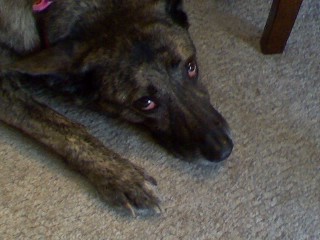
Dogs on the mind

Sometimes, you can't fight off the sadness.

I'm at the Tiger's Tale in Montgomery for a holiday get-together and I find myself talking with my friend Charles about dogs — about our plan to adopt a pup (or two) in January, and the dogs we lost.

The conversation reminds me just how much I still miss my dog Honey, and how much after so many years our big hairy mutt, Benny, remains a presence.

Dogs dig in and take over the heart.

This message was sent using the Picture and Video Messaging service from Verizon Wireless!

To learn how you can snap pictures and capture videos with your wireless phone visit www.verizonwireless.com/picture.

To play video messages sent to email, QuickTime� 6.5 or higher is required. Visit www.apple.com/quicktime/download to download the free player or upgrade your existing QuickTime� Player. Note: During the download process when asked to choose an installation type (Minimum, Recommended or Custom), select Minimum for faster download.

Let’s hope Lawrence makes the leap

Lawrence may — just may — take a rather historic leap into public financing of local elections.

The proposal, which has been kicking around for about two years, now has the support of a sharply divide local panel charged with studying public financing.

The panel found that

7,000 of the township’s 19,000 registered voters belong to the Democratic or Republican parties. The nominees for the Township Council are chosen from the ranks of registered Democrats and Republicans, generally without primary election challenges.

“It would be desirable to broaden the choice of nominees, but without party support, the raising of campaign funds is difficult,” the report said. “If public funds were available, it might broaden interest in running for office, and the candidates would not be beholden to a political party or private donors.”

An analysis of the 2007 Township Council election revealed the six candidates spent $56,425, which amounts to $1.47 per household per year, the report said. There are 12,554 properties in Lawrence that are assessed for tax purposes.

“This is certainly within reason and without significant effect on the township budget, even in these recessionary times,” the report said. “It may be beneficial when political contributors no longer have to buy ‘no-bid’ contracts with their contributions. Competitive bidding may well save more than public financing of the election costs.”

The report also found that the four states with so-called clean elections laws, “the majority of candidates participated.”

“We conclude that public funding has shown itself to be feasible and beneficial in other places. It is affordable in the township, and the voters should be given the opportunity to act on it,” the report concluded.

Will they? Hard to say. The eight-member committee was split on the issue and it is now up to the Township Council. I’m hoping they endorse the idea and let Lawrence lead the way on reform.