Religion in the public eye

The intersection of faith and public morality too often is derided or, at the very least, cast on the shoals of the church-state debate.

Let me say, first off, that the wall Jefferson wrote separating religion from government is one of the most important constructions devised by the founders. It protects religious minorities amd the irreligious from the majority and the state and, avoid unnecessary and dangerous entanglements, while creating space for religion to grow and prosper.

That is why the religious culture of the United States is healthier and more diverse than in most European nations. There is no war on religion, despite what Bill O’Reilly and his neandethal brethren say, (I would argue, in fact, that if anyone is doing harm to religion in the United States, it is folks like O’Reilly and the American Taliban).

The Constitution prohibits government involvement or endorsement — which I read to include religious holiday displays on government properties — but not public involvlement. Churches and synagogues and mosques and all other religious groups are free to display their symbols publicly — as the Chabad does in South Brunswick, with its massive menorah on its Route 130 property.

More importantly, religious congregations, clergy and parishioners are free to engage in the political debates of the day (though specific churches and denominations cannot endorse because of their status as nonprofit entities).

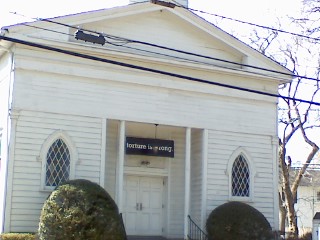
Religion, as the banner hanging from the Witherspoon Street Presbyterian Church in Princeton makes clear, has a lot to say about the issues of the day. In this case, the “Torture is wrong” is proclaimed.

There is the clergy component of the battle against poverty in the state, the clergy letter condemning the death penalty, the Catholic Church’s “Just War” theory, the civil rights movement and so on. We don’t need to agree with every decree — the Catholic Church is wrong on homosexuality and abortion is a private matter best left to individual women to wrestle with — but we should acknowledge the role religion can play in the debate.

I write this not in response to any specific news event, but because I saw the banner on the church as I walked from by office to a downtown deli. It hit me that, while there are people like Christopher Hitchens who see the religious as superstitious nits, the reality is that the mass of believers out there is a rather complex and diverse lot that reflects who we are in all of our imperfections.

What makes our democracy work is the cacophony of voices, secular and religious, liberal and conservative, and the miraculous music it can make when each voice is willing to make room for the other.

Where do these guys come off? Lies, damn lies and the war in Iraq

.msnbcLinks {font-size:11px; font-family:Arial, Helvetica, sans-serif; color: #999; margin-top: 5px; background: transparent; text-align: center; width: 375px;} .msnbcLinks a {text-decoration:none !important; border-bottom: 1px dotted #999 !important; font-weight:normal !important; height: 13px;} .msnbcLinks a:link, .msnbcLinks a:visited {color: #5799db !important;} .msnbcLinks a:hover, .msnbcLinks a:active {color:#CC0000 !important;}

I’m not a big fan of Chris Matthews. While I think some of the criticism he takes is overblown — he didn’t support the war in Iraq, for instance — he does tend to be a blowhard who is overly concerned with the game of politics and not the policy.

That said, I was lying in bed last night unable to sleep and uninterested in the overnight sitcoms, so I tuned him in just in time to catch his slapdown of Ari Fleischer and the bizarre exchange between Mother Jones’ David Corn (a great journalist) and Frank Gaffney.

Gaffney, a former defense department official, still lives in the neocon fantasy land and apparently believes that facts are pesky little things that are no different than opinions. His argument — and he made it loud and continuously, rarely leaving more than a second of dead air into which Corn could jump — was essentially that the intelligence supported George W. Bush’s decision to invade Iraq, even though it didn’t. It was strange to see him make his case — and Fleischer making his case — for war six years on and well after the public has turned away from the various lies and half-truths pushed to get things started.

I think that any television executive watching last night who still considers Gaffney a useful guest should find another line of work.

‘Wham’-boozled (Plus a podcast)

CJ Radio podcast on the budget can be heard here.

We had a few friends over tonight and the talk turned to the Corzine budget and the NJ101.5 “analysis” — which comes straight from the Republican talking points — of a so-called “double-whammy” that is supposed to cost middle-class taxpayers oodles of cash.

The double-whammy — the loss of property tax rebates for families making more than $75,000 and the one-year elimination of the property tax deduction — is not something that will be easy to swallow. But it’s not the apocalyptic policy that the Republicans are making it out to be.

Consider these statements from Assembly Republicans. Assemblyman Peter Biondi, who represents Hillsborough, Manville and Montgomery, said the budget would “drive more people out of our state.”

Republicans warned that families should hold onto their pocketbooks, and we weren’t surprised by his plan. The average family would lose approximately $1000 by this budget, not counting the impact of reduced municipal aid.

Monmouth County Assemblyman Declan O’Scanlon was equally extreme:

“Property taxpayers, who yesterday heard that their property tax bills will skyrocket with cuts to municipal aid, loss of the tax deduction and elimination of rebates, have learned all too well that while the governor speaks, his tax men creep.”

And then there was Alex DeCroce, the Assembly Republican leader:

“For New Jersey taxpayers who are already saddled with the highest property taxes in the nation and are in danger of losing their homes and jobs during the worst recession in generations, Corzine’s budget is the equivalent of a knockout punch. I don’t consider anyone who would do this to families struggling trying to survive a friend of the middle class.”

Now, $1,000 is a lot of cash, but the question is whether it is enough of a hit to recreate the anti-Democrat backlash of the Florio era — especially given that most people have come to understand how bad off the state is fiscally.

That said, as Charles Stile points out in today’s Record, the chances “the Double Whammy will spark the middle-class revolt … or deliver a deadly a political blow” appear somewhat slim:

For one thing, Corzine’s rebate plan is not an across-the-board cut. It would affect about 500,000 tax filers, or 20 percent fewer than in 2008, officials said.

The program has been narrowed over the years, he says, with most of the upper-income voters having lost their rebates a long time ago. At the same time, the plan “preserves rebates for sacrosanct senior voters and his lower-middle-class Democratic base.”

The second part of the whammy — scrapping a provision that lets homeowners write off the first $10,000 of their property taxes — is also not as politically treacherous as it sounds.

Officials said Wednesday that it could cost taxpayers, on average, $219. But tax filers can still take the deduction this year on their 2008 tax returns. That means the loss of the deduction won’t be felt until they or their accountants fill out their taxes in spring 2010, which in Trenton’s political terms, is an eternity.

Does this make the plan a good one or the best one under bad circumstances? It’s too early to tell. Let the debates begin.