
Dispatches is up — a revised version of my post on affordable housing.
Author: hankkalet
Hank Kalet is a poet and freelance journalist. He is the economic needs reporter for NJ Spotlight, teaches journalism at Rutgers University and writing at Middlesex County College and Brookdale Community College. He writes a semi-monthly column for the Progressive Populist. He is a lifelong fan of the New York Mets and New York Knicks, drinks too much coffee and attends as many Bruce Springsteen concerts as his meager finances will allow. He lives in South Brunswick with his wife Annie.
Runner’s diary, Tuesday
Once again, I’m back at square one in my running. It’s been almost two weeks off the road (or the treadmill), and I could feel the lack of work in my legs and chest. I did manage three miles — listening to Bob Dylan’s latest.
It has to get better, right?
The hinge question
Affordable housing is inherently beneficial.
That’s the upshot of today’s state appellate court ruling in Burlington County, which ruled in favor of a nonprofit group that was seeking to build a multi-unit development in an area of
Eastampton Township zoned for single-family housing.
The township Planning Board had denied a use-variance application from Homes of Hope to build two buildings containing eight affordable units on a less-then-an-acre parcel that already contained a four-unit brick building. The board had determined that, because the township had met its state-mandated affordable housing obligation — it had built 100, when 79 were required — affordable housing did not qualify as an “inherently beneficial use” under state law.
That meant that Homes of Hope was required to meet a more stringent standard to win approval from the board.
The Superior Court in Burlington County ruled last year in favor of Homes of Hope, saying that the the original Mount Laurel decision and the state’s Fair Housing Law, which created the state Council on Affordable Housing and the state-mandate, did not intend for “for each municipality to meet only the needs of the homeless within strict boundaries of each town.” The affordable housing program, the court said, was a statewide mandate and the individual obligations were just the mechanism used to meet the overall need.
The appellate panel endorsed the lower court’s finding, saying that meeting COAH’s requirements “does not impact affordable housing’s inherently beneficial use status.”
Affordable housing continues to foster the general welfare and constitutes a special reason to support a use variance.”
There are those who would disagree, especially in suburban communities around the state, where the ongoing need for lower-cost housing is viewed as an imposition bringing school children and the higher taxes necessary to support them.
William Dressel, executive director of the state League of Municipalities, told The Star-Ledger today that the ruling “brings to question what is the real meaning and purpose of the Fair Housing Act.”
He’s correct, but not because it penalizes towns that have played by the rules.
The court, in calling affordable housing a state obligation, alluded to the central issue facing the state: the arbitrary geographical divisions that govern taxing decisions, land-use planning and nearly every other issue that comes up.
Land-use planning, in particular, suffers from our inability to step beyind these boundaries as decisions get made based on immediate tax implications and not on regional need. Cranbury, for instance, builds warehousing near N.J. Turnpike Exit 8A and along Route 130 because it has open land and a desire to bring in what generally are called “clean ratables,” or taxable properties that do not generate school children and require few municipal services. At the same time, it has sought over the years to minimize the number of residential units built in town.
This, under current rules, is good planning; it keeps local taxes manageable.
The problem, however, is that it does little to address the state’s need for affordable housing, its segregated housing patterns or school-spending disparities.
That’s why the courts ruled that affordable housing should be considered an inherently beneficial use for planning purposes. It doesn’t mean that all affordable housing applications must be approved, the court said; it only means that towns must prove “substantial detriment to the public good.”
Weighing the criteria in this way makes “it more difficult for municipalities to exclude inherently beneficial uses,” but allows for exclusion where the detriment outweighs the benefit to the public good.
Given the current state of the law, unfortunately, it is virtually guaranteed that we will see these law suits occur over and over and over again.
State Sen. Christopher Bateman, R-Somerset, told The Star-Ledger that he planned to seek changes in the law that would protect towns from lawsuits over zoning applications involving affordable housing if they’ve met their state obligation.
“The Corzine administration promised that if towns didn’t pursue commercial development and met the quotas set down by the Council on Affordable Housing, they would be protected,” he said.
But that does little more than treat the symptom. The issue, as it always seems to be in New Jersey, is the number of competing jurisdictions, each with its own goals and needs and problems and each allowed to operate without regard for its neighbors.
A new paradigm is needed — fewer towns and better regional planning that focuses on need and not taxes — but the chances of that happening appear slim.
LBJ lead the way
Lyndon Johnson had his faults — arrogance, for instance — and he misread Vietnam. But he committed himself to the war on poverty and civil rights and got a slew of legislation passed that seemed unlikely before he began his push.
On the other hand, Barack Obama has managed so far to take something that seemed popular in the abstract — healthcare reform — and let the folks in Congress squeeze it until the last drop of toothpaste was washing down the sink, wiping away much of his public support on the issue in the process.
He could learn a thing or two from LBJ — so, please Mr. President, read this piece from The Daily Beast.
A mad-cap season
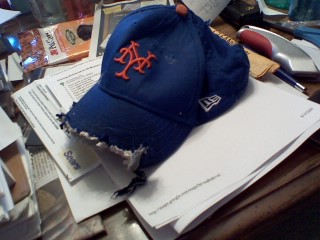
This picture — my nephew Dan's cap altered by Rosie and Sophie — kind of sums up the 2009 Mets, I think. Alas…. There's always next year (and a new hat).
This message has been sent using the picture and Video service from Verizon Wireless!
To learn how you can snap pictures and capture videos with your wireless phone visit www.verizonwireless.com/picture.
Note: To play video messages sent to email, Quicktime@ 6.5 or higher is required.

