
A sudden appearance of spine

Congressional Democrats are finally digging in their heels, for the most part — though it appears that the sudden appearance of a spine probably comes too late.

House Speaker Nancy Pelosi announced today that the healthcare bill as it currently stands is essentially dead, thanks to Scott Brown’s win in Massachussets on Tuesday and the realization on the part of House Democrats that the Senate bill contained far too many negatives to be considered a positive.

Pelosi (D-Calif.) has been struggling for days to sell the Senate legislation to reluctant Democrats in order to get a health-care bill to the president’s desk quickly. But House liberals strongly dislike the Senate version, while moderate Democrats in both the House and Senate have raised doubts about forging ahead with the ambitious legislation without bipartisan support.

The only way to keep the Senate bill alive, Pelosi said, would be for senators to initiate a package of fixes that would address House concerns about the bill. In particular, Pelosi described her members as vehemently opposed to a provision that benefits only Nebraska’s Medicaid system. Also problematic are the level of federal subsidies the Senate would offer to uninsured individuals and its new excise tax on high-value policies, which could hit union households.

“There are certain things the members simply cannot support,” Pelosi said.

The health bill has been flawed from the beginning, as I’ve pointed out on more than one occasion. The administration allowed the process to get away from it, leaving it in the hands of people like Max Baucus and others who have proven they owe their allegiance more to the health-insurance industry than to patients. The result has been a gutting of what looked to be a rather moderate bill in the first place. Single-payer was removed from the table before the discussion started and the so-called public option soon followed. The writing of the bill was then handed over to the money folks, who turned it into a massive giveaway to the insurance companies (forcing everyone to buy insurance from private companies while using tax dollars to subsidize low-income coverage).

Brown won, as this post from Corrente points out, because he became the change candidate, running as a populist against a Democratic Party that — as David Sirota has been saying on his Colorado-based radio show (listen to the podcast) — no longer is the party of the people but the party of corporations.

That’s nothing new, of course. That’s why I voted for Nader in 1996 and (gasp!) 2000. I would have voted for him again in 2004, except that the prospect of another four years of George W. Bush scared the hell out of me.

And it will continue to be the corporate party unless voters make it clear that they will run them out of town for it. That’s what happened in Massachussets and what was facing Democrat Chris Dodd before he decided to retire. It is what won the nomination and then the election for Barack Obama and what could destroy his presidency unless he rediscovers his inner populist.

Send me an e-mail.

First Amendment v. corporate campaign finance corruption

This decision was not unexpected, but it will present dramatic challenges for those of us who believe that the political system is awash in cash. The 5-4 decision, which found that a film essentially attacking Hillary Clinton as a danger to the nation, was protected speech and that provisions of federal election law that prevented its release violated the First Amendment.

“If the First Amendment has any force,” Justice Anthony M. Kennedy wrote for the majority, which included the four members of its conservative wing, “it prohibits Congress from fining or jailing citizens, or associations of citizens, for simply engaging in political speech.”

The issue is a thorny one. Money has overrun the system and squeezed out the voices of regular folks, but the McCain-Feingold restrictions on issue ads always has struck me as an infringment on the rights of political groups to speak on political issues.

Consider the flip test on this one: A group like MoveOn or some other liberal organization creates a documentary on George W. Bush that essentially is commentary and plays like a newspaper editorial critical of the then-president. The group wants to release the film to theaters in September or October of 2004 so that it can affect the campaign debate.

Should it be allowed? And what restrictions should be imposed? That is the crux here.

Certainly, this kind of communication should be disclosed, but should it be banned? And is it the best way to starve the system of the cash that is corrupting it?

I remain a proponent of public financing, which I believe is the best way to control this. But I doubt we’ll be hearing anyone in Washington go down this path. Instead, look for the political classes to look for some other way, far less effective (or constitutional) way to address the issue.

Send me an e-mail.
Read poetry at The Subterranean.
Suburban Pastoral, a chapbook by Hank Kalet, available here.
Move left, young man

To build off my last post, I think it is important to counter what is going to be the dominant narrative in the next few days — that the Democrats are too liberal and are trying to do too much.

Basically, I just don’t buy it.

The reality of the last 12 months is that voters were promised significant change — even if that promise was never explicit in the kinds of programs then-candidate Barack Obama was offering voters. He talked about hope and change, of making big strides into the future, of returning America to its earlier glories — essentially mixing JFK and MLK into one, overarching narrative designed to plug into the nostalgic streak that drives conservative politics while also offering liberals a progressive idyll to which they could connect.

Liberals heard what they wanted, disaffected conservatives and independents waited and the president, once in power, turned out not to be FDR, Truman and LBJ, but a triangulating Clinton-type (without the sex-capades) without the benefit of the humming economy to keep everyone happy.

The problem is and will continue to be the economy and the Democrats have shown that they have few answers — or lack the will to aggressively rebuild, to do battle with the interests (banks and investment houses, insurers, the permanent military industry) who stand in the way of change.

As this post on Truthdig points out, the calls from the mainstream media, Republicans and the meak and moderate wing of the Democratic Party to say “Democrats need to move to the right” ignore one simple fact: The party has been heading right “ever since our community organizer in chief walked away from a public option, opened up the national checkbook for the banks and doubled our troop levels in Afghanistan.”

Democrats have failed to improve anything since Obama became president, instead offering the nation the spectacle of a handful of Democrats from small states holding the rest of the party hostage.

The Democrats, as I said earlier, deserved to lose this seat, one that had been held by the Liberal Lion, a progressive champion (despite his warts) who always championed the progressive cause. If they want to staunch the bleeding, they need to move to the left, need to embrace the kind of populist remedies — single-payer healthcare, aggressive bank regulation, an end to the wars in Afghanistan and Iraq.

They have to stop worrying about what the media has to say, stop worrying about strategizing for November and just stand for something.

A wake-up call

If the Democrats lose the Massachussets Senate seat, as it appears likely will happen, they will have only themselves to blame.

Forget the local aspects of this — the awful campaign run by the Democrat, the hypocritical way in which the party rewrote electoral law to fill the seat on a temporary basis — the fault for this loss lies in the party’s failure to energize its base not just in Massachussets, but around the country, to get a real health reform bill passed, to fight for a more robust stimulus or enact strict financial regulations to rein in the banks.

Basically, as David Sirota — among others — has pointed out, there needs to be a vibrant and aggressive push from the left to pull the Democrats leftward, but a mix of timid gamesmanship on the part of elected Democrats and an unhealthy willingness to become part of the establishment by groups like MoveOn and other Democratic-leaners has robbed progressives of much of their steam, much of their force.

So now, with the Democrats holding only 57 seats in the Senate — including a half dozen small-state conservative Dems — the illusion of unity and power has been broken. Now, the party has little reason to humor people like former Democrat and putative independent Joe Lieberman or even Democrats in Name Only Ben Nelson and Max Baucus.

If the Democrats are to salvage any part of their agenda, they are going to have to go on the offensive, the president is going to have to forgo the cautious incrementalism that has marred his first term and turn the bold rhetoric he used back in January 2009 into reality.

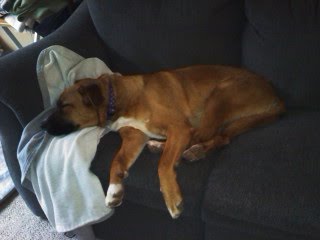
Doggy diaries: The story of Rosie and Sophie Living the dog’s life

I think this is how all of us should spnd every Sunday. Dogs really know how to live.

This message was sent using the Picture and Video Messaging service from Verizon Wireless!

To learn how you can snap pictures and capture videos with your wireless phone visit www.verizonwireless.com/picture.

Note: To play video messages sent to email, QuickTime� 6.5 or higher is required.