Convincing argument on climate

The deniers are wrong about climate change — it is happening and it’s happening more quickly and with more pwerfully than our political will can stand.

But the deniers — and big business — have enough traction on this to keep things stalled.

So we need a more effective argument to make sure we move ahead with efforts to control carbon emmission — such as this one offered by Robert Frank in his column in the Business section of Sunday’s issue of The New York Times:

WE don’t know how much hotter the planet will become by 2100. But the fact that we face “only” a 10 percent chance of a catastrophic 12-degree climb surely does not argue for inaction. It calls for immediate, decisive steps.

Most people would pay a substantial share of their wealth — much more, certainly, than the modest cost of a carbon tax — to avoid having someone pull the trigger on a gun pointed at their head with one bullet and nine empty chambers. Yet that’s the kind of risk that some people think we should take.

Conspicuous consumption, Part II

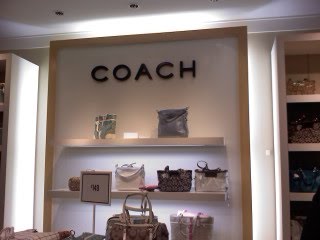
Seems my post on our little shopping trip to Jackson today to the Coach outlet was misconstrued as 1) criticism of Coach accessories or 2) of Annie. Neither was intended. Rather, what I found interesting was the obsessive quality to the trip — the long line to get into the store, with people waiting a half hour in the cold, and the women with four and five bags on their arms.

My criticism is of the way we have allowed ourselves to be sucked into the brand-name game. We pay extra for the name and then wear the name, literally, on our sleeves and breast, becoming walking billboards.

Consider the way pop stars and actors sponsor their own clothing and perfume lines — not because clothing design or pefume fulfills some creative need, but because it extends their personal brand, allows them to diversify as if they were some massive corporation. Which, of course, is what they have become.

As I said in my original post, there is a marked increase in quality when you buy something like a Coach purse and get rid of the knock-off or discout brand, as my wife did, or when I spend $100 on a pair of Brooks running shoes instead of paying half for a pair of inferior sneaks at Target.

Quality, however, is not what drives a teenager to refuse anything but Coach or Ed Hardy or Timberland. In that case, it is all about the name.

Conspicuous consumption is our dominant value

Annie decided she wanted a real Coach bag for her birthday, which was last month. At 47, after owning a couple of knock-offs, she decided it was time to splurge. Personally, I just don't get it, but it was her birthday and so here we are at the outlet in Jackson where the line to get in the store reminded me of the line for a general admission concert.

The experience is strange, at a time when job losses have mounted, for so many people to be swept up by the desire for what essentially is just conspicuous consumption run amok.

Coach bags — like a Rolex or any other designer label item — may offer a degree of added quality, but it,s mostly a status thing, a way to visually signal where you want people to see you on the American ladder of class and status.

That's not a criticism of anyone in particular — we all play the game to some degree. It's more a commentary on the skewed priorities of the larger society, our obsessive consumerism run amok.

This message was sent using the Picture and Video Messaging service from Verizon Wireless!

To learn how you can snap pictures and capture videos with your wireless phone visit www.verizonwireless.com/picture.

Note: To play video messages sent to email, QuickTime� 6.5 or higher is required.