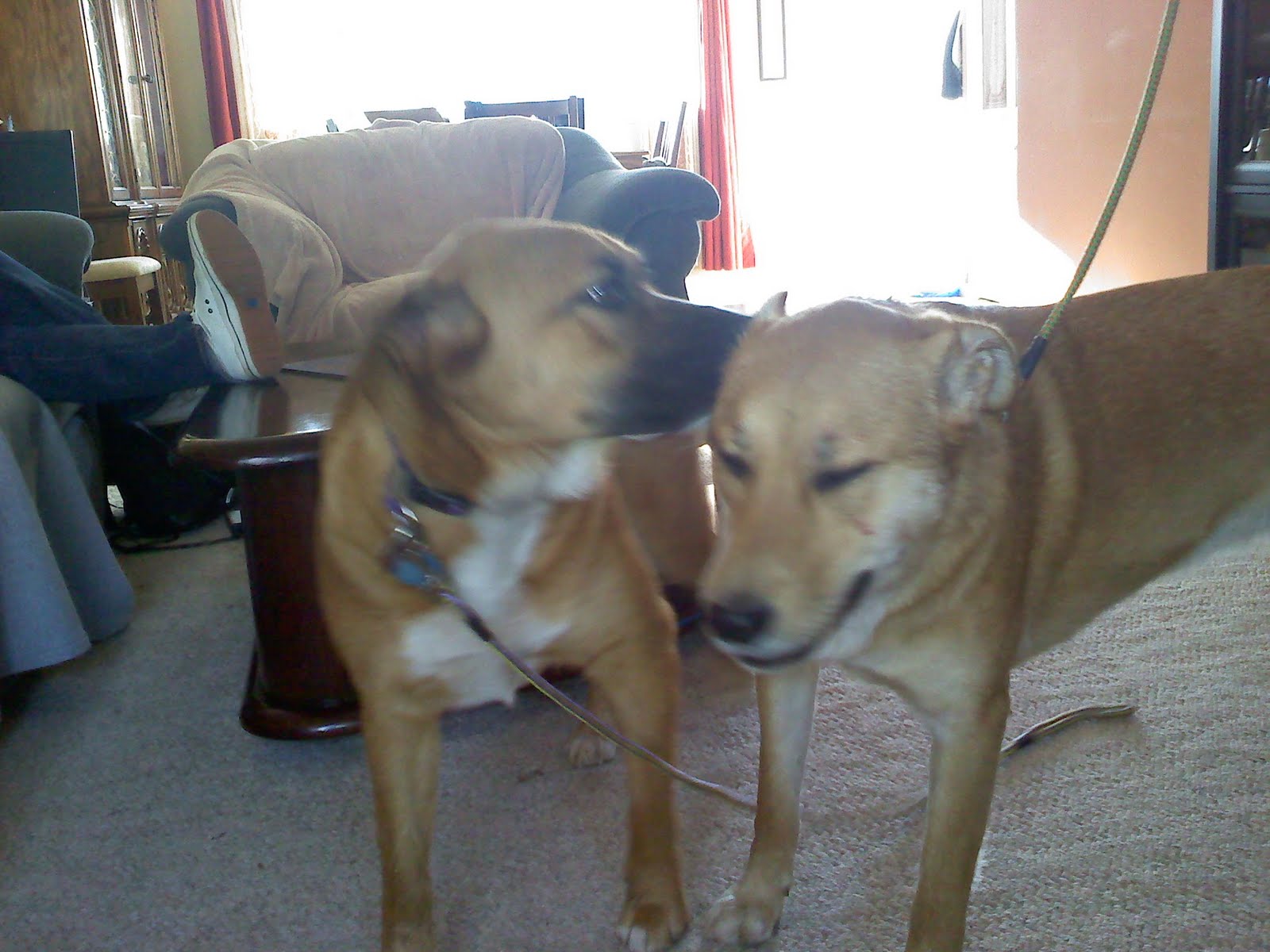
Doggie diaries: The story of Rosie and Sophie What we can learn from dogs

Aside from their injuries, Rosie and Sophie are getting along just fine today — a day after what probably was their worst fight and first in almost three months.

This is no surprise; dogs have short memories when they fight and long memories when it comes to the people they love.

Wouldn't it be nice if humans were the same way?

This message was sent using the Picture and Video Messaging service from Verizon Wireless!

To learn how you can snap pictures and capture videos with your wireless phone visit www.verizonwireless.com/picture.

Note: To play video messages sent to email, QuickTime� 6.5 or higher is required.

Doggie Diaries: The story of Rosie and Sophie Blood and bruises and the end of a bad week

Call this the perfect ending to the perfect week, a dog fight that drew blood and left my arm with a painful bruise.

The dogs were outside, sniffing around in the grass and mud, much of the snow having melted. Everything was fine until they found an old, muddy piece of rawhide that they must have left behind before the snow came.

I was watching them from the window when I saw them stiffen and tense up. I went out, grabbed the rawhide and then — call me stupid — attempted to toss it over the fence. It missed, landed in the yard and the dogs got to it and then got into it.

I was outside by myself, which made it difficult to stop — I got behind one and lived her like a wheelbarrow, but the other one kept coming. AFter what seemed like an eternity, my neighbors came running over and Annie’s sister Susan came out of the house along with my brother Mark. Susan grabbed one dog and I had the other and we finally pulled them apart.

Both had bloody wounds, a gash on Rosie’s snout and a larger gash on Sophie’s leg, but I think they look worse than they actually are. We put peroxide on the wounds — which caused Sophie to scream from the burning — and we’ll monitor the situation for now and hope they heal on their own.

In the meantime, they have decided to be friends again, as the above photo shows.

It was the first fight since Christmas Eve and probably would not have happened were I able to get to them sooner or had I been smarter about disposing of the rawhide.

It was just a capper to a week that included a death of a close friend of my sister-in-law, bad news at work that will make paying my bills more difficult and a brutal cold. It has to get better, right?


Runner’s diary, Tuesday

I got on the treadmill today and ran three miles in 26:51 — a good run given my recent history. My only hope of regaining consistency is to post these things and ask my readers to call me on my laziness. Next run is planned for Thursday.

Coffee time — but please make it strong

I just finished a column on a group that has dubbed itself the Coffee Party Movement, a nominally liberal answer to the Tea Partiers. My argument is that the group is useful, but lacks depth.

It reclaims government as a potentially positive influence on society and restates what should be obvious, that government “is not the enemy of the people, but the expression of our collective will, and that we must participate in the democratic process in order to address the challenges that we face as Americans.”

The problem is its apparently content-free agenda and the bloodless commitment to cooperation and efficiency that has stalled the Obama agenda and left progressives standing on the sidelines.

Its founder, Annabel Park, told The New York Times that the group would offer “a different model of civic participation” and hoped to “send a message to people in Washington that you have to learn how to work together, you have to learn how to talk about these issues without acting like you’re in an ultimate fighting session.”

It blames Washington gridlock on “the proliferation of partisanship,” an argument that ignores much of what actually happens in the nation’s capital and underplays the need for elected officials to take principled stands on issue.

What good is it, after all, if the U.S. Senate works together when the result is hundreds of thousands of American troops on foreign soil fighting in unnecessary and counterproductive wars? What good is it if elected officials work together, if it results in the dismantling of welfare, or the expansion of the national security state?

More Senate disfunction

Unemployment is at a decades-long high and yet federal benefits are scheduled to run out this weekend, unless a single U.S. senator lifts his objection.

Forget Sen. Jim Bunning’s hypocrisy — demanding benefits be paid for even after voting for massive tax cuts that were not offset with any spending cuts — the Senate hold he is using is just one more example of how the upper house has fallen into disrepair.

One senator can hold up legislation for any reasons at anytime. A minority of senators can stymie bills — a minority representing no more than one ninth of the national population — and even if we can get through a filibuster, we face the prospect that half the Senate — representing about 20 percent or 25 percent of the population — could kill a bill.

The compromise that created the Senate was a logical outgrowth of the times. The individual states in the late 18th century functioned as independent nations on some level and the compromise was needed to get the smaller states on board. Today, such a compromise looks quite quaint.

Amending the U.S. Constitution to reconstitute the Senate would likely be impossible, however, because the compromise enshrined small-state power in the amendment process. But the Senate cannot continue to (mal)function the way it has.