And this surprises us because?

We are facing high unemployment, which has sapped public budgets and led to major public-sector layoffs — and we are surprised when the thousands of public workers now out of work are slowing the economic recovery.

Economists at Rutgers University say losses in public jobs are, in part, slowing the Garden State’s economic comeback.

The findings will be released today during the Rutgers Economic Advisory Service forecast and conference in New Brunswick.

The study finds New Jersey has lost 269,000 jobs since January 2008. About 45,000 alone disappeared from May through September.

Economics Advisory Service director Nancy Mantell says New Jersey has lost 42,400 public sector jobs since May. More than half came from local governments.

It’s simple math: If you add more unemployed people to the mass of those already unemployed, you have more unemployed people — and that means there are fewer people who can buy houses, cars and other goods, making it less likely that businesses will be able to hire and so on. It is why many economists have pushed public spending — direct aid to workers, infrastructure projects, etc. — as the best approach to getting the economy moving in the right direction.

It appears, of course, that we are going to continue trying this other tack for a while, which means we shouldn’t expect an economic rebirth any time soon.

  • Send me an e-mail.
  • Read poetry at The Subterranean.
  • Certainties and Uncertainties a chapbook by Hank Kalet, will be published in November by Finishing Line Press. It can be ordered here.
  • Suburban Pastoral, a chapbook by Hank Kalet, available here.

Don’t feel sad, get mad

The Republican Party has taken back the House of Representatives in a nasty push back against the president’s party.

There is nothing surprising here, when you consider history (the president’s party generally loses seats in a midterm) and the mix of politics (gridlock in Washington), economics (a jobless faux recovery) and culture (race and class bias, generalized fear).

The argument we are likely to hear as the days go forward is that the Democrats must move right and that liberals must trim their sales and lower their expectations. I’m not buying it.

The bulk of yesterday’s losses came from swing districts and featured Blue Dog Dems who generally sided with the GOP on the most important issues.

According to an analysis by The Huffington Post, 23 of the 46 Blue Dogs up for re-election went down on Tuesday. Notable losses included Rep. Stephanie Herseth-Sandlin (D-S.D.), the coalition’s co-chair for administration, and Rep. Baron Hill (D-Ind.), the co-chair for policy. Two members were running for higher office (both lost), three were retiring and three races were still too close to call.

The Blue Dogs, a coalition of moderate to conservative Democrats in the House, have consistently frustrated their more progressive colleagues and activists within the party, especially during the health care debate. Blue Dog members pushed to limit the scope and the cost of the legislation and resisted some of the mandates of the bill. Last summer, seven of the eight Blue Dogs on the House Energy and Commerce Committee even threatened to block health care reform unless it met their cost requirements.

So, from a progressive point of view, there is no real loss here. (More on Russ Feingols later.)

And in real terms, this changes Washington only minimally. Let’s face it, it’s not like the Democrats were pushing real progressive change or had the guts to challenge the GOP’s obstructionism. How a Republican House will shift the balance is beyond me.

But I write this from my perch as an editor of local news, far from the maddening nonsense inside the Beltway. I am not a perfectly coiffed TV personality who must impose a narrative on results to make it conform with my own preconceptions.

There are a handful of things we know for sure:

  1. The Democrats control the White House and the Senate; the Republicans control the House and a majority of statehouses.
  2. The polls show significant dissatisfaction with the direction in which the country is moving — on both sides of the political divide.
  3. And progressives allowed themselves to become dejected, watching as their political messiah failed to be sufficiently messiah-like to remake the political world.

And this last one is key. We have to stop waiting for some white knight to arrive and fix things. We have to take control ourselves, impose a narrative and program that has nothing to do with the accepted wisdom in Washington, that by-passes the liberal elite and the Democratic Party. Waiting for a savior leaves us — and by us I mean everyone, not just lefties or even Americans, but everyone — paralyzed in fear and at the mercy of the folks who control the levers of power.

It was depressing to watch the results roll in, but we cannot allow the depression to paralyze us. The left must get mad and it must get active, must ensure that an alternative set of policies and programs are on the table and that conservatives and corporatists do not have an open field on which to maneuver.

A failure of false equivalence

Rally to Restore Sanity and/or Fear
Jon Stewart – Moment of Sincerity
www.comedycentral.com
http://media.mtvnservices.com/mgid:cms:item:comedycentral.com:363864
Rally to Restore Sainty and/or Fear The Daily Show The Colbert Report

Jon Stewart and Stephen Colbert hosted a comedy outing on the Mall in Washington the other day, one that could easily have been mistaken for a political rally.

There were plenty of laughs and too many speeches — and a plea for sanity and reasonableness that, on the surface, may seem, well, reasonable.

But, as Matt Rothschold pointed out in a sharp podcast critique, Stewart’s speech was an abject failure, a call for compromise and bi-partisanship that pays no heed to philosophy or ideology, that equates strong feeling with insanity and raises compromise to the level of belief.

Stewart, in essentially paraphrasing Rodney King and calling for us to “just get along,” ignores the real danger we face. Our problem is not a lack of cooperation, though cooperation has been in short supply in Washington. Our problem is the weakness of liberals, personified by a president who clearly privileges bipartisanship over ideology, who has been willing to bend over backward and gut even modest liberal reforms to gain one or two Republican votes — and this was before Scott Brown won a Senate seat and ended the mythic Democratic veto-proof majority.

The problem is not a lack of cooperation but a lack of cujones on the left.

http://www.msnbc.msn.com/id/32545640

Keith Olbermann last night bemoaned the false equivalence created by Stewart et al — Olbermann/Maddow equals Beck/O’Reilly — but failed to address the real issues raised by the Stewart rally and the rise of the Tea Party movement and the growing hegemony of the corporate state.

Chris Hedges, in his new book The Death of the Liberal Class, describes a liberal class or mainstream that acts as a bulwark against real and radical change. As Hedges points out, mainstream liberals’ focus on incremental reform and the rivalry between the political parties consigns real structural economic change to the margins. The basic contours of corporate capitalism are never questioned.

Whether we are talking about so-called Obamacare, financial reform, the bailouts of the banks and auto industry, the seemingly endless wars we are waging and continued outsourcing of government services (including warkmaking and intelligence) or the much-to-small Obama stimulus, it is corporate capitalism that was the big winner. This becomes clearer when you place these efforts, which has or will transfer wealth from the middle class upward, beside the rather meager aid offered to the unemployed, underemployed and foreclosed upon and the failure of the liberal majority in the federal legislature to re-empower American workers (anyone remember card check?).

The false equivalence pushed by Stewart — and endorsers of the rally like Arianna Huffington and Oprah Winfrey — obscures the very real anger and fear driving the Tea Party movement, an anger and fear that need an outlet.

If we had a vibrant left in the United States, rather than an accommodationist one, the working class would not have to turn to the Tea Party (not have to, though many still might do so). Instead, as Hedges wrote yesterday,

The liberal class wants to inhabit a political center to remain morally and politically disengaged.

Were the left to realize its impotence, Hedges says, it might “be forced, if it wants to act, to build movements outside the political system.” Rather than mock the Tea Party, which I admit is emminently mockable, liberals and progressives should be emulating it, co-opting and immitating its energy and organizing skills to force weak, centrist Democrats (this would be most of them) out of Congress.

This would require the liberal class to demand acts of resistance, including civil disobedience, to attempt to salvage what is left of our anemic democratic state. But this type of political activity, as costly as it is difficult, is too unpalatable to a bankrupt liberal establishment that has sold its soul to corporate interests.

What this means, unfortunately, is that incremental reforms are the best we can hope for, that the corporate greed heads will continue to control our economy and politics and the liberty the Tea Partiers claim to be defending will continue to erode and decay.

  • Send me an e-mail.
  • Read poetry at The Subterranean.
  • Certainties and Uncertainties a chapbook by Hank Kalet, will be published in November by Finishing Line Press. it can be ordered here.
  • Suburban Pastoral, a chapbook by Hank Kalet, available here.
Robo calls make my skin crawl

The robo-call phenomena baffles me. Over the last few days, I have received robo calls from President Barack Obama, former Sen. Bill Bradley and a variety of local and regional folks. And it’s not over, at least for another 30 hours.

The notion that a recorded phone call from some famous person is considered a good use of a campaign’s resources just doesn’t seem logical, given how distasteful most people find telemarketers — and politicians.

  • Send me an e-mail.
  • Read poetry at The Subterranean.
  • Certainties and Uncertainties a chapbook by Hank Kalet, will be published in November by Finishing Line Press. it can be ordered here.
  • Suburban Pastoral, a chapbook by Hank Kalet, available here.

The final day

We have finally hit the end of this dismal election cycle, with the Democrats — deservedly — facing dim prospects and a wave of lunatics on the precipice of gaining entry to the nation’s statehouses and national legislature.

It is a sad state of affairs, but one that serves the corporate world well, because it keeps the rightwing strong and sends liberals chasing their tales until they collapse from exhaustion.

That said, I will hit the voting booth tomorrow to cast my ballot. Look, I have no illusions that either party has much in common with my belief system — I am, as I have taken to describing myself, an Anarchist radical populist progressive socialist, meaning I hate large concetrations of power, in particular corporate power, but view the existence of democratic government (when it functions as an extension of the people) as a bulkwark against corporate power. But I can see some candidates — U.S. Rep. Rush Holt, for instance — as having a lot to recommend themselves.

But this is not the post I intended to write. My focus was to be on the anti-politician meme that has controlled this year’s election. Consider Scott Sipprelle, who is running against Rush Holt. His campaign is predicated on painting Holt as a career politician, while painting himself as outside of politics.

A businessman, not a politician — but then, the act of running for office makes one a politican. That’s just the way the language works.

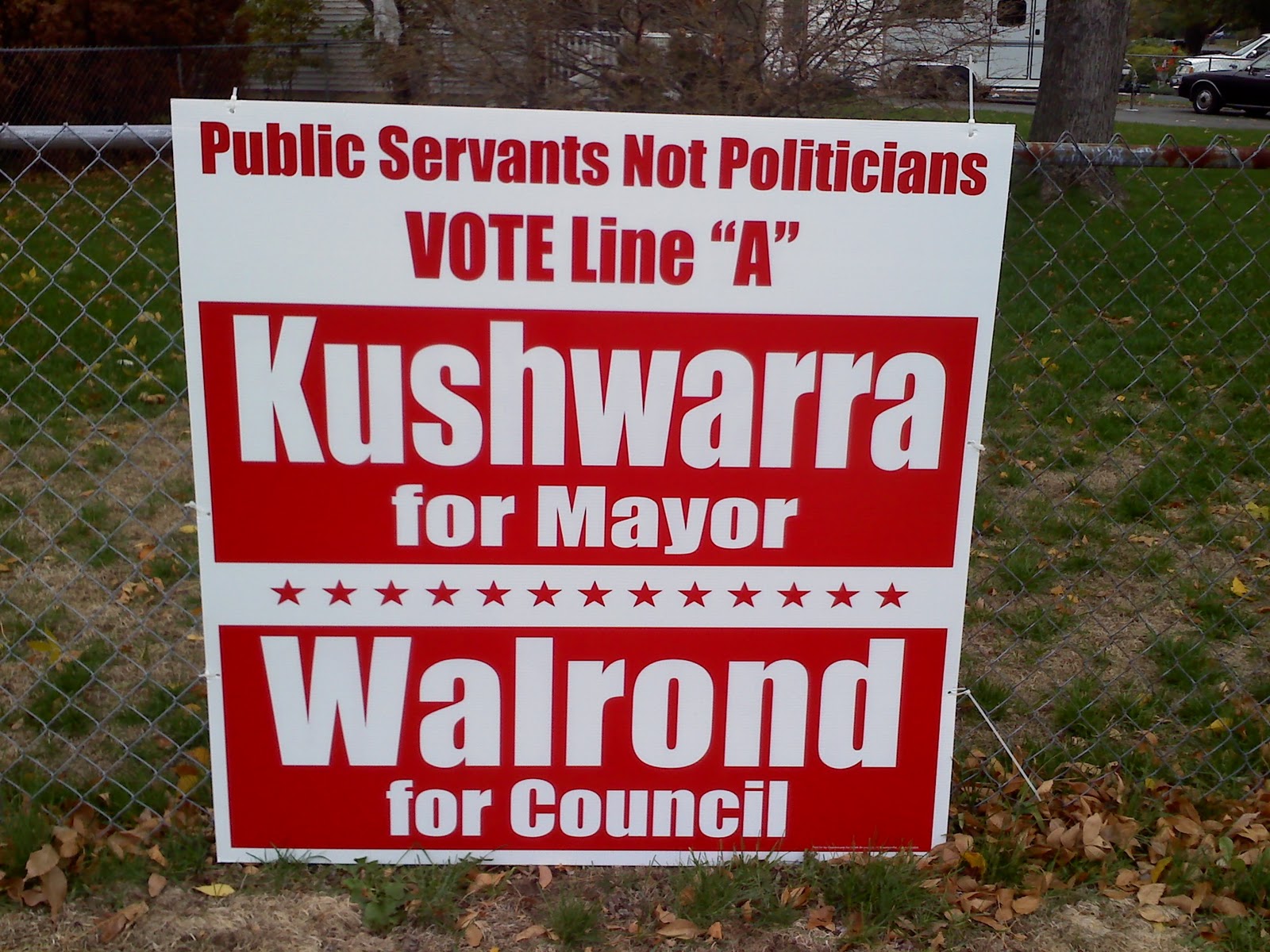
A sign on Kendall Park in Kendall Park.

And it happens at the local level, as well. Mike Kushwarra and Steven Walrond, the Republicans running for mayor and Township Council in South Brunswick, are calling themselves “public servants not politicans,” a claim that automatically paints the opposition as politicians. Both were township police officers and still live in town — the public service part of the claim — but aren’t they, by virtue of the campaign, politicians, as well? Walrond, of course, ran for council two years ago — which makes it pretty clear that he is a politician just like everyone else. And Kushwarra has run for school board, so I leave it to readers to make up their minds.

None of this should surprise anyone, given the anti-incumbency tenor of the election season. Politicians are running against themselves, which cannot be good for anyone, especially voters.

  • Send me an e-mail.
  • Read poetry at The Subterranean.
  • Certainties and Uncertainties a chapbook by Hank Kalet, will be published in November by Finishing Line Press. it can be ordered here.
  • Suburban Pastoral, a chapbook by Hank Kalet, available here.