
When a story is not a story

A story in today’s New York Times is likely to raise eyebrows.

According to the paper,

The American Bar Association has secretly declared a significant number of President Obama’s potential judicial nominees “not qualified,” slowing White House efforts to fill vacant judgeships — and nearly all of the prospects given poor ratings were women or members of an ethnic minority group, according to interviews.

The rate, according to the story, is three times the previous two presidencies, which makes it seem as though we are looking at a run of unqualified judicial candidates being nominated.

A closer look, however, makes it clear that there is a lot more smoke than fire to this story:

the association’s judicial vetting committee has opposed 14 of the roughly 185 potential nominees the administration asked it to evaluate, according to a person familiar with the matter. 

That’s 7.5 percent who were opposed by the ABA — or, to put it another way, 92.5 percent approved.

The administration points to a shift in philosophy — the push to appoint more judges with varied backgrounds, including those who have not worked as courtroom lawyers. This could be at odds with the ABA’s apparent preference for courtroom litigators and explain the higher number of rejections.

In any case, it seems like a non-issue, though I have a sneaky feeling that we’ll be hearing from conservatives on this one claiming that Obama is damaging the federal bench with unqualified judges. These, of course, will be the same conservatives who applauded when George W. Bush opted to stop sending nominees to the ABA for review because he felt the organization was ideologically biased.

  • Send me an e-mail.
  • Read poetry at The Subterranean.
  • Certainties and Uncertainties a chapbook by Hank Kalet, will be published in November by Finishing Line Press. It can be ordered here.
  • Suburban Pastoral, a chapbook by Hank Kalet, available here.
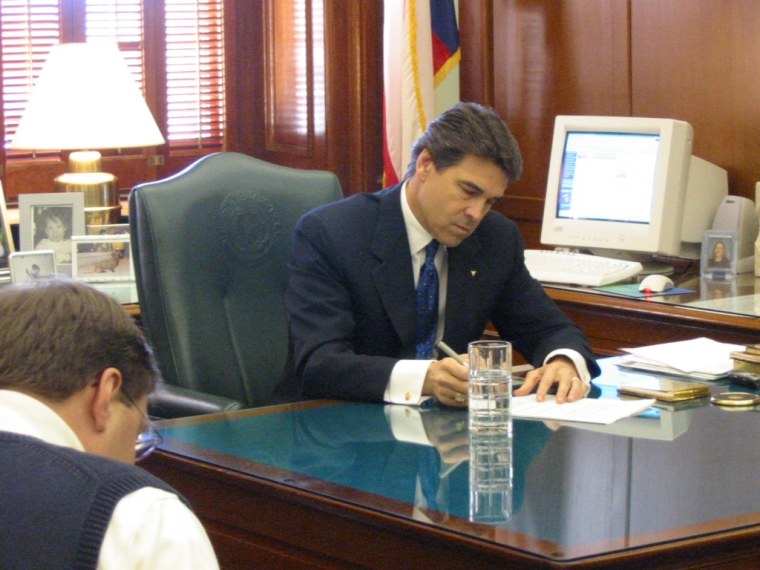
Even the crazy and unqualified sometimes have a good idea

Rick Perry will not be president. That much is certain. And Rick Perry’s ideas — the flat tax, elimination of government agencies, bellicose foreign policy, etc. — deserve to die with his candidacy.

Except for one: The proposal he announced today to impose term limits on federal judges. Since the appointment of the 43-year-old Clarence Thomas by President George H.W. Bush to what is likely to be a 35- 40-year reign on the Supreme Court, it has been clear to me that lifetime appointments come with the potential for disaster.

Perry is proposing an 18-year term, which seems too short to me, but why not limit terms on the federal bench to 25 years, which would guarantee some turnover and give presidents of both parties a chance to influence the work of the bench and could help ensure that changing mores are reflected by the men and women who sit.

It’s jut a thought, but just because Perry is, well, batty doesn’t mean we can’t at least discuss some of what he offers.

  • Send me an e-mail.
  • Read poetry at The Subterranean.
  • Certainties and Uncertainties a chapbook by Hank Kalet, will be published in November by Finishing Line Press. It can be ordered here.
  • Suburban Pastoral, a chapbook by Hank Kalet, available here.

Quote of the day: #OWS edition

From Guy Horton’s blog on Huffington Post today, in the aftermath of the New York crackdown on Occupy Wall Street:

So is this the death of Occupy? My suspicion is that this is, in fact, just the beginning. What form will it take next? It may not have Zuccotti Park anymore, but it increasingly has the intellectual and emotional landscape of the American psyche.

They can shut down the protests and end the physical occupation, but the fight to reclaim American democracy from the elite is just beginning.

  • Send me an e-mail.
  • Read poetry at The Subterranean.
  • Certainties and Uncertainties a chapbook by Hank Kalet, will be published in November by Finishing Line Press. It can be ordered here.
  • Suburban Pastoral, a chapbook by Hank Kalet, available here.

Capital makes a clean sweep

Make no mistake, the nationwide purge of protesters from public parks is not about the comportment of the protesters, no matter how much the powers in cities like Oakland and New York want to paint it that way.

The sweeps are about capital and protecting the 1 percent in the cities, the people who pay the campaign bills for elected officials and, therefore, demand allegiance.

To understand how this works, one just needs to listen to the mayor of New York, Michael Bloomberg:

“New York City is the city where you can come and express yourself,” the mayor said. “What was happening in Zuccotti Park was not that.” He said the protesters had taken over the park, “making it unavailable to anyone else.”

New York also is the financial capital of the world and the place where the first police-triggered violence took place. It is a city in which the mayor has shown nothing but hostility toward the protesters from the inception of the occupy movement. In his mind, the bankers had nothing to do with the financial crisis and unrelenting economic meltdown that has left one in six Americans un- or under-employed.

The anger that has triggered these protests is real. Shutting them down will not make it go away. Asking the protesters to turn to the ballot box or petition Congress is, as the protesters know, a waste of time and ignores the history of social movements, which almost always begin with an aggrieved group taking to the streets and creating a moral imperative for change. That’s what the protests are about and it is why protectors of the 1 percent like Mayor Bloomberg have little sympathy.

  • Send me an e-mail.
  • Read poetry at The Subterranean.
  • Certainties and Uncertainties a chapbook by Hank Kalet, will be published in November by Finishing Line Press. It can be ordered here.
  • Suburban Pastoral, a chapbook by Hank Kalet, available here.

Phillies and Papelbon: Big money, big mistake

Jonathan Papelbon is the game’s second-best closer. But he’s not worth $50 million over four years.

Why? Two reasons: The Phillies have other, more pressing needs, and spending big money on closers just doesn’t wash historically. The Mets learned this with Francisco Rodriguez and Billy Wagner, both of whom pitched well, but not well enough to earn $40-$45 million over four years and not well enough for the Mets to succeed. The Reds have Francisco Cordero, whom they paid $46 million over four, and they’ve lost more games than they won since he joined the team; the one winning season, 2010, saw the Reds get swept in the first round by the Phillies without Cordero even getting into a game.

And then there is the lesson of this year’s Cardinals, who cobbled together a bullpen during a miraculous end of the season and then rode the unheralded arms to a title, something they did in 2006, as well.

The lesson, to me, is not to overestimate your need for a closer and then overpay. It just doesn’t seem worth the risk.

  • Send me an e-mail.
  • Read poetry at The Subterranean.
  • Certainties and Uncertainties a chapbook by Hank Kalet, will be published in November by Finishing Line Press. It can be ordered here.
  • Suburban Pastoral, a chapbook by Hank Kalet, available here.