College wish list, an investment in the future

It’s not going to be an easy sell, but New Jersey voters need to endorse a plan to expand the state’s public and private college systems.

NJ.com reported today that the schools submitted a $6 billion wish list to renovate existing facilities and add important new programs in health, technology and environmental sciences. The state’s four-year schools need to expand their opportunities for in-state students. College presidents

cite a study that shows the state’s four-year colleges provide only 19 seats for every 100 high school graduates, forcing families to spend more on out-of-state schools or abandon the idea of higher college education for their children.

The list, which has yet to be discussed by the state Legislature as part of its discussion of a potential state bond referendum, could be the kind of jobs program with long-term benefits the state needs, creating construction jobs now and research and teaching slots later.

“There is no better investment the state can make than in higher education,” said Richard McCormick, the departing president of Rutgers University, who is leading the lobbying effort for the financing. “In the short term, it will put a whole of lot of people to work, while increasing statewide capacity for higher education and meeting a strategic objective by investing in science, medicine and engineering.”

Pipe dreams in the war on drugs

The American war on drugs — both domestically and abroad — has always been a sham, a pipe dram if you will fueled by the arrogant notion that we can control people’s consumption behavior while also ignoring massive inequality and poverty under which our economy operates.

The equation seems fairly simple to me: criminalize drugs — pot, liquor, even poppies — and you drive the price up. That increases the potential profit, which in turn offsets the extreme risk involved. The upshot is the pseudo normalization of the drug trade even as we expand our crackdown and use increasingly brutal methods.

Consider this comment from today’s New York Times by an otherwise mainstream Afghan farmer:

“Now I am desperate, what can I do?” said Mohammed Amin, a poppy farmer in Tirin Kot in Oruzgan Province, who harvested only one kilogram of opium poppy this year compared with 15 last year. “I don’t have any cash now to start another business, and if I grow any other crops, I cannot make a profit.”

The poppy crop offered a livelihood, which has been damaged by the crackdown, leaving him in deeper financial straits that make it impossible for him to get out of the poppy business.

Not that he would, as he told the Times. There are risks, but poppy farming offers a better and more stable return than other crops.

“The poppy is always good, you can sell it at any time. It is like gold, you can sell it whenever and get cash.”

In the United States, we’ve ignored our own history, using law enforcement — federal, state and local — to attack what should be treated as a public issue. The money spent on our ever-more militarized police forces could be better spent on treatment centers, with money raised through a tax on decriminalized substances.

There is movement on the margins on this — the medical marijuana movement and pot decriminalization pushes, for instance — but this nibbling does little to redirect the larger mindset. That means the failed model on which we have relied will remain in place and we will continue to waste billions on a drug war that cannot be won.

Approve the wage hike

Today’s vote by the New Jersey General Assembly on a hike in the minimum wage shouldn’t surprise anyone: It was approved on a party-line 46-33 vote with Republican opponents trotting out the standard arguments.

Assembly Minority Leader Jon Bramnick (R-Union) said the move would hurt the state’s economic recovery at a time when Gov. Chris Christie and lawmakers are “starting to turn around that notion that New Jersey is not the right place for their business.”

Business groups took the same tack, arguing that wage hikes would lead to lost jobs.

Stefanie Riehl, assistant vice president of the New Jersey Business and Industry Association, urged lawmakers to vote down the bill today.

“Unfortunately, legislation raising the minimum wage does not increase the sales and revenues that businesses would need to pay higher wages,” she said in a statement. “I sales are not rising fast enough to accommodate forced wage hikes, employers will be forced to make tough personnel and operating decisions, such as reducing workers’ hours or cutting other costs.”

New Jersey Policy Perspective said the increasing the state’s minimum wage from $7.25 to $8.50 “would boost the state’s ailing economy while improving the lives of many of the state’s working families.”

NJPP says that the hike would increase the amount earned by low-wage workers by $489 million in the first year and generate $278 million in new economic activity, with more than a half-million workers feeling the direct impact. There are 307,255 workers making less than $8.50 an hour in the state.

“Raising the minimum wage is the right thing to do for New Jersey’s working families. It’s also the right thing to do for our ailing economy,” says NJPP president Gordon MacInnes. “Approving the proposed $1.25 per hour increase will ripple throughout New Jersey, producing an estimated $278 million in new economic activity. That’s what I call a smart investment.”

The Senate is expected to follow suit, but it is unlikely that the governor will approve the legislation. Expect a veto, which would be bad news for the state’s low-wage workers.

  • Send me an e-mail.
  • Read poetry at The Subterranean.
  • Certainties and Uncertainties a chapbook by Hank Kalet, will be published in November by Finishing Line Press. It can be ordered here.
  • Suburban Pastoral, a chapbook by Hank Kalet, available here.

Campers are a canary in the coal mine


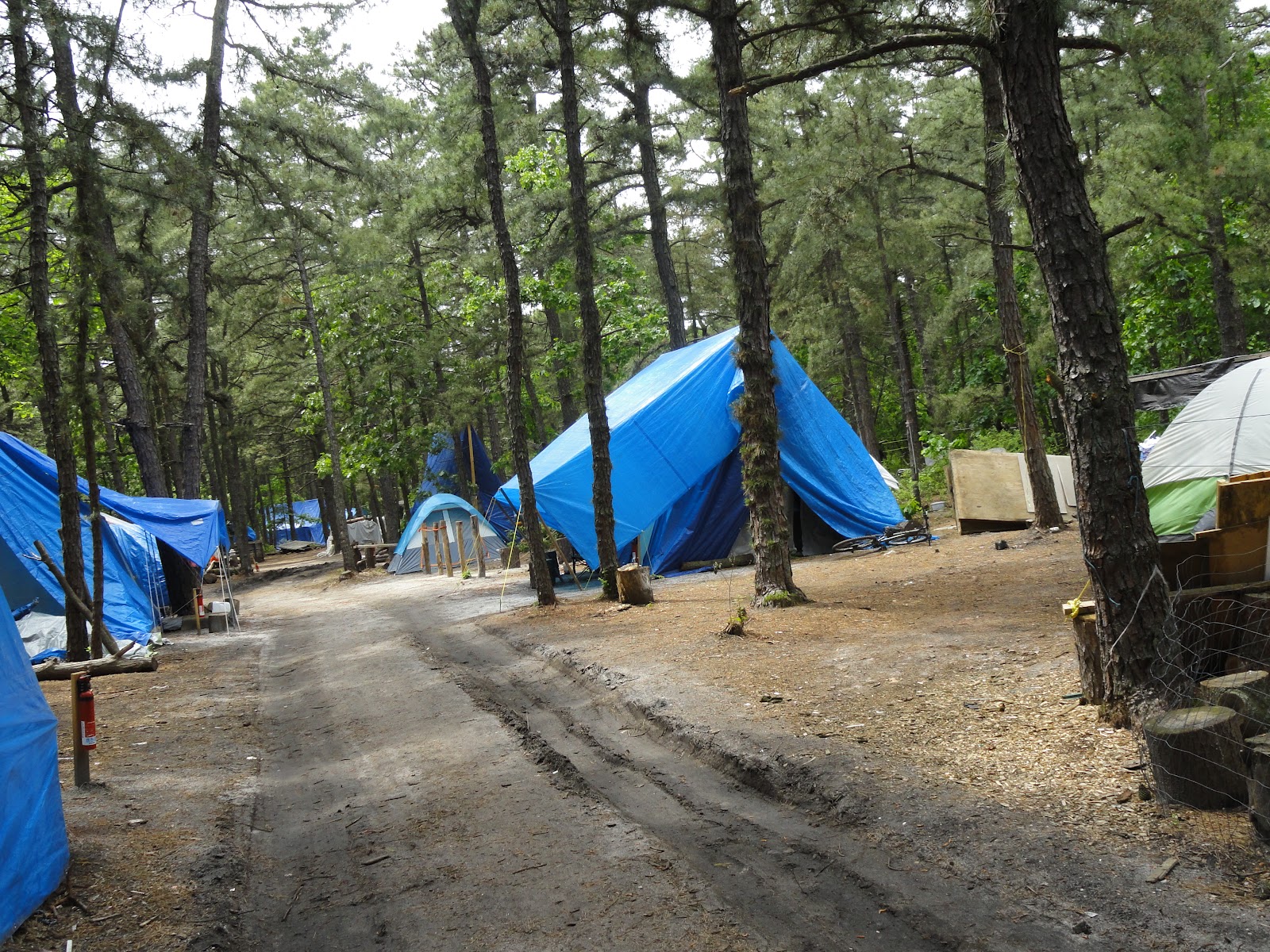
The population at Lakewood’s tent city encampment is growing. When I talked with the Rev. Steve Brigham last month during my first visit, he told me he anticipated growth — from about 70 then to about 100 by July — but based on conversations today, he could be underestimating things.
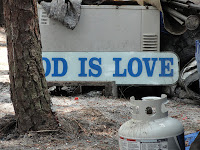
Part of the issue is a lack of shelter space in Ocean County and the aggressive efforts of municipal and county officials to close down the smaller encampments that dot the area. That has resulted in a large number of people having little choice but to arrive in Lakewood hoping that Brigham can find them a tent.
William, who arrived early this morning with his girlfriend Lisa, is a house painter who works seasonably in Seaside Heights — doing most of his work in the winter when the hotels are closed. Once they opened, he lost his job and the ability to pay his rent. They moved in with a friend in Freehold, but it turned out the friend was bipolar and off his medication and he began threatening them. So they left and moved into tent city.

Sheridan lost his job as a cook in Atlantic City, one he held for 22 years, when he found out he was bipolar. After trouble with the various social services — he thought he would be able to enter a program in Asbury Park but that fell through — he also found himself in Lakewood.


Today was my third visit down, part of a project I am working on with photographer Sherry Rubel and filmmaker Jack Ballo. I’m writing a long poem (and doing some magazine features) and we’ll present the multimedia collaborative when it’s done.

In the meantime, I’ll do what I can to draw attention to the structural economic problems of which tent cities like the one in Lakewood are symptoms. Officially, there are 645,000 homeless people on any given day in the United States and about 3.5 million who are homeless at some point annually. That figure is the number of individuals who access resources or services through the federal Department of Housing and Urban Development. The number does not include a variety of others who lack housing, including about 660,000 children considered un-housed but not in the HUD system and about 55,000 veterans not covered by HUD. And for the most part, the numbers also do not include those living in tent city encampments.

The Lakewood encampment is one of hundreds that have cropped up across the country, most of which – like the one in Lakewood – predate the 2008 banking collapse. Their existence offers a stark reminder that the gross economic inequality that we have come to accept as a larger society has very real impacts and the housing industry, by chasing every dollar, has priced large numbers out of the market.

The response from Lakewood — and from other towns, like Denver — has been to criminalize the encampments and the homeless in general, rather than take steps to expand and improve the shelter and affordable housing systems.


Capitalism is the culprit here, or at least capitalism as practice in the United States. Our focus on winners and losers, on profits at all costs and our unwillingness to admit that our economic actions — whether we are talking about buying an iPod, building a house or buying produce — has its impacts. The corporate control we have come to accept has left us powerless to understand our own economy.


We are, as Don — a man who helps out by bringing food and clothing by the camp periodically — says, one catastrophe and a few weeks or a couple of months away from ending up in a tent in Lakewood ourselves.

  • Send me an e-mail.
  • Read poetry at The Subterranean.
  • Certainties and Uncertainties a chapbook by Hank Kalet, can be ordered here.
  • Suburban Pastoral, a chapbook by Hank Kalet, available here.

Killing the messenger with ad hominem attacks

If I were teaching a course on logical arguments, I think it’s safe to say the governor’s latest rant against his critics would land him a fairly poor mark.

Here’s the back story:

Gov. Chris Christie has developed a budget plan that more than one analyst says includes rosy revenue projections — or an inflated sense of what can reasonably be expected to be collected via taxes and fees.

The budget plan drew criticism from the bond rating agencies a while back, and now the state Office of Legislative Services is saying that revenues are growing but falling well below anticipated levels — to the tune of about $688 million for the current fiscal year and $635 million for the next one.

Christie, who is pushing an income tax cut, is furious and his response, in typical Christie fashion, was to tear down the messenger and not really address the messenger’s analysis:

Gov. Chris Christie today attacked the legislature’s non-partisan budget expert, calling him “the Dr. Kevorkian of the numbers.”

“Why would anybody with a functioning brain believe this guy,” Christie said of David Rosen, the budget officer for the Office of Legislative Services. “How often do you have to be wrong to finally be dismissed?”

He then went on to decry the non-partisan office as the “handmaiden of the majority.”
Look, there is an argument to be made here, but it should focus on the methodology that created the estimates. The question is how did each side come to its revenue figure and why does each side think it’s right. Past experience is useful here — so Christie is on solid ground when he questions last year’s numbers. But he is cherry-picking, as NJ.com points out:
Though Christie’s revenue estimate last year was more accurate, the OLS has been closer to the mark over the decade. On average since 2000, governors have been off 1.99 percent, the OLS 1.36 percent.
Where the ground shifts and becomes rocky is in the name-calling, which is part of Christie’s standard arsenal and has nothing to do with rational argument but makes for good copy.