
Rolling Stone, journalism and boycotting the boycott

The upcoming issue of Rolling Stone magazine has created quite a stir — and it hasn’t even hit newsstands yet.

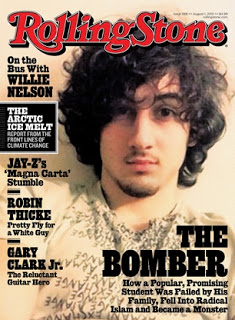
That’s because it features a cover story — and cover — of suspected Boston Marathon bomber Dzhohkar Tsarnaev. Officials in the Boston area and many, many others in the social media universe reacted harshly. I posted a link yesterday to Twitter and Facebook saying I agreed with Jon Wolfson, the editor of Boston Magazine. Wolfson told Jim Romenesko, who runs the influential Romenesko journalism blog, that

“There are people here in the city, and even on my staff, who are really angry about the cover, but I’m having a hard time getting as upset as everyone else. I completely understand how the cover could be interpreted as glamorizing Tsarnaev and, in a way that further wounds the victims, painting him in a sympathetic light. But I think that interpretation misses the point of what Rolling Stone was trying to do, which was to spotlight just how unlikely it would have seemed on April 14 that his kid could have done something like this.

“Could the execution have been better? I think so. The cover language describes Tsarnaev himself as a victim, and from my perspective at least, that was insensitive to the people who were killed and wounded in the bombings. But overall, it’s my opinion that the outrage has been to some degree out of proportion to the magazine’s offenses.”

This seems eminently reasonable. It is important to note, for instance, that — as The Huffington Post reports — Tsarnaev’s picture (a self-portrait)

has in fact been used by other publications since the April 15 Boston Marathon bombing, which Tsarnaev stands accused of carrying out with his brother, Tamerlan. The photo even appeared on the front page of The New York Times in May. However, its presence on the cover of Rolling Stone, a space typically occupied by rock stars and actors, sparked outrage on Twitter and Facebook, where many observers objected to what they saw as the glamorization of Tsarnaev.

Both assertions are correct. The photo has been used in the past and a story like this, which purports to explain how a seemingly integrated kid ended up turning extremist and conducting an act of terror on American soil, certainly deserves cover treatment. But the cover, as designed by Rolling Stone, does treat Tsarnaev like the pop-culture stars that usually take up this coveted real estate.

In judging the cover, I attempt to follow a set of journalist principles, some of which are in conflict and require a delicate balancing: Is the story and cover newsworthy? Does it warrant lead placement — i.e., is it the most interesting or important piece in the magazine? What are the expectations of the readership (this is different than the expectations of the larger community)? There are other questions that I would ask and there are questions that might come from someone higher on the food chain — like the publisher — but I think you can understand the general outlines of the decision-making process.

I’ve already answered the first two questions — yes, it is newsworthy and, yes, it does warrant lead treatment, though executed a bit differently. The expectation question is harder to answer, but I suspect that the magazine’s audience will have far less of an issue with this cover than those who are criticizing it, meaning that the community that Rolling Stone serves is likely to be OK with what has been presented here.

This brings me to one of the more interesting parts of this story — the call for boycotts. First, I am generally critical of boycotts that target media organizations and their sponsors, whether they be Rolling Stone or Rush Limbaugh. They amount to an economic attack on editorial independence and are really just the converse of a publisher coming to an editor and saying “write this story to please our advertiser.” Rolling Stone attempts to make this argument, but does so badly — no, Rolling Stone, this is not a constitutional issue because government is not involved in censoring the press and because newsstands, stores and advertisers have a right to determine what they will sell and where to place their advertising.

I also find it unlikely that the boycott will have their desired effect, partly because the goal seems kind of murky — is it to get Rolling Stone to change its cover? to punish the magazine for offending the community? or is the goal something else? — and partly because the people who are engaged in this conversation are not the people reading the magazine in the first place. Rolling Stone’s demographic skews young and somewhat liberal. It is not a group likely to take umbrage at the cover, as I said, and in the end the advertisers are going to acknowledge that and stick with the magazine.

The uproar over the cover is overblown and likely to blow over quickly, though it does have the potential to spark a conversation about what good journalism is, what responsibilities journalists have to the community and — something rarely ever mentioned — what the community at large owes to the journalists.

In the end, I’ll be boycotting the boycott.

Send me an e-mail.

In immigration debate, words do matter

Language matters. That’s why the Associated Press’ decision to drop the use of “illegal immigrant” as a way of describing those immigrants who lack legal standing was such an important moment in the immigration debate. The AP’s decision accepted one of the basic arguments being made by activists — that a person cannot be illegal, only an action can.

A piece on Salon today wants to take this rhetorical shift a step further. Anat Shenker-Osario asks that we stop using the term “undocumented worker.” Reformers, Shenker-Osario says, “the delicate euphemism ‘undocumented worker'”

is becoming the journalistic term of favor for the people who used to be called “illegal aliens.” The U-word is certainly many steps above that noxious label, but public opinion research shows that it still fares poorly among likely voters. They smell the forced artificiality, and they are not wrong in finding the term ineffective.

The argument goes like this: “it describes immigrants by what they lack, not what they bring” and it keeps the immigration debate “squarely in the rule of law framework.”

The language here is a problem, but the polling Shenker-Osario offers is of no use. Yes, terms like “aspiring American” and “new Americans” may be more positive, but they carry the same level of bias from a journalistic standpoint as does “illegal immigrant.” They may be useful terms for activists, giving them access to a more positive rhetorical language, but they do little to address how journalists can better and more accurately describe the people at the center of the immigration debate. They are as flabby and potentially inaccurate as any of the less positive terms being offered.

For instance, “Aspiring citizens” assumes that all of those who lack legal residency papers want to become citizens. Most likely do, but given that there are 10.5 million immigrants here without official status we can also assume that at least some don’t. “New Americans” is flawed in the same way — many of those without status have been here for decades, which stretches the word “new” beyond its logical meaning. The terms also don’t differentiate between those with legal status — work visas, for instance — and those here without, a distinction that has been central to the debate. From a journalistic standpoint, then, Shenker-Osario’s alternatives offer very little help.

“Illegal immigrant” is inaccurate because it conflates the person with the legal action and “aspiring citizen,” like “undocumented workers” is inaccurate because it is too vague.  

What I tell my students — and have told reporters who have worked for me in the past — is that they should be as descriptive as they can be. There are moments when short-hand is necessary, but as a general rule you should provide as much information as possible.

Take some of the people who testified at the hearing last month on the New Jersey tuition equality bill. The bill would treat students who are lack legal residency papers but who graduated from New Jersey high schools as in-state students for the purpose of tuition. One former student who testified came to the United States from Mexico when she was 1 with her parents on a tourist visa to visit family. They overstayed the visa and stayed. She is now about 25, graduated from a New Jersey high school and Rutgers.

How should we describe her? She works as a bartender, but does not have legal residency papers. In that way, she is undocumented. But she has other documents, so calling her undocumented would seem to fall short. Is she an “aspiring citizen”? I believe so. Is she a “new American”? Only if you can still be new 23 years or so after your arrival.

So, how do we describe her? We need some kind of short-hand — I have been using “immigrants who lack legal documentation” or “immigrants who are currently undocumented” — to help set up the larger issues in a story (in the lede and nut graphs).

But when we get to the specific person in question, we should be as detailed as we can be, providing as much information as we can about the individual immigrant so that he or she is not just a statistic or a stereotype, but a real person.
It is not about polling data, but about accuracy.

Send me an e-mail.

A tale of two economies

David Cay Johnston has a piece today at The National Memo that should put an end to the notion that unleashing the corporate monster will make our economy whole. Rather, giving corporations a free reign does little more than allow those at the top of the economic heap to reap even more benefits, while the rest of us struggle with unemployment, underemployment and a shredded safety net.

As Johnston reports,

Individual income tax payments have been rising fast since the economy began to recover, even though wages have hardly budged.

For corporations of all sizes, the story is quite difference, however.

For the vast majority of America’s 5.8 million corporations, profits soared in 2010 — up 53 percent compared to 2009 — when the recession official ended at mid-year. Despite skyrocketing profits, however, their corporate income tax bills actually shrank by $1.9 billion, or 2.6 percent.

The effective tax rate paid by 99.95 percent of companies fell to 15.9 percent in the robustly profitable year of 2010, from 24.9 percent in the half-recession year 2009.

Those figures do not count the 2,772 companies that dominate the American economy. These giant firms, with an average of $23 billion in assets, own 81 percent of all business assets in America.

Their combined profits soared 45.2 percent to a new record in 2010, but their taxes rose just 14.8 percent, new IRS data show. Profits growing three times faster than taxes means their effective tax rates fell.

In 2010 these corporate giants paid just 16.7 percent of their profits in taxes, down from 21.1 percent in 2009. The official tax rate is 35 percent.

Corporations, as we can see, are doing quite well. So, how about the rest of us? The national unemployment rate remains at 7.6 percent, which is lower than at nearly any point during the Obama administration but still about 2 percentage points above pre-recession levels. The under-employment rate — or the percentage of people who are out of work, stopped looking or working part-time when they would prefer full-time employment — according to Money Morning, “climbed to 14.3% from 13.8%. The number of ‘involuntary part-timers’ jumped by 322,000 to 8.2 million.”

This is, quite simply, the tale of two economies. Corporations are doing quite well, but the rest of us continue to struggle. The argument we consistently hear from the anti-tax crowd is that we need to take the shackles off businesses — in the form of taxes and regulations — so that businesses can generate profit, which then will trickle down to the rest of us in the form of jobs and higher wages. Yet, we are living in a time of record corporate profits AND higher-than-acceptable unemployment.

Doesn’t anyone else see the contradiction?

Send me an e-mail.

Racial bias and the canard of self-defense

Like many, I was saddened by the failure of a Florida jury to do justice following the murder of Trayvon Martin. But I was only nominally surprised. Florida law and the Sanford police made it nearly impossible for justice to actually be done. They jury, unfortunately, may have been following the law in this case — which is why we need to put the law on trial.

The only thing we know for sure is that Trayvon Martin was shot to death by George Zimmerman after Zimmerman saw the hoodie-clad kid in Zimmerman’s Florida neighborhood. Zimmerman called police and then proceeded to follow the teen, which led to a fight and the fatal shot. There were no witnesses and, thanks to the seeming indifference of police, no physical evidence.

The entire case depended upon the characterization of Zimmerman as a seething racist and overzealous police-wannabe. This proved too tall an order and Zimmerman was acquitted.

We can view this trial singularly — as just an effort to determine the guilt or innocence of Zimmerman, which it of course was — but that ignores the larger racial subtext and the larger legal structure that probably created the circumstances that led to Martin’s death.

I have no idea whether Zimmerman is an overt racist — the prosecution failed to make that case — but he did appear to exhibit the kind of tacit and endemic racism that plagues the larger society. He sees a 17-year-old African American wearing a hoodie and he reacts — the same way that too many react when we see a black kid on the street and assume the worst. That is what triggered the events of Feb. 26, 2012.

And this endemic racism was compounded by Florida’s “stand your ground” law, which allows people in Florida to claim self defense and to use deadly force if they claim that they felt afraid — not that they were actually under attack or that there was an imminent threat.

Zimmerman claimed self-defense, relying on both the “stand your ground” concept and allegations that Martin had attacked him and was beating his head into the sidewalk. There were no witnesses to the scuffle, though Zimmerman did sustain some injuries. If Martin and Zimmerman did fight, isn’t it fair to assume that Zimmerman’s actions — his decision to ignore dispatcher warnings not to follow Martin — left the teen fearful? That’s the question that Eugene Robinson raises in his column today. The jury, he said, along with police and the initial prosecutors bought into the notion that “black boys in this country are not allowed to be children.”

They are assumed to be men, and to be full of menace.

I don’t know if the jury, which included no African Americans, consciously or unconsciously bought into this racist way of thinking — there’s really no other word. But it hardly matters, because police and prosecutors initially did.

The assumption underlying their ho-hum approach to the case was that Zimmerman had the right to self-defense but Martin — young, male, black — did not. The assumption was that Zimmerman would fear for his life in a hand-to-hand struggle but Martin — young, male, black — would not.

The confluence of these — the cultural acceptance of the notion that young black males are predators and automatically inspire fear and a law that allows a man with a gun to use it if he feels afraid — has to be addressed. Florida’s “stand your ground” law — and the variations of it on the books in many other states — needs to be put on trial.

***
An addendum comes from Ryan Grim on Huffington Post, who pretty well sums up the series of bad decisions in play — and the seventh, stated ironically, which pretty much sums up how Florida law treated Zimmerman and Martin differently. Martin, Grim says, “could have chosen to not defend himself.”

It’s important to note that the jury’s verdict sends a message to anyone confronted or pursued by another man: If you engage the confrontation, even an act of self defense could be used as justification to shoot and kill you. What led up to the confrontation in the Martin-Zimmerman case was ruled irrelevant; only Zimmerman’s state of mind at the time he shot him was to be taken into account by the jury. That doesn’t leave someone being followed through their neighborhood many options other than fighting back.

Send me an e-mail.