
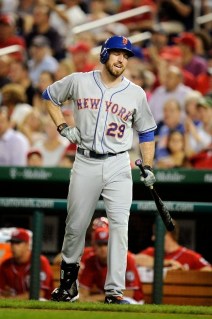
Who’s on first? For Mets, it should be Ike Davis, for now

ESPN photo

Ike Davis was a disaster at the plate last year. He was so bad, in fact, that the Mets considered using the dreadful Lucas Duda there on a permanent basis as an alternative.

The plan, according to all the press reports, was to move Davis in the offseason — mostly because he still had some value, unlike Duda. There were no takers, or none, at least, who wanted to pay the Mets’ price.

So Davis and Duda entered spring in competition for the job. Injuries have slowed the competition, but it shouldn’t matter. Davis was a former top pick by the Mets, is a good defensive first-baseman and, most importantly, has upside — even if he did not show it last year.

My argument is pretty simple: Davis is 26 and has shown flashes of what he can do. His second half in 2012 was impressive (flawed, but impressive). And, more importantly, his numbers match up with some decent first-basemen:

Here are Ike’s career numbers:

He has played 442 games, hit 67 homers, walked 207 times while striking out 411 times. His splits (batting average / on-base percentage / slugging percentage) are .242/.334/.434. These are not all-star numbers, to be sure. And his career arc is troubling — good start, but little improvement with his worst year coming last year.

That said, consider these numbers: 436 games played, 77 homers, 107 walks, 510 strikeouts and a .258/.309/.466 split. Not much better, right? Those are the numbers put up by Chris “Crash” Davis, the slugging first-baseman of the Orioles. Davis was a rock-headed, swing-at-anything hitter until he showed up in Baltimore and they subjected him to some very targeted hitting exercises (contrast this with the Mets’ efforts — send Ike to Vegas but do nothing with him). The results for Crash — 33 homers in 2012 (included in the above numbers) and a whopping 53 in 2013, with 138 runs batted in and .286/.370/.634 splits. Davis turned 27 last year, the same age as Ike will be this year.

How about these numbers: 402 games, 57 homers, 136 walks, 213 strikeouts and a .254/.320/.434 split. Again, a very familiar stat line. These were the numbers Tino Martinez put up through age 26.
I am in no way saying that Ike can turn into Chris Davis or Tino Martinez. All I am doing is making the case that Davis deserves one last long look at first for the Mets. He should be there everyday, for the most part, though the clock must be ticking. See if there are signs of the 2011 Ike — before he went down for the year, he was hitting .302 with 8 homers in 36 games — or even the Ike of 2012’s second half. If he doesn’t show up, send him packing. What are the alternatives this year? Lucas Duda? Josh Satin? Zack Lutz? Exactly.

Send me an e-mail.

No model army

If my news writing classes over the last three semesters are any indication, fewer and fewer journalism students are reading newspapers or news magazines. This is not conjecture — ask the class and they will tell you (and have told me) that they get their news from social media, the Web, from a variety of sources both reliable and unreliable. And it is evident in their early efforts at news writing.

The issue is not their writing — most of my Rutgers students have a solid grasp of the various mechanical issues that seem to plague students in my freshmen classes at Middlesex County College. They can put a sentence together fairly well and link those sentences into solid paragraphs and so on.

The issue is that they are seeking to learn to use a form with which they have had little experience or contact. Not reading a newspaper — or even a newspaper on line — means that the structural components of news writing (good ledes, nut graphs, how to handle quotations) are all brand new to them. They have no reference points or models on which to build — or from which to steal — which is how all writers learn their craft. It adds a layer of difficulty to the already difficult processes of teaching and learning the news format.

Modeling, of course, is part of what we do in the classroom. I break down news articles every week for my students, attempting to show them the component parts and explain how they fit together. And they respond and they learn, but they are behind where they might have been were they regular readers of more traditional news and sports coverage. They are learning from scratch and many — hopefully most — of them will get where they need to go.

It must may take them a lot longer and a lot more effort to get there.

Send me an e-mail.

Another bad idea for rating teachers

John Burzichelli is right that parent involvement makes for better students, but judging teachers based on whether parents engage with the school is pure nonsense.

A-2732, Burzichelli’s bill, calls on the state education commissioner to create standards for parentla involvement on which teachers would be judged, which can include “the parent’s responsiveness to communications initiated by the teacher; the parent’s participation in parent-teacher conferences; the student’s completion rate for homework; and the parent’s responsiveness in returning documents requiring the parent’s signature.”

Got that? A teacher potentially is going to be held accountable for the speed with which a parent fills out paperwork and gets it back to the school or whether a parent actually shows up for a conference.

There seems to be some support for Burzichelli’s bill — based on this story in MyCentralJersey.com, though, the structure of the story and some of the quotations raise questions about just how committed any of the educators quoted are to the bill. The focus of the story is on the importance of parental involvement — nearly everyone quoted talks about it and I don’t think you would find anyone who would disagree that it is better to engage parents than to not do so. But little attention is paid in the story to the elephant in the room — exactly how will teachers hold parent’s feet to the fire” — at least not until the final paragraph.

MyCentralJersey.com quotes Bruce Titen, who is the supervisor of mathematics and a school leader at Plainfield’s Frank J. Hubbard Middle School. Titen “called parental involvement a “very taboo” subject,” though it is “the No. 1 indicator for academic achievement in 95 percent of students, especially at the elementary and middle school levels.” Does he support this kind of legislation? Hard to say, but he does offer this comment:

“The quote given to me from numerous administrators from the time I was teaching,” Titen said, “was we can’t talk about what the parents do or don’t do at home because it’s not something in our control as a school system.”

The story never says whether Titen agrees with these previous administrators or not, though it implies that he does. More telling is that this is the only mention of what is likely to be a massive logistical problem. Teachers cannot control whether parents get involved. They can reach out. They can make the effort. But if a parent doesn’t care or, more likely, doesn’t have the time because he or she has to work, what is the teacher supposed to do?

I just don’t see how you can hold a teacher accountable for the things that go on outside of the classroom. We know, for instance, that students who get a good night’s sleep perform better in school, as do students who have healthy diets. Should these things be included in teachers’ evaluations, as well? What about making sure that students live in safe neighborhoods or that their parents are not economically forced to work multiple jobs?

We should be letting teachers do what they do best: Teach students, engage with students. And we should make sure they have the tools they need — which include money and top-notch facilities. We shouldn’t be blaming them for society’s larger failures.

If the goal is engaged parents, then let’s focus on the parents by enacting policies that make it easier for parents to be available to be engaged, starting with a fair economy that treats all work as valuable.

Send me an e-mail.

Even a stopped clock named Alec Baldwin is right twice a day

Just because the man is a self-obsessed bore, it doesn’t mean he’s not occasionally right.

Alec Baldwin announced very publicly yesterday — in a 5,000-word screed in New York Magazine — that he was taking his larger-than-life personality and petulant I’m-the-only-one-who-matters attitude and retiring from public life.

It’s hard to know what this means — is he forever forsaking guest spots on SNL or his absolutely brilliant turns in the Capital One credit card commercials? Or is he just going to keep a low profile and stop being a very public jerk? Hard to say and, really, does it matter?

Probably not, though I am intrigued by some of the criticisms he levels, especially at the liberal news media as typified by MSNBC. His critiques are not just the ravings of a lunatic or the parting shots of a wounded ego. Many of them are on target and deserve more than the dismissive wave the media is offering.

The relevant critiques are contained in this Salon sum-up — and thanks to Salon for providing an alternative to reading the entire, painful missive.

Here is what he had to say about MSNBC:

I watched MSNBC, prior to working there, very sporadically. Once I had signed a contract with them, I wanted to see more of what they were about. It turned out to be the same shit all day long. The only difference was who was actually pulling off whatever act they had come up with. Morning Joe was boring. Scarborough is neither eloquent nor funny. And merely cranky doesn’t always work well in the morning. Mika B. is the Margaret Dumont of cable news. I liked Chris Jansing a lot. Very straightforward. I like Lawrence O’Donnell, but he’s too smart to be doing that show. Rachel Maddow is Rachel Maddow, the ultimate wonk/dweeb who got a show, polished it, made it her own. She’s talented. The problem with everybody on MSNBC is none of them are funny, although that doesn’t prevent them from trying to be.

Of course, the comment reeks of resentment — but it also is not wrong. That Joe and Mika have a morning show and that people actually watch shocks me on an almost daily basis. They — and the rest of their crew — are not only not funny, but they offer nothing original to say about politics or culture, instead vomiting up the standard nonsense that has come to pass for political analysis in the United States. O’Donnell is smart, but he remains a party hack. Maddow, whose show I listen to daily via podcast, is as smart a host as there is on television and offers trenchant analysis — despite Baldwin’s obvious personal disagreements with her (see his comments about her running the show) — though I find that she too often offers the party-line, as well, failing to call out Democrats unless she has to. (Only Chris Hayes, of the MSNBC crowd, is truly independent.)
Baldwin calls the media “superfluous at best and toxic at its worst.”

If MSNBC went off the air tomorrow, what difference would it make? If the Huffington Post went out of business tomorrow, what difference would it make?

Expand that comment to include Fox and CNN, BuzzFeed and its ilk, and it’s something with which it is difficult to argue.

In a broader sense, Baldwin says, it is a larger cultural failure, an American one. The United STates, he says, “is so preposterously judgmental now.”

The heart, the arteries of the country are now clogged with hate. The fuel of American political life is hatred. Who would ever dream that Obama would deserve to be treated the way he has been? The birth-certificate bullshit, which is just Obama’s version of Swiftboating. And all for the electoral nullification that seems like a cancer on the American system. But this is Roger Ailes. And Fox. And Breitbart. And this is all about hate. It’s Hate Incorporated. But the liberals have taken the bait and run in the same direction—and it’s just as corrosive. MSNBC, in its own way, is as full of shit, as redundant and as superfluous, as Fox.

I think America’s more fucked up now than it’s ever been. People are angry that in the game of musical chairs that is the U.S. economy, there are less seats at the table when the music stops. And at every recession, the music is stopping.

So, yes, this New York Magazine piece is really nothing more than the rantings of a spoiled rich kid. But, somehow, amid the bloated self-obsession, he manages to speak the truth about the American zeitgeist. Go figure.