You can read it in the Sunday paper

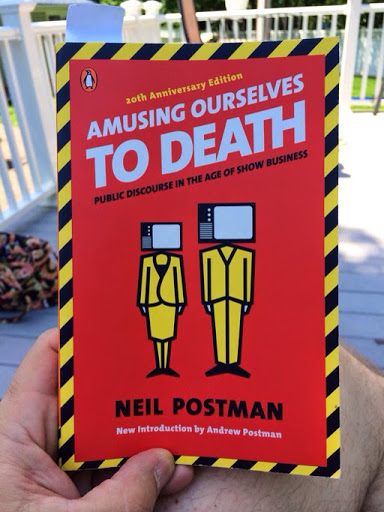
What we blame on the Web really goes back to the telegraph and other mass-communications tools, as Neil Postman points out in 1985:

(Most) of our daily news is inert, consisting of information that gives us something to talk about but cannot lead to any meaningful action. This fact is the principal legacy of the telegraph: By generating an abundance of irrelevant information, it dramatically altered what may be called the “information-action ratio.”

Information, he writes, was divorced from context, creating a flow of disconnected headlines that carry equal weight, regardless of geography or political impact. Think of the cat recently that fought off the dog attack. What relevance does it hold for most of us beyond acting as a conversation starter?

(The) situation created by telegraphy, and exacerbated by later technologies, made the relationship between information and action both abstract and remote.

Rather than reading about crime in our own neighborhoods, we now read about crime everywhere, which distorted crime’s impact and stripped us of a sense of agency or “potency.”
The “whole world became the context for news,” Postman writes. “Everything became everyone’s business.” And ultimately nothing was our business, leaving us feeling politically neutered.

Tennessee removes the death penalty’s cloak of civility

Tennessee is bringing back the electric chair.

I hope that shocks you. I hope it repulses you. But before you give in to that revulsion or shock, ask yourself this: Why doesn’t the use of a drug cocktail bother you the way the electric chair does? What makes the medicalization of capital punishment by forcibly causing someone to overdose on drugs less barbaric than running thousands of volts of power through his body?

These are the operative questions as we move forward, as we try to deal with the aftermath of the nearly botched execution in Oklahoma (I say “nearly botched,” because the inmate ultimately died, which is the point). As Think Progress points out, “lethal injection is commonly viewed as a less barbaric way to kill inmates than more primitive methods such as the electric chair.” But this view is based solely on the notion that there is a nice way to take a life, that the entire business of state-sanctioned revenge killing (if we are honest with ourselves we would admit that the death penalty is about nothing more than revenge) is not, in and of itself, an act of barbarity.

Albert Camus, the French novelist and philosopher, raises this question in “Reflections on the Guillotine” calling the death penalty a form of premeditated murder that leaves the condemned man to face “the horror of his situation,” which “is served up to him at every moment for months on end. Torture by hope alternates only with the pangs of animal despair” To medicalize it with a drug cocktail does nothing to ameliorate this, to make it any less barbaric. It remains, as he says, a premeditated act of revenge perpetrated by the state, no matter how cleverly we attempt to cloak it in the garb of respectability.

Tennessee’s decision to bring back the electric chair may seem shocking, but all it does is lift the veil.

***

Postscript: Here, again, is my most recent column on the issue in The Progressive Populist.

Send me an e-mail.

Recommended reading: ‘The criminalization of poverty’

Here is a strong piece by Radley Balko about a disturbing trend — the use of fees and other additional costs to “pay for” the functioning of the criminal justice system. These add-ons, he says, have “have a disproportionate effect on the poor, because the poor are the people who can least afford to pay them.” That leaves them with skyrocketing costs that they cannot pay and often results in them spending time in jail — not for the original offense, but for the simple fact that they are poor.

Send me an e-mail.

Quote of the Day: The minimum wage

From David Cay Johnston’s column today at Al Jazeera America:

Driving down pay for low-skilled workers — and cutting labor law enforcement so severely that even brand-name employers such as WalMart and McDonald’s steal from their workers through wage theft — is the path to a future in which public costs must rise as overworked people become disabled or die and children grow up less than whole.

Johnston’s point is simple: The best way to ensure a strong economy for the country is to ensure that all workers have the opportunity to participate. You do that by ensuring that work pays, that parents can be present in their children’s lives — rather than at a second or third low-paying job — and that we stop pretending that the people affected by the minimum-wage debate are high school kids working for pocket change.

Send me an e-mail.

Please don’t feed the homeless (updated)

Here is an update — a story from Think Progress on Louisiana’s anti-begging laws.

Here is the latest news in the war on homelessness:

A husband and wife who’ve been feeding the homeless and other needy people in a city park for a year are no longer allowed there after police cited them for illegally feeding a crowd.

The citations and trespass warnings against Chico and Debbie Jimenez and their volunteers are part of an increased effort by the police to discourage Good Samaritans from steering homeless people away from the agencies set up to provide the same services. It’s part of the city’s and county’s broader effort to eventually centralize homeless services.

The city, rightly, says that providing food does not aid the homeless in the long run or address the larger problem of homelessness more generally. The problem with its argument, however, is that asking people like the Jimenezes and their church to refrain from helping people on the streets is cruel. It has nothing to do with homelessness and everything to do with a larger attempt to keep public spaces free of capitalism’s inevitable waste product — human capital that the economic system has decided has no value. I’ve written about this before, but it bears repeating:

The homeless can be seen as the unfortunate by-product of a corporate capitalism that views workers as interchangeable cogs in a larger machine. For those with limited skill sets (and even for some with higher level or specific abilities), their compensation — as the lagging minimum wage shows — has been disconnected from what it takes to live an even modest existence in most areas, leaving them to fall behind and sometimes fall into homelessness.

For those without skills — or for those struggling with medical or mental illnesses and addiction — the system can be far more unforgiving. They have no value, no way — aside from an inadequate welfare system and patchy set of social services – to survive in a country that commodifies everything from housing to health care. So we consign them to the scrap heap – or the woods at the outskirts of a former seaside resort.

This is unsustainable. Housing and utility costs, food prices, health costs all continue to rise, but wages have stagnated. The minimum wage, which has not been increased nationally in six years, does not pay enough to keep a full-time worker out of poverty. And the companies that rely on these workers – and provide them with the health insurance, the food, the housing they need – are earning record profits.

Workers are nothing more than commodities and, as with every other commodity used by our corporate system, their cost to the business sector must be kept to a minimum and excess costs must be socialized.

The result, ultimately, is a group of human beings who find themselves priced out of housing or lacking value in the workforce. They end up on the streets. This puts them at odds with municipal governments and chambers of commerce who want to sell their cities as the perfect destination. Having someone sleeping in the park or on a sidewalk grate disturbs the optics and damages the brand, which triggers action.

As the Daytona Beach News-Journal writes,
Daytona Beach is one of dozens of cities across the country cracking down on mass-feeding of homeless people in public parks. Last month in Alabama, Rick Wood, a pastor who had been driving around Birmingham handing out hot dogs and water for six years, was told to stop because he didn’t have a city permit. In December, in St. Louis, Mo., a street church serving homemade meals was told to stop the day after their program was featured on the front page of the newspaper.

The paper continues that these battles “pits the case for charity against city governments that are trying to keep parks from becoming regular destinations for the homeless” that often are trying to take a more comprehensive approach to homelessness. Daytona Beach, to its credit, is attempting to address homelessness — by creating a single point of intake designed to allow every homeless person in the city to get the specific services he or she needs. (This will be helpful — see the Bergen County Housing, Health and Human Services Center — but it only goes so far. What’s needed is more housing and more decent-paying jobs, along with services for those who are not capable of working.)

Most cities, however, are not taking even this kind of approach. Most, if the news coverage I’ve seen over the last few years is accurate, are more concerned with sweeping the parks of bad visuals than with creating shelter or good jobs for the people on the streets.

Send me an e-mail.