Two peas in a gubernatorial pod

Charles Stile at The Record uses his column today to analyze the under-reported “bromance” between Govs. Chris Christie and Andrew Cuomo. As Stile points out, the two have engaged in what he calls “a political non-aggression pact that has been in force behind the scenes for several years and has benefited the careers of both men.” Cuomo, for instance, has opted not to “hammer Christie throughout the furor” over the George Washington Bridge or to use his notoriety and name to help other Democrats — whether in New York or New Jersey. Christie has done the same, in return, staying above last year’s legislative races for the most part and staying out of the current New York gubernatorial race — despite being president of the Republican Governors Association.

Stile says there are “practical and strategic reasons why both men have collaborated rather than clashed.”

Both pitch themselves to the public as pragmatists who put the greater good ahead of partisan obligations. Attacking each other would only undermine that image.

Stile’s focus is on Christie (he does write for a New Jersey audience), in particular, Christie’s ability to co-opt Democrats by cutting deals that offer short-term gain to those Democrats while burnishing his image as a pragmatist.

What Stile doesn’t discuss — mostly due to space, I would argue — is the transactional nature of the relationships crafted by both Christie and Cuomo (this has been written about in a number of places, but this offers a good overview of what I mean). Nor does he get into the ideological commonalities, which are striking once you remove social issues from the table. Both have placed the health of the corporate sector above other constituencies; both have made budget cutting their mantra; both have targeted public-employee unions; both have attacked public pensions; and both back the expansion of charter schools and school choice.

These commonalities — and the apparent truce (of not alliance) between the two governors — actually says a lot more about Cuomo than Christie. At least the New Jersey governor is being consistent. He’s a conservative and he has attempted to govern as one, with the occasional bone tossed to his liberals (this is New Jersey, after all).

Cuomo, however, is a Democrat and the son of one of the leading liberals of the last quarter of the 20th Century. But he has never been a progressive — he is from the Clinton wing of the Democratic Party, meaning he is more in tune with corporate interests than workers’ interests. And while he has won some important victories on same-sex marriage and gun control, he has reversed course on campaign finance and ethics reform.

All of this is well-known — and it is why he faced a spirited primary challenge from Zephyr Teachout. He is going to breeze to re-election (just like Christie) and his name will remain in play as a presidential contender, though his national reputation (again, like Christie’s and also like Hillary Clinton’s) is based mostly on a press-constructed image and not on what he actually stands for.

The social-issue efforts, of course, will make Cuomo palatable to Democrats, or palatable enough to excuse the rest of his agenda — should the field clear (i.e., should Hillary opt out) and he toss his hat into the ring.

Send me an e-mail.
6 musical notes

Sept. 23 is one of those rare days for me, as a music fan. Four fine new album — among many good ones — were released by some of my favorite artists, and it is the birthday of not just one, but two of my personal musical lode stars.

What follows attempts a brief summary of the day:

Happy 65th birthday to Bruce Springsteen.

It’s hard to imagine, but I’ve been listening to Bruce Sprinsteen for nearly 40 years (his career spans 41 years) and have seen him 10 times (plus once when he made a surprise appearance at the Stone Pony). The Boss has, in many ways, been as influential to my writing — as poet and journalist — and my political philosophy as William Carlos Williams, The New York Times, The Nation magazine and Howard Zinn.

Here is an interesting piece on Springsteen and history — thanks to Eric Alterman for posting it to his Facebook page, which is where I first saw it — that makes a strong case for The Boss’ cultural and historical importance.

Here is a video of Bruce — on the Born in the U.S.A. Tour — performing my favorite of his songs, “Backstreets.”

Happy birthday, John Coltrane.

The great saxophonist was the first jazz artist to capture my attention, and his magnum opus, so to speak, the brilliant A Love Supreme, remains a touchstone and foundation for my sense of sound and of spirituality.

New music:

Leonard Cohen (who turned 80 on Sunday) has released another understated poetic collection. Popular Problems may not be his best recording, but it is quite good and, as The Guardian writes, hopeful evidence that Cohen has more to say and will continue saying it well into his ninth decade.

Imelda May has released another rockabilly-jazz-punk hybrid, Tribal, one that crackles so energy (and features a ukelele version of Blondie’s “Dreaming,” of all things), thanks to one of the better bands in the business.

I love Chuck Prophet and I love his latest, Night Surfer, because it rocks and because his voice reminds me a bit of Iggy Pop on this one.

Tweedy is the side-project of Wilco frontman Jeff Tweedy, and while the band takes his last name as it’s own, it is not designed as a vanity project. The band features Tweedy’s 18-year-old son Spencer on drums (he’s damned good) and its debut album, Sukierae, was conceived and created as a family affair and is thematically centered on the cancer diagnosis of Tweedy’s wife, Susan Miller — listen to the Sound Opinions interview or read Greg Kot’s Chicago Tribune piece for more on that.

The album, of course, is reminiscent of Wilco — as with Wilco, Jeff writes and sings all the songs — though it has a different sonic feel. Based on my first listen, it is one of the better releases of the year so far.

Bringing Tent City’s story to Lambertville

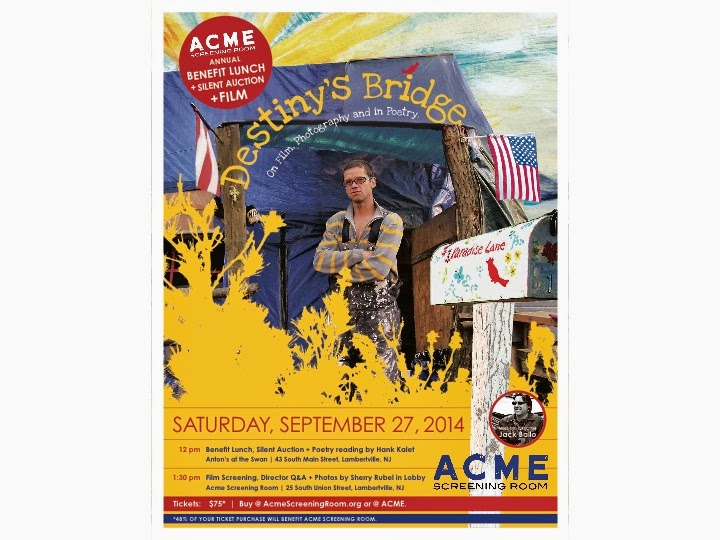
I’ll be reading from As an Alien in a Land of Promise during a luncheon fundraiser for the ACME Screening Room in Lambertville on Saturday.

After the luncheon, there will be a showing of Jack Ballo’s film and an exhibit of photos from Sherry Rubel.

The three of us spent the better part of a year visiting Tent City in Lakewood to document what can only be described as a community of internally displaced persons that sprouted in Ocean County. Lakewood officials fought the camp, which was closed earlier this year, and far too many have attempted to ignore the economic dysfunction that made it unfortunately necessary — and makes it likely that others will continue to sprout.

Now, nearly two years after we began the project, we are back together to present our work to the public — and, hopefully, to draw some attention to the plight of the homeless.

Send me an e-mail.

Unnamed sources are at it again

NBC News reported last night that a federal probe has found no evidence that Gov. Chris Christie knew anything in advance about the closure in 2013 of the local lanes connecting with the George Washington Bridge.

The governor responded last night on 101.5 by saying he was unsurprised. Earlier in the day, he called for an end to the Legislative investigation, which he called a partisan witch hunt. The report, he essentially says, is a vindication. Time to move on.

Perhaps, but let’s step back a bit and review what NBC actually reported.

The U.S. Justice Department investigation into Gov. Chris Christie’s role in the George Washington Bridge lane closure scandal has thus far uncovered no evidence indicating that he either knew in advance or directed the closure of traffic lanes on the span, federal officials tell NBC 4 New York.

The September 2013 closures — where several entrance lanes to the George Washington Bridge in Fort Lee were shut down, causing a traffic nightmare for commuters — has been the subject of several federal and state investigations.

Federal officials caution that the investigation that began nine months ago is ongoing and that no final determination has been made, but say that authorities haven’t uncovered anything that indicates that Christie knew in advance or ordered the closure of traffic lanes.

Two things should be immediately apparent.

1. The sources for this report are anonymous and there is no indication that they can be verified independently.

2. These unnamed federal officials are careful to couch their terms — nothing has been found “thus far” and the investigation “is ongoing and … no final determination has been made.”

I’m not questioning the report’s accuracy, only its sourcing and presentation, which is far more definitive than the reporting seems to indicate.

This is especially true given that the U.S. attorney’s office offered this curt comment to NJ.com:

“The investigation is not over,” said Rebekah Carmichael, a spokeswoman for New Jersey U.S. Attorney Paul Fishman.

But my post is not really about Christie or the bridge scandal. My issue here is with NBC’s use of unnamed sources, a practice that remains widespread among journalists and often results in a distortion of the news and a commandeering of the political news cycle. Implying that the governor has been cleared — which may turn out to be true — could affect the way the story is reported going forward and, in turn, affect public opinion. It may have an impact on the presidential race, on state-level investigations and other matters.

All of this would be acceptable we’re the information being provided to the public was more definitive. That is the trade-off we make. At this point, however, all we are tossing into the public space is speculation.