The day after: Some notes on the inaugural

So, it is done Donald J. Trump officially was sworn in as president Friday.

I didn’t watch — I was doing a interview for a story, though I’m not sure I would have. I hate pomp and circumstance, hate the pageantry that too often conflates elected political power with religious virtue. It is pure spectacle, though the words uttered, the inaugural address that follows the swearing in, matter greatly, as do the reactions of supporters and opponents of the new president.

Trump’s words matter, as do the reactions of the rest of us. His supporters will be supportive, will offer him a honeymoon period — and they should.

But critics are under no obligation, and pretending that unity is our highest priority will only make the defense of the things we believe and the gains we have won in recent years that much more difficult.

Trump’s Speech

Let’s start here, with the thankfully brief remarks he made. As much of the media pointed out, Trump’s speech was a mix of the traditional — borrowing liberally from ideas offered by previous office holders. These were generic and represented his olive branch, his symbolic effort at reuniting the nation. They also were bullshit. As my friend Matt Rothschild, former editor of The Progressive wrote on Facebook, Trump’s call for “total allegiance” and his use of the phrase “America First” to describe his “’new vision’ that ‘will govern our land’” echoed the language used during the pre-World War II period.

“America First” was the name of the isolationist and anti-Semitic organization in the 1930s that wanted to accommodate Nazi Germany.

The America Firsters blamed Jews for the march toward war, and they made the argument that the Nazis weren’t that bad. I’m not looking to argue the merits of WWII; I just want to point out that Trump’s language has these troubling associations.

He also called for “total loyalty” and “unity,” which Rothschild said was a “way to give a veiled warning that he might not tolerate boisterous dissent.”

This is not a surprise. Trump signaled this through out the campaign, belittling critics and endorsing violence against protesters. Yes, he praised open and honest debate but, as Rothschild pointed out, his support was conditional, secondary to “solidarity.”

An assumption of normalcy

Here is a paraphrase of a postmade by a friend on Facebook (I’m not linking to it or quoting directly because I don’t believe it was a public discussion). She is not a Republican, but was critical of those protesting, saying they need to grow up. She wanted to give her “patriotic support” to Trump. That’s fine, if shortsighted and unfair to the bulk of the peaceful protesters and critics of Trump. This is not about maturity; rather, it’s about standing up and defending one’s beliefs.

We need to be careful with our language and not alllow it to be co-opted as support for Trump’s policies. The phrase “patriotic support” is both vague and loaded. It’s vague because it can cover a wide range of emotions, motivations, and actions — including protest. But it’s loaded because it tends to be used in the more jingoistic sense — “my country right or wrong.”

Supporting the office of the president, respecting it, is a legitimate and logical attitude. It implies a respect for the processes that undergird our form of government. But that does not mean I have to support the man in the office or his policies. And it doesn’t mean I’m a sore loser. Here is how I responded:

I’m ready to go forward, which means preventing him from taking us backward. As with any president,I will respect the office but I make no promise that I will just follow along.

I posted elsewhere … that I am not wishing him success because I believe that his promises, if enacted, will be a travesty for the nation and especially for the most vulnerable among us. But I do not wish him failure because abject failure, when embodied in a president, means depression and/or war.

My point is that we are not in a normal moment, with a normal transfer of power. We have a man who targeted Latinos and Muslims during his campaign, associated with overt racists and anti-Semites, dismissed not only science but any sense of intellectual curiosity, and was completely self-aggrandizing. While George W. Bush also was famously incurious, he was not the kind of egomaniac or fellow-traveler. Nothing is normal, and I resent being told to treat things as if they were.

The office continues to have my respect and support, but I make not promises about its occupant.

Violence

Let me say, because I know the question is out there, I do not support the violence that marred the protests yesterday. Violent protest is rarely, if ever, warranted, too often obscures the message and, as Martin Luther King said, undercuts the moral purpose of the protest.

But, and this is important, “riot is the language of the unheard.” It is not justifiable, but can be understandable — though the clashes yesterday are hard to fathom.

Send me an e-mail.
#TBT: Reflections on an aging machine

I’m republishing this essay/blog post from a few years ago, because it summarizes where my mind — and body — have been the last couple of months. I am in the process of editing it, along with a number of other essays, in the hopes of pulling them into a single collection.

Defining Freedom in Track Shoes

No matter how strenuously we fight it, age always wins the battle. The years accumulate on the body like body blows to a boxer, eventually beating the stamina out, the strength and the will. Few boxers can withstand the repeated pounding and they ultimately fade.

Most of us do not have to bare the body blows, not literally anyway. But the wear and tear of everyday existence has the same effect. We age and the cumulative stresses take their toll, so that we ache more than we’d like to admit and the things we did as younger adults — drink into the night, play basketball, go for a run — require significantly more time for healing.

We do battle with the years — or many of us attempt to — and yet the years always win. We change our diet, exercise, take various pills, but our bodies have a limited lifespan. The body always reasserts its will, always has the final say.

I turned 50 in October. I have lived more years to date than I likely have left. And as I look back over this sentence — the use of the word “likely” to describe what is ahead, its wishful, pleading sense — I realize that I’ve tried to qualify the aging process, to wish away the reality of aching bones and a body that is showing its wear and tear. This wishfulness is, at base, the reason I go to the gym. It is the reason I run, or try to — to extend myself, to attempt to gain for my physical being an extended warranty of sorts. It is an effort to extend the life of the physical vessel.

And yet, there is something more to the running. There was a point when I ran for no other reason than it was what I did. It became a central element in my conception of myself; as much as I was a husband and brother and uncle, as much as I was a poet and journalist, I was a runner. I still think this way, even if I have not shown the same commitment that I did five years ago when I was training to run an 18-mile race that would take me the full length of Long Beach Island along the New Jersey coast.

Mark Rowlands, the Welsh philosopher, is philosophical about running. In a discussion on the “Philosophy Bites” podcast, he divides running into four philosophical stages. The first is the “embodied self”: “When you get to my age, you are either injured or you are about to be injured, so as the run starts off I am sort of a fully embodied self and my attention is keenly tuned to anything that might go wrong.” This is the physical stage — when you notice the ache in the knee, the hamstring, the calf. This is the place where I find myself living these days. I have become keenly aware of the injuries and the aches — in particular, the repeated strain or pull in my left calf, in the medial gastrocnemius. It is a sharp, stabbing pain and it takes days, sometimes weeks to heal.

When I was younger, and I only mean eight to 10 years ago, my runs would start out in the physical realm but quickly move on to what Rowlands describes as the Cartesian stage, a stage controlled by the mind. The body becomes the mind’s slave, Rowlands says, and the mind uses an array of tricks to get the body to respond. It is both conscious and subconscious, but it allows us to run through discomfort and exhaustion to reach the next point — the next corner, the next mile marker, the next utility pole — and then continue. The mind, Rowlands says, is duplicitous, but it is firmly in control.

The third stage — what he calls the Humian phase, after the philosopher David Hume — is connected to this second stage, but is far less frontal-lobe in its workings. Where the second phase is concerned with short-term goals and planning, this stage is much less directed. It is the equivalent of automatic writing.

The fourth stage, however, seems key to understanding the runner’s mindset, to understanding why we continue forward even when the reasons pile up and we probably should stop. He described his experience running a marathon a number of years ago. He’d been injured in the weeks leading up and had not had time to do the kind of necessary training. He was, he said, “undercooked.” At about the 14th mile-marker, he began to fade badly.

It occurred to me that there was no reason to stop. I could take all the reasons: You know, the sort of brutal, physical unpleasantness of the whole thing, the pain and the aches and so on. I could take all these reasons that I had to stop, and they were quite good ones really, and I could put them together and allow them to congeal into a dark persuasive mass. But still, they couldn’t make me stop. The reasons had no authority over me. Which is very like Sartre’s view of freedom. We’re free to the extent that our reasons have no authority over us.

Essentially, reasons are excuses. They come from the mind. They are rationales that can make us do things or not do things. But, he says — and this is the key point, I think — “there are reasons and there are causes.” The cause is the real injury. It is the thing that, he says, “deposits” the runner “on the tarmac in a second.” But absent these “causes,” we exert our freedom by acting independently of the reasons we have for doing or not doing things. To continue running despite the pain and aches, to push on despite the growing list of reasons he had to stop, was to demonstrate his freedom.

“Having achieved this realization in the past, I can tell you it is intoxicating,” he says. “To be free in this way is to be free of one’s body, to almost be pure mind.”

And yet, it is an illusory freedom, as any runner — and anyone who has had to live with his or her own physical limitations — can tell you. The physical is always there, always imposing limits. So while the runner may achieve this kind of freedom for a moment, he still has to be able to distinguish between reasons and causes. He has to know whether he is just using his pain as an excuse or whether that pain is signaling to him something more pernicious. It is something that becomes more difficult as we get older.

When I hurt my right calf a few weeks back, I ran through the pain. I finished my three miles, but the injury kept me from running for two weeks. I used the elliptical, which mimics the running motion without the pounding, but then did not get back onto the treadmill for several weeks when I set out for another three miles. The injury had not healed — in fact, I re-injured it — and I then faces another idle stretch. What I think this shows is that the differences between Rowlands’ reasons and his causes can change and do change with time. What may have been pure rationalization when I was younger, just an excuse to stop, has become something more, something potentially problematic. What was a trick of the mind is now a very real demand of the body that must be acknowledged.

In the end, we have no choice but to acknowledge the limitations our bodies impose on us, to recognize that these limitations may become greater as we get older. Running now has become a reminder of limitations, of the physical nature of existence, of the fact that there is an expiration date on our bodies. A scary thought, perhaps, but it is something from which we cannot escape.

Running is something I do because I want to and not because I need to — even if I may need to do it on some level to take off weight and address impending health issues. I run regardless of all of this because, no matter how much effort I put in, I know that I will never be able to escape the impact of Father Time. So I run because I want to, despite all of the reasons both for and against my doing so. Rowlands might say that this is an extension of the fourth stage. To do something just to do it, because we want to and not because we must, is to get to its intrinsic value, to find the absolute freedom in the effort.

Send me an e-mail.

Weekly reminder: Buy my book

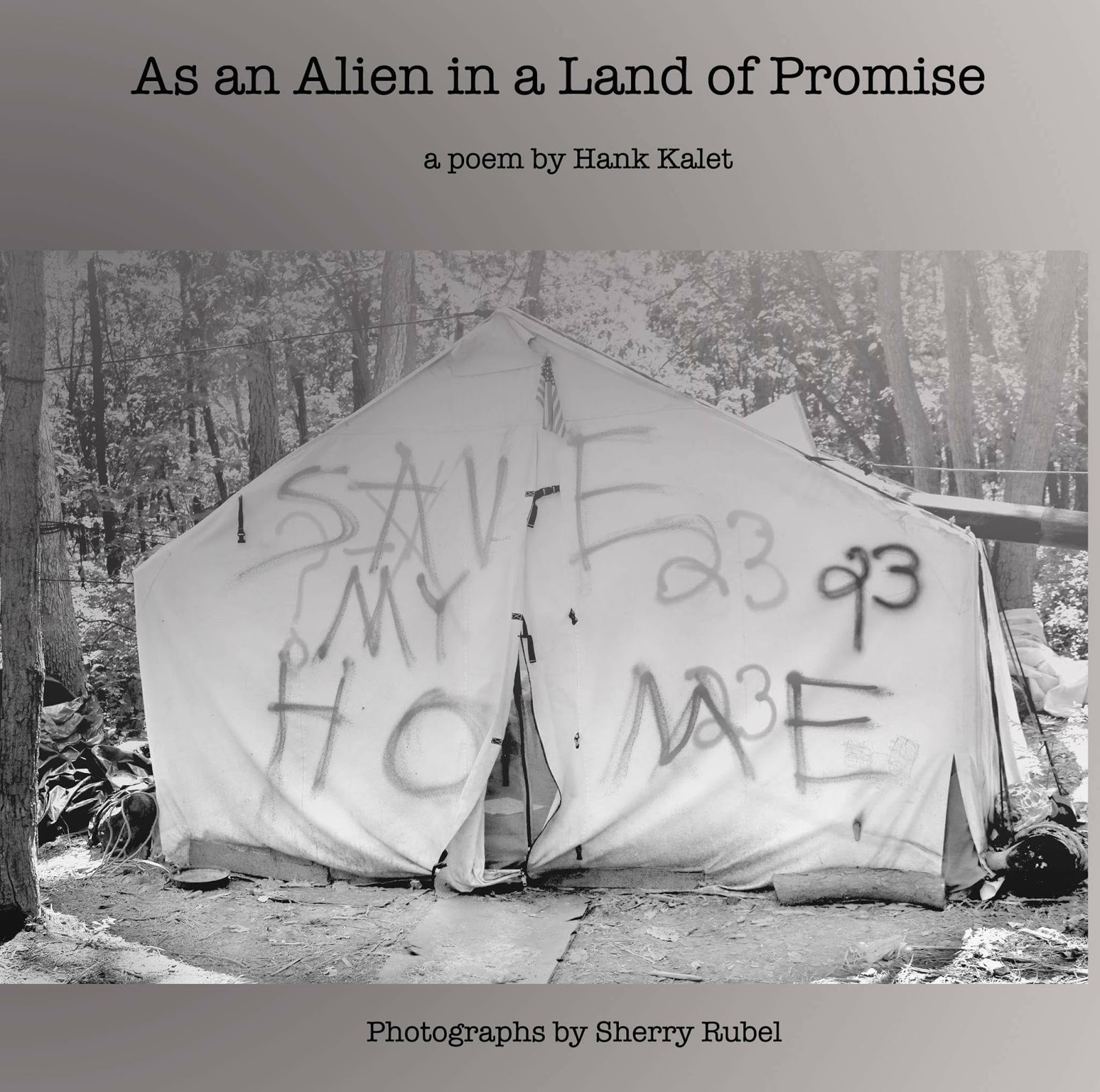
Reminder: As an Alien in a Land of Promise is available for purchase

Hank Kalet’s As an Alien in a Land of Promise is a book-length mediation on homelessness and American capitalism. Interspersed with Sherry Rubel’s black-and-white photos, the hybrid work of poetry and journalism tells the stories of those living in a now-defunct homeless camp in central New Jersey, asking why our economic system turns people into refuse.

Based on a year of interviews and research in the former Tent City in Lakewood, Kalet tells the stories of people like Angelo, who lost his job in the crash of 2008, and the musician Michael. Interspersed with their voices – and those of “the pastor,” are writers like Jonathan Kozol and Michael Harrington, whose earlier research informs Kalet’s work.

The poet Eliot Katz, a former advocate for the homeless in New Brunswick, calls the book an “inventive mix of objectivist-influenced, journalistic poems and moving photographs” that “brings real, often-ignored human stories, statistics, and local geographies to life.”

B.J. Ward, author of Jackleg Opera, says Kalet “works in the poetic traditions of the inspired and observant narrator in Whitman’s ‘The Sleepers’ and, with his sense of lineation, Williams’ image-emphasis.”

Kalet is a journalist, essayist and poet, whose work appears regularly in NJ Spotlight and has been published by The Progressive, In These Times, The Progressive Populist, Main Street Rag, Lips, The Journal of New Jersey Poets and elsewhere. He is the auther of Stealing Copper, Certainties and Uncertainties, and Suburban Pastoral.

The book is published by the independent Piscataway House Press.

For more, see asanalieninalandofpromise.wordpress.com/ The book can be ordered at channel-surfing.blogspot.com/p/buy-books-by-hank-kalet.html, from Piscataway House, or Amazon. For press information, contact Hank Kalet at hankkalet@gmail.com. Press kit available upon request.

Send me an e-mail.