Trump wins ‘serious’ support in Syria

In mainstream political discourse, one cannot be considered “serious” until one endorses military action. We saw this in the wake of the Bush war in Iraq, when critics of the invasion were ruled out as legitimate political actors even after the proved to be the disaster we predicted it to be.

And we’re seeing it again as foreign policy wonks rush to support Donald Trump’s rash and seemingly impetuous response to Syrian dictator Bashar al-Assad’s chemical attack on his own people — giving it a thumbs up and arguing that it turned the buffoonish commander-in-chief into a real president.

Fareed Zakaria, a CNN host and regular columnist for The Washington Post, said Saturday that Trump became president with his air strikes. He remains critical, as Mediaite reports, but doubled down on his original praise. “[I]n the short term, the president struck a blow against evil, for which I congratulate him.”

Zakaria was joined in his admittedly qualified praise by liberal interventionists like Nicholas Kristof, who opposed the Iraq War on what can best be described as practical and not particularly convincing terms. Kristof endorsed the missile strike as a way to deter not just Assad but “the next dictator for turning to sarin” and to maintain the international “taboo on the use of chemical weapons.”

For an overstretched military, poison gas is a convenient way to terrify and subdue a population. That’s why Saddam Hussein used gas on Kurds in 1988, and why Bashar al-Assad has used gas against his own people in Syria. The best way for the world to change the calculus is to show that use of chemical weapons carries a special price — such as a military strike on an airbase.

Kristof also recognizes that Trump’s haphazard foreign policy may have created a “perceived … green light,” which made “it doubly important for Trump to show that neither Assad nor any leader can get away with using weapons of mass destruction.”

Kristof, as I said, is somewhat muted in his praise. Others are supporting the strike, while adding that it does not really address the long-term issues. David Ignatius in The Washington Post, for instance, called it “a decisive step that Obama resisted,” adding that there remains “a dilemma of how to bring political change to a Syria shattered by six years of civil war.”

Robert Kagan, a neocon who calls himself a “liberal interventionist,” agrees. He wrote — also on The Washington Post, which tends to be home to the most hawkish op-ed writers among the mainstream — that Friday’s missile strikes were “a critical first step toward protecting civilians from the threat of chemical weapons.” More tellingly, he gives Trump credit for “doing what the Obama administration refused to do,” while calling on Trump to do a lot more.

Thursday’s action needs to be just the opening salvo in a broader campaign not only to protect the Syrian people from the brutality of the Bashar al-Assad regime but also to reverse the downward spiral of U.S. power and influence in the Middle East and throughout the world. A single missile strike unfortunately cannot undo the damage done by the Obama administration’s policies over the past six years.

Zakaria, Kristof, Ignatius and Kagan do not operate on the same plane when it comes to military intervention and might best be described as offering a continuum on the use-of-force in humanitarian situations. Kristof is by far the least hawkish, reserving military might for very specific humanitarian aims. Ignatius is more hawkish, but still cautious. Kagan, of course, is a full-blown hawk.

What they share is that they are taken as serious voices on intervention in a way that others who should be given broader public platforms — Juan Cole and Andrew Bacevich, as examples — often are not. And they have used their platforms in an attempt to lend credibility to a very uncredible president.

Jeremy Scahill, a veteran war correspondent and critic, was withering in his response to Zakaria — and the resit of the interventionist punditocrisy:

“You know, Fareed Zakaria––if that guy could have sex with this cruise missile attack, I think he would do it,” Scahill argued to Brian Stelter, host of “Reliable Sources.” He also slammed Brian Williams after referring to the Pentagon video of the strike, as “beautiful.” Scahill said Williams appeared as if he was in “true love.”

As we move forward it will be interesting to see how the major media cover the aftermath — not just in their reporting but in their choice of sources. Will they continue their love affair “serious” analysts like Zakaria and Ignatius and their use of retired military (see the Scahill link for more on this), along with granting significant time to Congressional and Senate hawks (enough with John McCain and Lindsay Graham already), while generally freezing out critics? The lineup for the network morning shows this morning was instructive — the closest we got to critics of the airstrikes were the responses from Tim Kaine and Bernie Sanders, both of which focused on process and not on the morality of Trump’s actions.

This, ultimately, leaves military action as the default response, robbing the American people of a fully fleshed out debate over Trump’s actions and what our role — if any — should be in Syria.

Send me an e-mail.
A poem for Passover and Syria

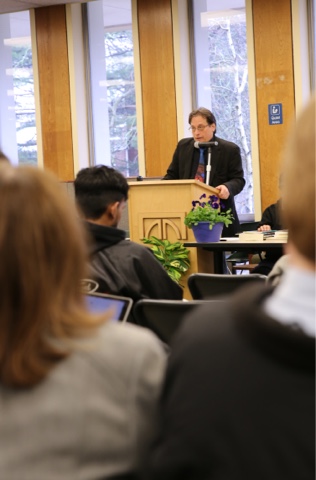
Photo by Thomas Peterson of me reading at Middlesex County College.

I wrote this poem a couple of years ago — I think — in response to a story in The New York Times on the refugees streaming out of Syria. Given this week’s saran gas attack by the Assad regime on its own people, and the unnecessary, immoral, and counterproductive missile attack in response by President Trump, I thought I’d share it today.

I read it yesterday during a spring poetry event at Middlesex County College in honor of the upcoming holiday and the Syrians, who are being blocked by our government from coming here for safety. This was before I learned that the president ordered a missile attack and made it clear he sees war as a viable tool.

Send me an e-mail.

For Trump, war appears to be the answer

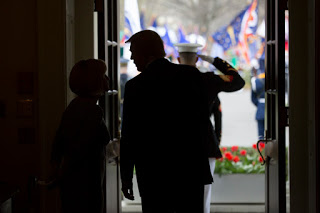
Moments before Egyptian President Abdel Fattah Al Sisi arrives at the West Wing Lobby of the White House, President Donald Trump talks with a member of staff on Monday, April 3, 2017, in Washington, D.C.  (Official White House Photo by Benjamin Applebaum)

Donald Trump’s response to yesterday’s chemical attack in Syria, likely perpetrated by the Assad government, was fairly boilerplate — except that it spread blame beyond the Assad regime to include  former President Obama, damning Obama’s attempt at navigating one of the more delicate foreign policy challenges of his or any administration without offering any kind of direction of his own.

Today’s chemical attack in Syria against innocent people, including women and children, is reprehensible and cannot be ignored by the civilized world. These heinous actions by the Bashar al-Assad regime are a consequence of the past administration’s weakness and irresolution. President Obama said in 2012 that he would establish a “red line” against the use of chemical weapons and then did nothing. The United States stands with our allies across the globe to condemn this intolerable attack.

The response is confusing. Trump calls the attack heinous, connects it to Assad, but essentially blames Obama. We stand with allies, he says, but does not say how. It’s as if this statement was the least he could offer, given his lack of interest in the civil war that has raged in Syria beyond its impact on the growth of the Islamic State — and the increase in American troops on the ground in Syria.

This inconsistency is fairly consistent. The Trump administration seems to be backing away from the Obama era focus on Bashar al-Assad, which theoretically should make it easier to get all sides to the table and potentially negotiate an end to what is now a nearly five-year-long civil war. I say “theoretically,” because President Trump does not appear concerned with the civil war except with how it affects his ability to go after the Islamic State.

Trump has made it clear that the United States’ only concern in the region is the destruction of ISIS. He has increased the number of soldiers on the ground in Syria and has ignored calls from even those in his own party to prioritize ending the civil war.

To be fair, Trump is in a difficult spot. There are no easy answers in Syria — arming the rebels and picking sides, as Sen. Jon McCain (R-Ariz.) advocates, makes little sense, nor does the calls for Assad’s removal, no matter how brutal he has been. That’s just not our call, and any decision to remove Assad would need to come from the Syrian people as part of a negotiated peace.

But Trump’s America First foreign policy, which echoes some of Obama’s language and many progressive arguments against foolish foreign engagements, lacks coherence. Obama’s goals were pretty much in line with long-term American foreign policy interests — a focus on human rights and democracy, but tempered with a real politik concern for impact on Americans. And while power was located in the White House, Obama’s secretaries of state, Hillary Clinton and John Kerry, commanded attention on the world stage and projected a sense of legitimacy. The same, at this point, cannot be said about Rex Tillerson.

I’m not endorsing the Obama approach. He remained too enamored of military means and made far too much of what were minor military successes (I’m in the minority here, but the killing of bin Laden ultimately was more about public perception than anything else). My preference is for multilateral diplomacy that preserves national self-determination, which in Syria would mean bringing all participants to the table.

This may be a pipe dream, as well, but I’m just a local blogger and do not have to do the heavy lifting. Trump is president and has at his disposal all of the tools of the office — and yet, he continues to operate as reality TV star with an overactive Twitter account and extreme sensitivity to criticism.

Trump, essentially, has no plan. This was the criticism of Obama from the right — and was the criticism of Bill Clinton in the 1990s — but there it seems more accurate when applied to Trump. Colin H. Kahl, in Politico, describes the Trump Doctrine (if there is one) as “shoot first” and as lacking in the civilian (i.e., diplomancy) components of a functioning foreign policy.

In charting a new course to combat terrorism across the greater Middle East, Trump has both embraced and rejected elements of the George W. Bush and Barack Obama approaches—but he has done so in an almost perfectly dysfunctional way. He has escalated U.S. military actions, while remaining diplomatically aloof from festering conflicts and de-emphasizing non-military instruments of American power. The result, so far, is a kind of bizarro-Goldilocks approach: not hot enough, not cold enough—just wrong. Left uncorrected, the emerging Trump doctrine will result in more war, but few sustainable gains against terrorism emanating from the world’s most dangerous region.

It also is likely to result in less concern for civilian casualties. Kahl writes that, “as the list of countries considered areas of active hostilities grows beyond Iraq and Syria, we can expect civilian casualties to rise in places like Yemen and Somalia as well,” which has damaging moral implications and “could undermine the efficacy of the U.S. counterterrorism campaign.”

The United States has benefited from the notion that, unlike ISIS and al Qaeda, it does not wantonly kill innocents. That perception could now be put in jeopardy. As Hussam Essa, a founder of an organization that monitors violence in Raqqa, told the Washington Post: “People used to feel safe when the American planes were in the sky, because they knew they didn’t hit civilians. They were only afraid of the Russian and regime planes. But now they are very afraid of the American airstrikes.” If sentiments like this become widespread, it could shift the sympathies of local residents back in the direction of jihadists, complicating the liberation of ISIS’s remaining strongholds and increasing prospects for the re-emergence of extremism in the aftermath.

Our focus, so far, has been on the Trump-Russia connection and Trump’s domestic agenda. This is understandable. We must maintain some focus on military matters.

Send me an e-mail.

South Brunswick Crime Trends

South Brunswick remains a relatively safe community. State Police statistics show that overall crime in South Brunswick in 2016 — 11.9 crimes per thousand residents (533 overall) is less than half the state figure of 24 crimes per thousand. Violent crimes are less frequent — 0.4 in South Brunswick, compared with 2.4 statewide.

Here is what the month-to-month trend has been since January 2016.

The breakdown of crimes committed in 2016 looks like this:


Send me an e-mail.