I’m trying something a bit different this year. Rather than an alphabet soup offering my take on the year just passed, I’ll be rolling out several short lists — starting today with the five biggest disappointments of 2015.
Author: hankkalet
Notes on ‘The Force Awakens’
Star Wars: The Force Awakens Trailer (Official) on Disney Video
Star Wars: The Force Awakens is out nearly two weeks now and, as could be predicted after the release-week hype, we are witnessing a critical and fan backlash of sorts.
A friend posts that The Force Awakens is the worst movie to gross more than a billion dollars in its first weekend. Others are calling it derivative, going so far as to call it a form of plagiarism. The acting has been derided, the storytelling questioned, and on and on.
On the other side is the full-bore defense, with point-by-point rebutted.
I can see both sides of this: The Force Awakens is a thrilling ride, well paced and compelling, helping to erase the stench of the three prequels. It also is derivative and was over-hyped.

I saw the movie this week, for the second time, which gave me a chance to temper my initial enthusiasm and let the hype recede. My judgment remains essentially the same: The Force Awakens re-energizes the Star Wars franchise, recapturing the feel of the originals. But I have to admit the film is flawed, but only because the entire franchise is also flawed: It’s really nothing more than a glorified cowboys-and-Indians saga layered with Eastern and Christian mysticism.
I think much of the hype on both sides owes to Star Wars’ place in our imagination. It is generational, and it means we remember the film as being a better cinematic product than it actually is. As I said, the original hits on all of the problem spots: cliches? Got ’em. A overly simple storyline? Yep. Less-than-stellar acting? Got that too.
The new movie is plagued by all of these things, as well, plus it is weighed down by the nearly 40 years of memories that few films have to carry. Even the longest-tenured franchises — James Bond, for instance — have less emotional baggage to carry.
So, what do we make of this latest awakening?
1. It is, as I said, a rebirth of sorts. My friend Vince called it a reboot without the rebooting, and I think that is accurate. It carries all of the old tropes without getting bogged down. It retreads much of the same thematic territory — birth of the hero, good. v. evil, the need to balance the “force” — without tripping over itself.
2. It is derivative and an excuse to sell toys. But we can say that about the previous four films (Empire Strikes Back remains the most complete and fleshed out of the series, while the three “prequels” are just eye candy).
3. The acting is universally mediocre, but consistent with the B-movie-meets-blockbuster sensibility that buttresses the entire franchise.
4. It is great to see Harrison Ford and Carrie Fisher, along with Chewbacca, but Ford hasn’t turned in a good performance in years. As Vince said after we saw it earlier this week, Ford just mugs his way through this.
5. The decision to have a woman be the newest Jedi savior is genius. After years of essentially reinforcing gender stereotypes, we have a female character who not only breaks the mold, but needs no help from anyone. Ray makes this film work.
6. Finn gets to play a variant of the Han Solo arc — struggling within himself over whether to join the resistance. It is a story as old as stories and serves this movie well.
7. The good-v.-evil storyline has less of a Reagan “Morning in America” feel than the earlier films did and more of a sense of liberty v. tyranny. Leia is no longer a princess, but a general in a rebel army, allowing the film to move away from an endorsement of rightful heirs and monarchical bloodlines.
8. Whatever else can be said about this movie, it moves. Its pacing is, with a few exceptions, exceptional. I found that I couldn’t fully sit back, even on second viewing, even as when I knew what has going to happen.

Music notes: The Byrds in 7
We went to see a friend’s band on Sunday — a pickup band featuring guys playing their favorite classic rock. It was a loose affair, but the harmonies were tight and it made for a nice respite from grading and the craziness of the season.
It was an interesting mix of songs, but one jumped out — “I’ll Feel a Whole Lot Better” by The Byrds. The guys did a nice job with a song that, while sounding simple, is one that helped remake rock ‘n’ roll. Critics credit The Byrds with creating a new genre, folk rock — a hybrid of Dylan folk and Beatles rock. That’s probably too simple — 1965 was also the year Dylan went electric and released both Bringing It All Back Home and Highway 61 Revisited and The Beatles issued Rubber Soul.
But The Byrds added something to the mix — a California feel, perhaps, or a softer sound infused with a kinetic charge that made it feel revolutionary.
“I’ll Feel a Whole Lot Better” appears on Mr. Tambourine Man, which came out in the summer of 1965. A second Byrds album, Turn! Turn! Turn!, arrived in December of that year — making this year that is closing the 50th anniversary of the band. (It also is the 50th anniversary of what may be the single most significant year in rock history, but that’s another discussion.)
What strikes me is that The Byrds are sometimes overlooked, that when we tick off the list of important and influential rock acts, The Byrds do not always make the list, though there is no question they belong.
1. 12-string guitars: The Byrds were not the first to use the 12-string, but the band’s reliance on the instrument created a signature sound that many have tried to emulate. The jangling sound has influenced many, most notably early Tom Petty and the power pop movement led by Big Star.
2. Roger — or is it Jim — McGuinn: McGuinn was a transformative guitar player. Rolling Stone ranked him 95th (I’d rank him higher) and had this to say about him:
Roger McGuinn’s sparkling, chordal 12-string Rickenbacker riffs on the Byrds‘ early hits were the sonic bridge between folk and rock – and an irreplaceable color in rock’s palette: Every indie band who’s more interested in beatific strumming than screaming solos owes him a debt (the striking break in “Bells of Rhymney” could be on a Smiths record). McGuinn could do a lot more than chime, however, as demonstrated by his still-astonishing psychedelic-raga-Coltrane licks on “Eight Miles High.”
3. Gram Parsons and the creation of alt-country: Four words (an album title) — Sweetheart of the Rodeo. Simply a breathtaking work, it is Americana or alt-country years before we recognized those genres.
4. Those harmonies: In early rock, only The Beatles’ use of harmonies was as divine.
5. “Eight Miles High”: Listen to McGuinn’s guitar. Just listen. No one was doing that in rock at the time, and few have done it as impressively since.
6. “So You Want to be a Rock ‘n’ Roll Star”: A parody of the the industry, the song flat out rocks — and features among the greatest trumpet work (by the legendary Hugh Masekela) on a rock record you will ever hear.
7. Aside from, maybe, Jimi Hendrix — and this a big maybe — no one covers Dylan like Roger McGuinn and company. From their debut record, Mr. Tambourine Man through the early ’70s, the band in its many incarnations turned out one great cover after another of the rock bard’s songs. (They were eventually collected on a single record long after the band split.)
#onPC: A Twitter essay on political correctness
Another Twitter experiment — an essay on political correctness and its variations,
#onPC 1. Student filed assignment on #politicalcorrectness @RutgersU campus. Article struggled w/definition — consistent w/current use.
— Hank Kalet (@newspoet41) December 11, 2015
#onPC 2. She interviewed students 2 explain or debunk problem on campus. But no 1 sd what problem might b. #PoliticalCorrectness
— Hank Kalet (@newspoet41) December 11, 2015
#onPC 3. Malleability of phrase #PoliticalCorrectness means debate over PC is not a debate @ all.
— Hank Kalet (@newspoet41) December 11, 2015
#onPC 4. The term #PoliticalCorrectness has its legitimate uses as a check on dogma.
— Hank Kalet (@newspoet41) December 11, 2015
#onPC 5. But this is true only if wet careful w/definitions. #PoliticalCorrectness
— Hank Kalet (@newspoet41) December 11, 2015
#onPC 6. Most public figures who use #PoliticalCorrectness use it as an epithet, as a way 2 shut debate.
— Hank Kalet (@newspoet41) December 11, 2015
#onPC 7. When #Trump decries #PoliticalCorrectness he does so 2 dismiss his critics, whose critiques he says r w/o substance.
— Hank Kalet (@newspoet41) December 11, 2015
#onPC 8. #Seinfeld & others, 2 a lesser degree, wield phrase #PoliticalCorrectness 2 avoid self examination.
— Hank Kalet (@newspoet41) December 11, 2015
#onPC 9. These college kids, #Seinfeld says, r being #PoliticallyCorrect — 2 sensitive. It's never abt what he says. #PoliticalCorrectness
— Hank Kalet (@newspoet41) December 11, 2015
#onPC 10. Sometimes it is a hypersensitivity, but wielding the term #PoliticalCorrectness w/such ease shuts debate. No discussion necessary.
— Hank Kalet (@newspoet41) December 11, 2015
#onPC 11. Is it #PoliticalCorrectness that drives the response 2 #trump & his #muslimban or his bashing of immigrants?
— Hank Kalet (@newspoet41) December 11, 2015
#onPC 12. #Trump certainly has the right 2 say what he says, however noxious & I'll defend that right. #PoliticalCorrectness
— Hank Kalet (@newspoet41) December 11, 2015
#onPC 13. But I have the right 2 call #Trump out. Just b/c he CAN say something does not mean he can't b criticized. #PoliticalCorrectness
— Hank Kalet (@newspoet41) December 11, 2015
#onPC 14. Calling criticism of speech #PoliticalCorrectness is a dodge, as is equating criticism w/censorship.
— Hank Kalet (@newspoet41) December 11, 2015
#onPC 15. The phrase #culturalappropriation may fall into the same category as #PoliticalCorrectness — overused & lacking precision.
— Hank Kalet (@newspoet41) December 11, 2015
#onPC 16. Like #PoliticalCorrectness #culturalappropriation purports 2 describe a real phenomenon but does so 2 broadly
— Hank Kalet (@newspoet41) December 11, 2015
#onPC 17 #culturalappropriation used 2 describe everything from #IggyAzalea & #VanillaIce 2 #Eminem & Elvis. Usually is meant derisively.
— Hank Kalet (@newspoet41) December 11, 2015
#onPC 18. Does qualitative difference among these artists factor into debate over #culturalappropriation & shd it? #PoliticalCorrectness
— Hank Kalet (@newspoet41) December 11, 2015
#onPC 19. Perhaps the problem is in defining #culturalappropriation as always being negative. #PoliticalCorrectness
— Hank Kalet (@newspoet41) December 11, 2015
#onPC 20. Sometimes borrowing leads 2 great art/new forms. #Elvis, #countryblues, #honktonk . #PoliticalCorrectness #culturalappropriation
— Hank Kalet (@newspoet41) December 11, 2015
#onPC 21. Sometimes #culturalappropriation is posing – #IggyAzalea – though we have 2b careful not 2 assume intention #PoliticalCorrectness
— Hank Kalet (@newspoet41) December 11, 2015
#onPC 22. I'm not arguing that either phenomena is a lie, only that the terms lack precision. #PoliticalCorrectness #culturalappropriation
— Hank Kalet (@newspoet41) December 11, 2015
#onPC 23. It occurs 2 me that black #respectabilitypolitics works the same way #PoliticalCorrectness #culturalappropriation
— Hank Kalet (@newspoet41) December 11, 2015
#onPC 24. Much of this is debate over authenticity. Who is authentically American, black, etc #culturalappropriation #PoliticalCorrectness #
— Hank Kalet (@newspoet41) December 11, 2015
#onPC 25. Tho we don't like 2 admit it. These terms r the way we define our world. Jargon narrows it #PoliticalCorrectness
— Hank Kalet (@newspoet41) December 11, 2015
#onPC 26. The retreat into jargon — a form of dogma — is a retreat from complexity & nuance. #PoliticalCorrectness
— Hank Kalet (@newspoet41) December 11, 2015
Send me an e-mail.
#twowrongs — a Twitter essay of sorts on ‘The Donald’
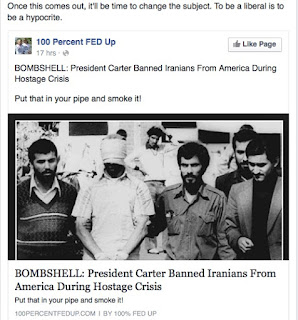
I’ve been seeing a lot of this kind of reasoning on Facebook the last couple of days (I removed the name of the poster):
The point of this link and others is to call liberals out as hypocrites. “Carter did it,” this argument goes, so what do have to say about that?
My response is simple: so what? Carter was wrong. I have no problem saying that and many of my liberal friends feel as I do.
But the reality is this is part of a larger pattern used to deflect focus from what is on the table today.
1. Getting tired of conservatives defending indefensible by saying “but Obama,” “but Clinton,” “but Carter.” #twowrongs— Hank Kalet (@newspoet41) December 9, 2015
2. Own yr arguments. If u think #Trump is right, tell me why & stop pointing 2 others’ moral failing as excuse. #twowrongs— Hank Kalet (@newspoet41) December 9, 2015
3. Yr argument is political equivalent of “but mom, they did it too.” #Trump #twowrongs— Hank Kalet (@newspoet41) December 9, 2015
4. Remember what yr mom sd: “just b/c yr friends were stupid & jumped off the roof, doesn’t mean u shd b stupid too.” #Trump #twowrongs— Hank Kalet (@newspoet41) December 9, 2015
5. #Trump call 4 #muslimban is contrary 2 American ideals (if sadly consistent w/our history). It is form of racism. #twowrongs— Hank Kalet (@newspoet41) December 9, 2015
6. #Trump #muslimban might even fall on #ethniccleansing continuum in that its goal is reducing size of Muslim population in US. #twowrongs— Hank Kalet (@newspoet41) December 9, 2015
Called out by a friend on this specific point on Facebook, so I offer this clarification (from my Facebook response):
Hyperbole on my part. Yes. It isn’t ethnic or religious cleansing, but the specific targeting of a religious or ethnic group with the intention of separating them in some way (physically, symbolically) from the general population would seem a first step in its direction — hence my calling it a continuum. You start by painting a group as a threat, then you use legal measures to control them in some way (which, at the very least, confers legal status on their separateness), then you expand those measures beyond control, and so on. I think Trump’s rhetoric falls at the beginning of that continuum.
To elaborate further: Banning entry of an individual religious or ethnic group by force of law or executive order is creating a separate legal class for that group, which then opens the doors for other things. Does this mean that a more explicit form of agitation and separate will waltz in through that door? No. A lot of other things would need to occur before something like that might follow. But opening the door does seem a dangerous first step.
— Hank Kalet (@newspoet41) December 9, 2015
This line of argument has been building up for a few days as I attempted to respond on Facebook to some of the memes and links that have been circulating, but the response to my posting of today’s Daily News cover ultimately led me to put it in writing (or tweets):
The Daily News in full crusader mode.
Posted by Hank Kalet on Tuesday, December 8, 2015
So, jump into the fray. What do you think. Answer in the comments, or feel free to join in the fun on Twitter or my Facebook page.
Send me an e-mail.