Ah, I fear that many of my mainstream liberal friends are drinking the Washington Kool-Aid, buying into the notion that the vaunted Iraq Study Group has actually recommended something creative or earth-shakingly important.
Sen. Bob Menendez leads the way with a rather limp response (though better than the one offered by New Jersey’s other U.S. Senator, Frank Lautenberg) to the report that proves the Rorshack nature of the report. Menendez follows the “see-the-report-proves-Bush-was-wrong” tack that so many are taking (as if we didn’t know that already) but does not really offer a cohesive approach to disentangling us from this mess.
And read this editorial in The New York Times, which admits the split-the-difference nature of the report and praises the “political cover” it offers to an administration out of touch with reality. The Boston Globe offers a similar assessment — saying it struck a “realistic and worldly tone” and might just offer the president a path back to reality.
I’m not buying it. The report, the product of a group of Washington insiders, does little more than state the obvious — that the Iraq mission is a failure, that diplomacy is needed and that a solution must be found to the Israel-Palestine issue. It tilts toward bringing American troops home but calls for a significant troop presence to remain and ignores one very basic fact: The mission is a failure because it is one that never should have been undertaken.
William Hartung, a senior fellow at the World Policy Institute in New York, offers a pretty straightfoward critique of the report on Common Dreams, closing with this point:
By offering the prospect of some change – even if it leaves tens of thousands of combat troops and trainers in Iraq in 2008 and beyond — the Baker-Hamilton report could take pressure off Republicans and Democrats alike. Major figures in both parties could be relieved of the demand to push for a genuine withdrawal prior to the 2008 presidential elections.
Citizens who want a quicker timeline for U.S. withdrawal and a genuine military disengagement from Iraq will need to make their voices heard if U.S. policy is to go beyond the half-measures set out by the Baker-Hamilton panel.
It is a point echoed by Tom Hayden:
But the ISG equivocates on the alternative to prolonged war, speaking of “one last chance” to “succeed.” The panel’s proposed gradual pullback of 15 US combat brigades by early 2008 is a welcome alternative to presidential rhetoric about “staying the course.” But there is no deadline attached to the recommendation. There is no recommendation that they all be brought home. The ISG envisions keeping at least 70,000 or more US troops in Iraq for the long-term. Does the ISG imagine that the Iraqi nationalist insurgency will fade away? Does the ISG imagine that a “new” Iraqi army with US trainers will succeed against a nationalist insurgency and militias? Will US trainers be successful where US ground troops failed? Or is this the revival of the “decent interval” doctrine that ended in the collapse of South Vietnam after the US withdrew? No one knows what may be between the lines of this report.
But on their face the ISG recommendations fail to reflect the desire of the American people, and the Iraqi people, for military withdrawal, as measured in polls. Sixty-two percent of all Americans favor withdrawing all our troops, either immediately or within one year. Eighty percent of all Iraqis feel the same way, even more strongly; sixty percent favor armed resistance against US troops.
A diplomatic offensive will succeed only if the US counter-insurgency, bombing and occupation is abandoned. Merely proposing to talk with Iran and Syria only postpones the question of whether US troops will be withdrawn. The American government should end its Cold War towards Iran and Syria and begin open-ended talks about solutions to regional problems, including the humanitarian crisis of cross-border refugees and a political settlement of the Palestinian crisis. But state-to-state diplomacy is no substitute for addressing directly the grievances of the nationalist resistance movement who have been fighting the occupation since 2003. Above all, they are demanding a timetable for withdrawal and support for a national reconciliation process.
The political goal of the ISG report appears to be a reduction of US casualties and maintenance of a low-visibility US occupation as another American national election looms in 2008. The danger is that many Americans will be lulled with the familiar and deceptive promise that “peace is at hand.”
Another critical take come in the form of this op-ed from The Boston Globe by Peter W. Galbraith, who served as the first U.S. ambassador to Croatia. He criticizes the report as one part self-deception, another part delusion:
Iraq has broken up and is in the midst of a civil war, but this is never acknowledged in the report. The panel seems to assume that nation building is still possible in Iraq, and this underlies its recommendations. The result is a report that, on the most essential points, is pie in the sky.
The report, rather than pointing a way out, may tether us to the smoldering inferno well into the future. The subtext, unfortunately, is Galbraith’s contention that partition is in the offing (he doesn’t say it directly, but he uses the experience of the former Yugoslavia as a template for much of his argument). I’m not sure, given the location of oil in Iraq that this makes sense (partition would somehow have to equally distribute oil wealth, which may not be possible without forced (and morally suspect) relocations.
But his overall point is key: The Baker panel has not faced the “reality of a disintegrated Iraq” and “has missed an opportunity to forge a consensus around concrete steps that could contain Iraq’s civil war and extricate the United States from the quagmire.”
Sen. Russ Feingold (clip from “Countdown with Keith Olbermann” from Crooks and Liars, via Brilliant at Breakfast) also isn’t buying it, nor is U.S. Rep. Rush Holt (who should have been chairman of the House Intelligence Committee).
I’ll leave the final word, for now, to Matthew Rothschild, editor of The Progressive. He calls the report “criticism on the margins,” and “based on a central fantasy: that magically, within a year, the Iraqi Army will be able to take over most of the fighting from U.S. combat forces.”
And, most importantly, he worries that the report, rather than leading to a more open debate, will actually put an end to the discussion:
But having made its criticisms on the margins, the Baker Report is trying to silence others about the fundamentals.
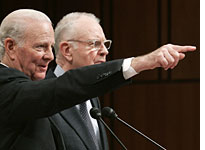
“Success depends on the unity of the American people in a time of political polarization,” James Baker and Lee Hamilton declare in their opening note. “Americans can and must enjoy right of robust debate within a democracy. Yet U.S foreign policy is doomed to failure—as is any course of action in Iraq—if it is not supported by a broad, sustained consensus.”
That’s a bunch of crap.
The U.S. is going to fail there regardless of dissent here. And the Baker Report should not be used as a gag in the mouths of the majority of Americans who want all troops out within a year.
Just because James Baker and Lee Hamilton have spoken doesn’t mean the rest of us have to shut up and get in line.
South Brunswick Post, The Cranbury Press
The Blog of South Brunswick