
He was older. Scar down the center of his chest and white, bloated belly. Overweight, yes, but taken on water. The salt turns gas, inflates the body or blows through like lava. They had him laid out on the sand. Pressing on his chest. Alternating breaths into his larynx, into his lungs. Waiting.
The crowd was restless. None of us wanted to be here. Watching this. But we couldn’t not watch. We had to.
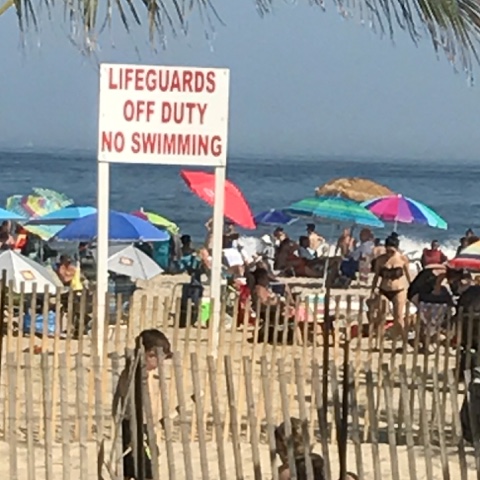
The beach was packed. Early fall masquerading as summer, but there were no lifeguards, no swimming was allowed. My nephew hovered at the water’s edge. He’s 14, would run with the others, the kids he just met, into the water and back out as the waves crashed in. We told him no swimming. Rip currents. Rough surf. The undertow was stronger than I’d ever seen.
I had walked down to the water from my chair, left Annie sitting on a blanket, so I could check on Dan. I couldn’t find him at first, but everyone was standing at the water’s edge. Everyone was staring at the same point about 50 feet out. A head bobbing on the waves. A swimmer beyond the reach of safety.
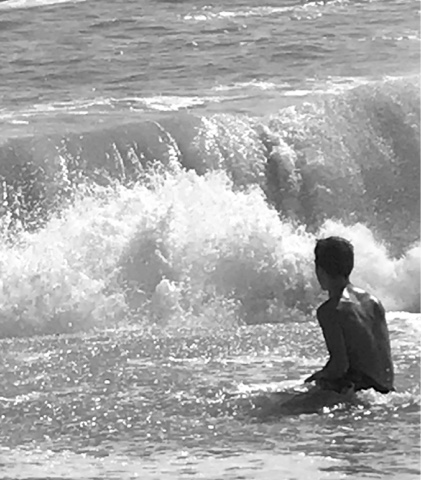
No one could say how he ended up so far out — did he lose his sense of place? Was he dragged out beyond the breakers? Did he venture into the deep knowingly? We watched the head rise and fall. Someone said he called for help. I never heard it. We all knew what we were watching, most of us frozen in place, most of us holding our breath.some wept. Then the head went under. We could see it, but it didn’t rise above the surface. Five minutes. Ten minutes. I can’t say how long.
Annie came running from the chair. Someone had been funning toward the boardwalk screaming for help. Annie thought, “Dan. Hank.” Couldn’t find us at first, nearly panicked, but found us. Others ran to the water from their chairs, fear in their eyes.
A woman with a surfboard swam out, several men followed. They reached him, wrestled him onto the board, worked as a team to bring him ashore. As they approached, a massive wave struck, capsized the board. A dozen people on the beach formed a human chain to stabilize and and dragged them all from the water.
The swimmer was unconscious, not breathing. Police cleared space and EMTs started working. A woman, gray hair, his wife I assume, rushed through the crowd, ran at the body. Police stopped her. She screamed, she cried, she nearly fainted. She swung her arms, she collapsed to the ground.
The crowd was silent. The crowd was pressing in. Police pushed us back. Then there were applause. Someone said the swimmer coughed up water, took a breath. Then another. Then more cheers. They took him off the beach to an ambulance, but someone on Facebook said they needed to do CPR again on the boardwalk.
As they carried him off, the crowd let out its collective breath. Dan was quiet. We all were quiet. “I’m too young,” 14, “to see death that close,” he said. “He isn’t dead,” we told him, but we don’t know. Nothing’s been reported, but a man died in Long Branch yesterday, a woman at Seaside today. Dead trails us. Taunts us. We read about it daily — hurricanes and earthquakes, terrorism and drone attacks, shootings and botched robberies. All of us are in the wrong place waiting for the clock to strike the wrong time.

 Hank Kalet