
 |
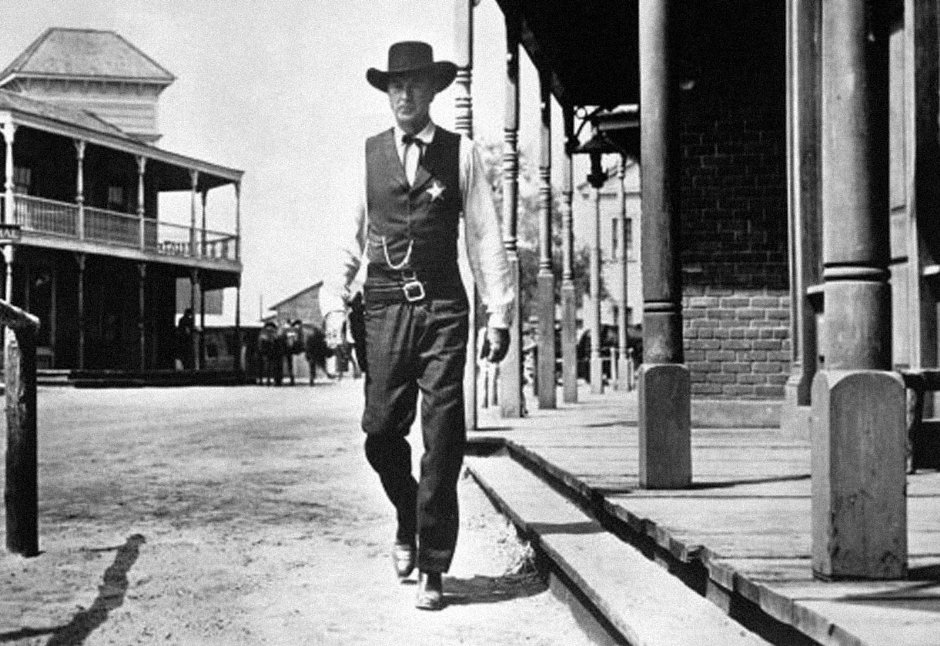
| Gary Cooper in High Noon |
I thought I was a beat, but I was just a boy
(Read Part 15 here, Part 14, Part 13 here, Part 12 here, Part 11 here, Part 10 here, Part 9 here, Part 8 here, Part 7 here, Part 6 here, Part 5 here, Part 4 here, Part 3 here, Part 2 here, and Part 1 here.)
I keep coming back to the words “myth” and “mythology” as central tenets of Kerouac’s world view in On the Road, and I think it’s because Kerouac uses superlatives and archetypes as shorthand, offering the reader a story of a disappearing America that he’s gleaned from popular culture as much as from actual American history.
The superlatives — big, great, mysterious — tend to be generic, but work together to create an impression of godlike grandeur. He writes of “the bird of Shenandoah” and the “hillbilly night of Charleston,” phrases that are relatively vague and that ultimately derive their meaning from repetition over the full expanse of the novel.
The dark and mysterious Ohio, and Cincinnati at dawn. The Indiana fields again, and St. Louis as ever in its great valley clouds of afternoon. The muddy cobbles and the Montana logs, the broken steamboats, the ancient signs, the grass and ropes by the river. The endless poem. By night Missouri, Kansas fields, Kansas night-cows in the secret wides, crackerbox towns with a sea for the end of every street; dawn in Abilene. East Kansas grasses become West Kansas rangelands that climb up to the hill of the Western night. (255)
Wildly impressionistic, to borrow a construction Kerouac might use, the passage depends on the reader having followed Sal on his travels for 250-plus pages, and on the hundreds of novels, stories, songs, films, etc., that the reader has grown up with and internalized. Woody Guthrie and his “ribbon of highway” is there, as are Huck and Jim’s travels on the Mississippi and James Fennimore Cooper’s forays into the dark American woods. All are present in these few words, and in Sal’s/Jack’s perceptions of the world around him. It is there in his concept of the Fellaheen (which he only touches upon in On the Road and more fully develops later), in his depictions of small towns, of Denver, his imaginings of Dean’s father, even of Dean himself.
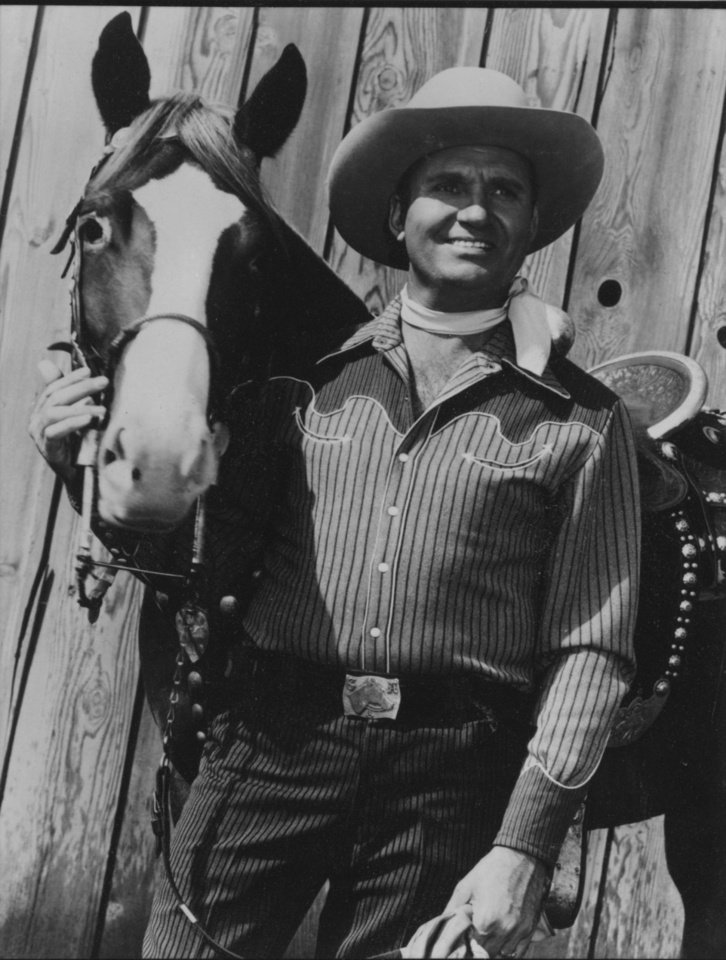 |
| A young Gene Autry |
Dean is as much an archetype as he is a fully fleshed out character. As Sal describes him, Dean is a man of the West and a native American intelligence. Sal’s first impression of Dean is key, because it builds the character from a set of broadly understood cultural archetypes. He “was a young Gene Autry — trim, thin-hipped, blue-eyed, with a real Oklahoma accent — a sideburned hero of the snowy West” (5). This is the trope from which all of the mythologizing flows.
Roland Barthes describes myth as “a type of speech” (109) that “is chosen by history” (110) and “has already been worked on so as to make it suitable for communication” (110). It carried pre-agreed-upon, though often unstated, cultural meaning, acts as a touchstone to which we can return to construct our narratives. Think the evil step sister, mother-in-law jokes, and the various monsters that come to us via folk and fairy tales. These act as shorthand, returning again and again in different tales, more often than not providing this agreed-upon information.
Advertising uses the myth-making function, building brands by creating a common language — both word and image based. The vague phrase “just do it” has been transformed into an exhortation to workout, to be an athlete, no excuses, while also being linked specifically to the Nike brand. Nike equals athletics, is athletics, in the popular imagination, thanks in no small part to Michael Jordan (another figure who has attained mythological status) and a pithy turn of phrase.
Myth, Barthes says, uses pre-existing semiological chains — “a relation between two terms,” and a third, the correlation between them that unites them and creates meaning. He uses the example of a bunch of roses that “signify” passion (Barthes 113). Roses exist on their own as flowers and are turned into a signifier through the act of giving. Passion is the message, indicated by the relationship between giver and recipient, but also by historical associations. The roses, therefore, become more than flowers, the giving more than action. Together, they tell a story.
We see this form of myth in our understanding of the American West. John Mack Faragher, writing about Daniel Boone and “the myth of the frontier,” he describes myth
not as a synonym for erroneous belief, but as the body of tales, fables, and fantasies that help a people make sense of its history. Like history, myth finds meaning in the events of the past. But unlike history, myth is less concerned with facts than with ideological essences.
The Western, whether a Buffalo Bill extravaganza, pulp novel or film, film, is “the story form of the myth,” he writes, and “tells a tale of progress, a justification of violent conquest and untrammeled development” — a narrative of American exceptionalism that contains within itself its own critique. It is “consistently subverted by the presence of pathfinders who are also critics of civilization, outlaws who are Robin Hoods, or whores who have hearts of gold.”
Kerouac’s vision of the West, which is the primary focus of On the Road, like his vision of Dean is based in this Western myth. He writes of the “Great American Desert” (182) and “huts with the weather beaten signs still flapping in the haunted shrouded desert wind, saying ‘Rattlesnake Bill lived here’ or ‘Broken-mouth Annie holed up here for years.'” In doing so, he is signifying a lost time and a changing landscape by alluding to a kind of Hollywood-inspired western lore, a legend of the American West filtered through memory, dime-store novels and John Ford westerns that exists on a plane parallel to what we learn about the west in our history books — a romantic notion that is as backward-gazing as the the work of Ford, Zane Grey, or Frederick Remington.
This is not a criticism, so much as an observation — and one that often gets left out of discussions of Kerouac’s work. There often is an effort to cast Kerouac as a groundbreaking progenitor of a new mode of writing, the scion of a world-changing generation that has always held itself in great regard. This obscures Kerouac’s connections to earlier American writers or his mournful view of change.
Kerouac, through Sal and his other stand-ins, is conflicted, caught between the need to break free from social restraints and a romantic attachment to the past, which drives his own movement.
This myth-making is central to his ethos, and is as important as the freedom he extols and that Dean represents in creating an audience for the book. The first wave of young readers wanted something different, but also were brought up in a culture that mythologized itself, that revered an Old West and American archetypes symbolized in the images of Gary Cooper, John Wayne, Jimmy Stewart, and Henry Fonda.
Western imagery would come to be an important component of the ’60s counterculture. Some of it was overt: films like Sergio Leone’s trilogy or Butch Cassidy and the Sundance Kid, of course, updated the Western genre, but musical groups like Neil Young and Crazy Horse, The Byrds, The Band, and even The Monkees toyed with wardrobe, album art, and lyrics that harkened back to a supposedly simpler and freer time. It is no accident, I think, that Peter Fonda — Henry’s son — and Dennis Hopper play Wyatt and Billy (as in Earp and The Kid) in Easy Rider, which is really just a modernized retelling of any number of Westerns from the ’50s and tracks almost perfectly with Newman and Redford’s Butch Cassidy.
Anti-heroes had become the norm, with flawed men (and it was almost always men) doing battle with an even more flawed and gravely ill social structure. Bonnie and Clyde were ruthless, but they were the heroes of Arthur Penn’s violent classic; no one was rooting for the g-men. The same goes for Sam Peckinpah’s The Wild Bunch, which captured the sense of change and drift that had marked American culture in the post-war period.
The anti-heroes were “real”; they existed outside the structures of square society and lived an “authentic life,” untainted by the conventions of polite society — which is why the Hell’s Angels, a group of violent marauders, attained a level of heroic legitimacy.
Again, Cooper and his Leatherstocking Tales are significant. Faragher ties Cooper’s tales, which he describes as “an enduring literary version of the (Daniel) Boone character” that “staged a conflict between civilized restraint and natural freedom.”
On the surface, (Cooper’s) stories make the case for “the march of our nation across the continent.” Yet his characters voice powerful countervailing arguments. “The garden of the Lord was the forest,” Leatherstocking declares, and was not patterned “after the miserable fashions of our times, thereby giving the lie to what the world calls its civilizing.” Ambivalence about progress resonated with a deeply felt American regret over the loss of wilderness as an imagined place of unbound freedom.
This easily could describe Kerouac’s vision of the West.
Send me an e-mail.

 Hank Kalet