
The following is a journal entry that I have decided to post publicly:
The news cycle in The Age of Trump moves at lightning speed. It has been less than a month since the awful spectacle of Nazis and other racists and anti-Semites marching in Charlottesville and this show of strength by an emboldened new-fascist right seems ancient.
But this substrata of conservatism remains a potential threat, and the issues it raises must be addressed. White supremacy is a real undercurrent in our culture, baked into the cake of American exceptionalism, that lie we tell ourselves to allow us to avoid confronting the real problems with which we are beset. It’s not just slavery, but Jim Crow. Not just lynching, but red-lining. It’s in our language and in the kinds of public expressions we deem acceptable. We elected a man president after he demeaned Mexicans and Muslims, winked and nodded at the KKK and so on.
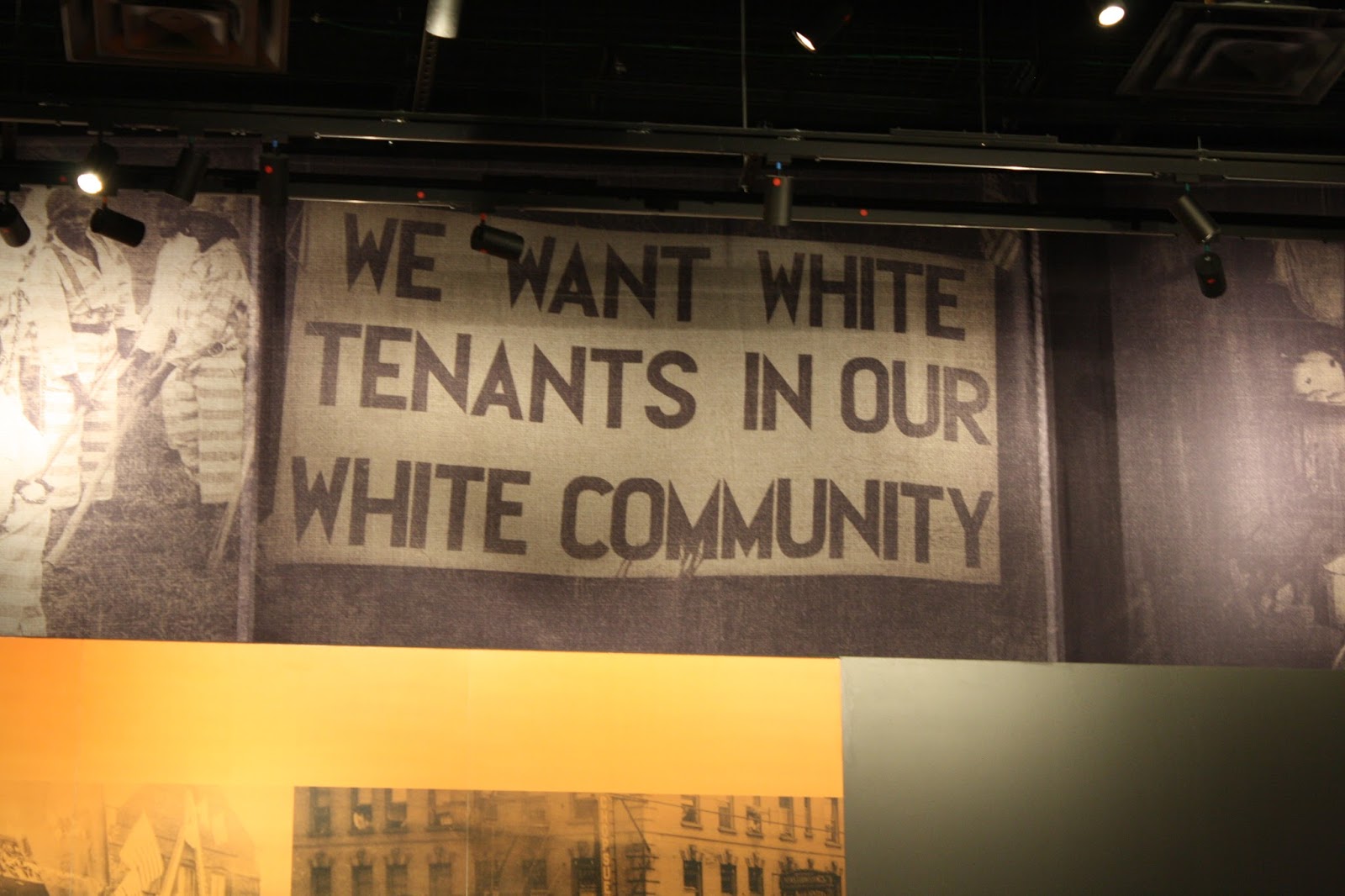 |
| I took this photo at the National Civil Rights Museum in Memphis in August 2015. |
The history of people of color in the United States has been a troubling one. Trump ended DACA yesterday, following on the heels of Charlottesville and his Muslim ban, hot on the heels of his ugly nativist campaign. But he is not the aberration we wish to believe. His racism is our racism — ours in a cultural sense. Our nation was built on it — slavery and Jim Crow, Chinese labor and the Chinese exclusion acts, the Zoot Suit riots, Japanese internment camps, exclusionary policies — “No Niggers, No Dogs, No Jews,” “Mexicans Needs Not Apply,” etc.
This history, or a part of it, is the point of Roger Cohen’s column in The New York Times today: “In moments of national fragility, history rears its head,” he writes. “The past becomes a vast storehouse of grievance. Revived memory is manipulated to produce violent nationalism. This is what is happening today in the United States, a nation suddenly at war with its past.”
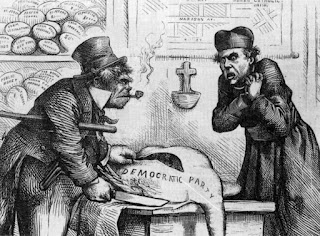 |
| An infamous cartoon from the mid-1800s. |
He goes on to describe the current debate over Confederate statues, which really is a debate over imagery, over symbols, and a debate over how we define the word “American.” There always has been an element of race in this definition. Americanness and whiteness have been conflated. This notion has created a racial hierarchy, but also allowed the notion of white supremacy to maintain its hold. Whiteness originally included only the Brits, Germans and French. The Irish, early on, were an other, portrayed in political cartoons as apes, left to toil in decrepit cities with free blacks and other “others.” But whiteness has been a fungible concept, as Nell Irvin Painter points out in The History of Whiteness, expanding to include previously excluded groups as a way of buttressing the white power structure against changing demographic tides. The Irish were first, subsumed into whiteness as a bulwark against emancipated blacks and the growing immigration from southern and Eastern Europe. Christian immigrants were next, and so on.
Blacks have been excluded from this designation, though the exclusion is no longer strictly a legal one. Jim Crow and red-lining have been ended, but policing strategies and legislative priorities, while officially race-neutral, continue to have what the courts call a disparate effect on blacks — in schooling, in asset ownership and wealth accumulation, and so on.
We pretend otherwise — John Roberts saying the only way to end discrimination is to end discrimination is the most concise example of this, an empty tautology presented as a statement of purpose. Roberts, however, ignores the history, demeans the victims of one of history’s greatest crimes (the enslavement and then oppression of black Americans), and elides the need for a full accounting, which has to include some for of restitution to the victims and their descendants. I’m sorry, Mr. Chief Justice, but “Oops, I’m sorry. We’ll stop now,” just isn’t enough.
Roberts comes from a tradition that says history is past tense, that it is nothing more than what has been consigned to the history books. (Yes, I’m reading a lot into his comment, but so be it.) But history is a living thing. Facts are facts, of course, but interpretations can change as we New information comes to light or previously known, but disregarded information gets a new hearing.
How we view our history speaks to who we are. Thomas Jefferson is not the saint of American democracy he had been painted as for so long, but a complicated figure who was both a democrat and a slaveholder. Focusing only on his ability to sell the democratic ideal to his contemporaries — and to posterity — but ignoring his slave ownership and “relationship” with Sally Hemings (rape is probably more accurate, given the inability of Hemings, a slave, to truly consent) says a lot about what we as a society may consider important.
The debate over Confederate statues must be seen in his light. As Cohen writes:
America has been adept at evasion. A nation conceived as exceptional, a beacon to the world, could not but run from its original sin. How often I have wondered at all the museums and memorials to the Holocaust, the great crime against European Jewry that did not happen here, of which the United States was neither perpetrator nor victim. By comparison, the great American crime of slavery, the laceration and lynching of black bodies, was scarcely memorialized.
The “bravery” of Confederate soldiers and their leaders, however, remains on full display throughout the south — monuments to “heritage,” which is just another way of saying whiteness. As Cohen points out:
The statues now being upended tell a story, after all. Not the story they were erected to propagate — of Confederate valor — but of an attempt in defeat to mask the terrible “great truth” of the Confederacy and by so doing extend for many decades the subjugation and humiliation of American blacks.
In the end, I’m ambivalent about their outright removal. They exist, we need to find a way to recontextualize them, to tie these “brave heroes” back to the evil institution they were defending and make it clear that the statues themselves were the product of Jim Crow-era efforts to intimidate blacks.
Send me an e-mail.

 Hank Kalet