
 |
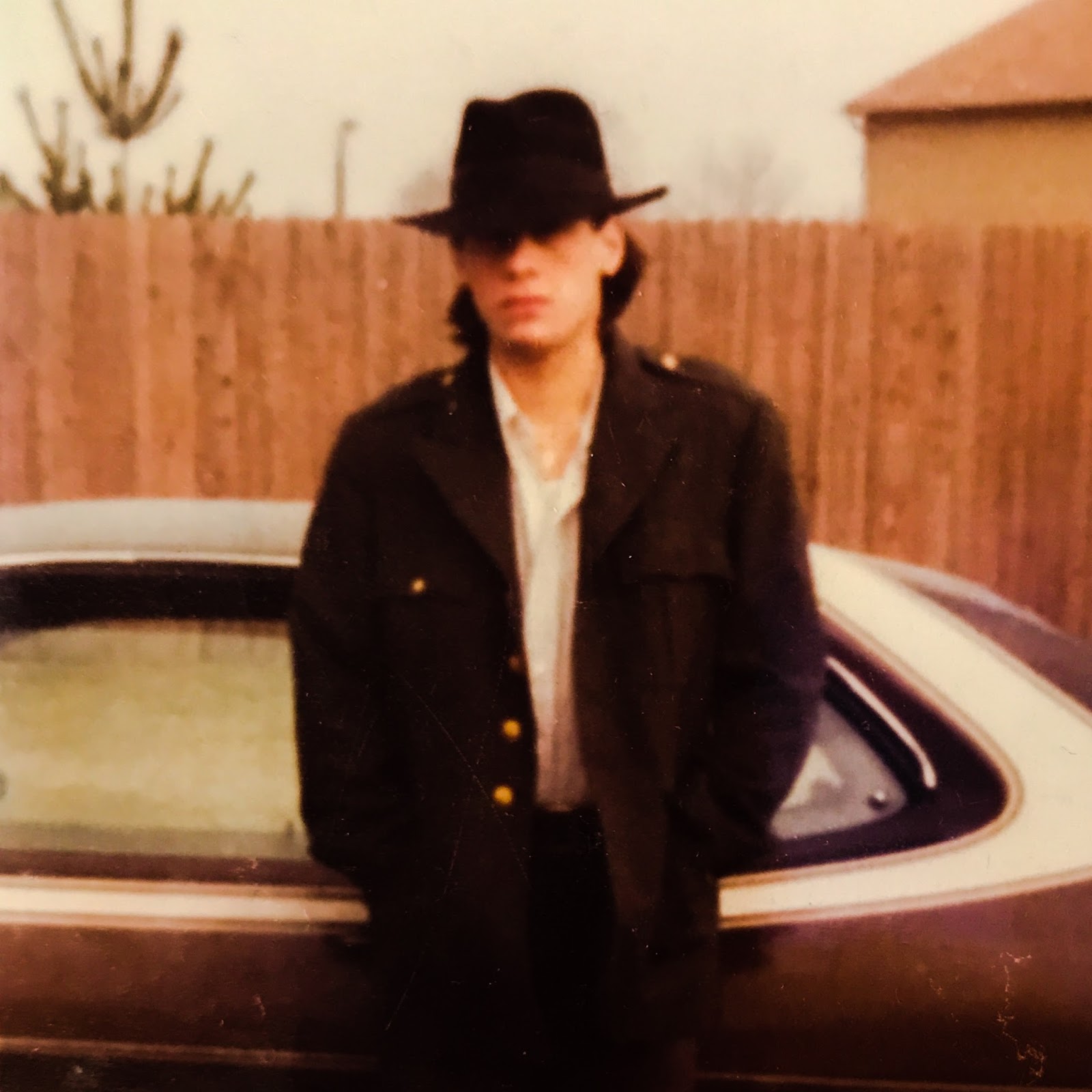
| I don’t have any pictures of the Oldsmobile, but here I am with my first car — a 1974 Dodge Dart Sport.. |
I thought I was a beat, but I was just a boy
(Read Part 14 here, Part 13 here, Part 12 here, Part 11 here, Part 10 here, Part 9 here, Part 8 here, Part 7 here, Part 6 here, Part 5 here, Part 4 here, Part 3 here, Part 2 here and Part 1 here.)
It was my dad’s car, a 1976 Cutlass with an eight-cylinder engine that demanded fuel at least twice a week. It looked tame, but could rev up to triple digits if you pushed it, and sometimes I just had to push it. Route 80 heading out to State College had a long, empty stretch, straight as a razor, mountains rising on both sides. I drove that stretch a dozen times, maybe more, in the two years I attended Penn State. And I hitchhiked the same stretch another half dozen times, before finally leaving school in the spring of 1982.
I was restless. I’d worked a summer job in a factory, a job for which I was ill-suited but that I found more authentic than what was expected of me. College felt wrong, class work unnecessary. At the same time, being away at school, at Penn State, gave me a chance to break with the bland conformist I had been in high school, to engage my right brain.
The car offered me a sense of freedom. State College was a small town back then, surrounded by smaller towns and farms, and it felt like it existed on a different planet, divorced from everything that made sense. When I had the car, I would take long drives out by the quiet stadium where, during the fall, more than 80,000 would pack in for games and the parking lots would be filled with tailgaters. I would head east beyond the medical center and the mall, beyond the suburban tract housing on roads lined with farms and granaries. Past the highway. Past the prison that was visible from the distance.
Sometimes I’d stop, get out, and wander along a creek bank. It reminded me of the creek behind my house, which would freeze. I’d walk it with my neighbor Neil, or my friend Bic, or Mukul, tramping through the suburban backyards to the park and school down the road. It seems cliche — is cliche — but tramping frozen ground in silence connected me both to home and to Jack Kerouac, who had become one of my heroes.
On the Road, Kerouac’s most famous novel, was published in 1957 after several years of rewriting and editing. Written in 1950 on a massive roll that he created by taping one sheet to another so he could avoid stopping to change paper, it recounts the three-year period following Kerouac’s introduction to the charismatic and maniacal Neal Cassidy. The book’s opening captured my feelings perfectly: “I first met Dean not long after my wife and I split up. I had just gotten over a serious illness that I won’t bother to talk about, except that it has something to with the miserably weary split-up and my feeling that everything was dead” (3).
I wasn’t ill but I was struggling. Call it ennui or undiagnosed depression. Call it teen-aged angst. I was 19 and looking ahead with trepidation, awe and confusion. On the Road spoke to those feelings, granted permission for my restlessness, while creating a romantic image of the young artist in his infancy — mirroring my conception of myself as a developing poet.
 This permission was important. I’ve come to realize that two strands comprise my personality: an urge toward non-conformity and a fear of how my nonconformity will be received. It’s why, I think, I’ve always felt a discomfort within groups, a sense that I don’t fully fit in regardless of the association. My need for approval runs deep, but so does a questioning of that approval’s necessity, along with a skepticism of authority more generally.
I get the need for approval from my father. My dad, as I write in another essay, has always been overly concerned with others’ opinions of him and of his family. This is not unusual for someone his age — he turns 80 next year and came of age during a decade — the 1950s — characterized by William H. Whyte’s The Organization Man and the growing corporatization of America. Father Knows Best and Leave It to Beaver offered powerful lures, especially for a boy who’d lost his father, as my dad had. My dad and I have never discussed this — part of my ambivalence about authority, perhaps? — and it’s possible I’m turning my dad into an archetype and not giving him the credit he deserves. But his political and social conservatism is deeply ingrained and it made telling him I planned to leave Penn State difficult.
I don’t remember what I said, nor his exact response. I imagine it was something like, “You’re out of your mind.” That’s long been his response when my brother, sister or I would do something he finds odd or out of bounds.
It was probably March of 1982 when I told him what I was planning. The University of North Carolina was making a run to a college basketball title. I was a fan of the Tar Heels, but I remember little of that tournament, only know UNC featured James Worthy and Michael Jordan. There was probably snow on the ground in State College, because there always seemed to be snow on the ground in State College during the winter trimester and into the beginning of the spring.
I hate snow, have since those two Penn State winters. I lived in Sproul Hall in the East Halls area. To get to classes, I had to walk across a massive parking lot. In the winter, the lot would turn into a a vast tundra of ice and wind that blew horizontally, that cut threw you with the precision of a stiletto.
It snowed at home in Jersey, too, but it would turn slushy and black with car exhaust and then melt away before the NCAA tournament, before the Mets would open the season. There were winds, but they lacked the ferocity of the Penn State winter.
The winter’s brutality — along with my own inertia and what I see now was a form of depression — led me to abandon my course work. I attended few classes that winter, failing each in spectacular fashion.
There may have been snow on the ground when I got home. I probably watched some of the tournament with my dad, perhaps the St. John’s game — everything cordial until I dropped the news. He would have been angry, but probably didn’t yell. He didn’t yell. He’d go silent. That has always been his way, the sudden, inexplicable silence, the bottling up. I probably left. I may have taken the Cutlass, or perhaps called Bob or Bill or Rich. We probably hit to the Hub for beers and cigarettes. Or we’d walk, or find some place to hang out and get high.
I say probably, because I don’t really remember. I remember few of the details of that time. I remember friends — Steve and Doug and Katie, my work at the radio station. I remember blowing off classes, smoking a lot of dope.
This was my rebel period, something I think most of us experience after high school in some form. For most it manifests in a stretching of boundaries, in discovering and crossing the line between childhood and adulthood. For me, it involved something more. It was a period in which I created a personal ethos that mixed sixties-era political revolt (without the actual activism), a perceived punk-rock nose-snubbing, and Beat-era Bohemianism. The first two ingredients were musical: I was listening to Lou Reed’s The Blue Mask, The Clash and The Sex Pistols, XTC, the Talking Heads. The Beatles, Stones and Dylan, of course, and Springsteen. Jazz was new to me, and I was particularly taken by Traffic’s live album, with its slinky horns. The album filled the gaps for me between bebop and rock and roll, and the larger palette of sounds — which I often boiled down into mix tapes — created a soundtrack for my somewhat limited rebellion.
I’d read On the Road by this time. More than once. And The Dharma Bums and The Subterraneans. It was my “born again” experience, opening my eyes and mind to possibilities I’d never fully considered. The world as I understood it was in flux and I needed a sign post. Or a map. On the Road offered a version of that map, a structure for the haphazard and unformed accumulations of thoughts and beliefs that were swirling around my brain.
That the structure was never stable, that the narrative Kerouac presents lacks a traditional or at least overt dramatic arc has never mattered; On the Road has a frame — Sal’s relationship with Dean — but it is not so much about their friendship/love as is is a meandering journal of Sal’s exploration of post-War America, a time when everything and nothing seemed possible, when the immediate was most important.
Everything and nothing. Certainty and doubt. The ineffable unreliability of life. The world does not move in a straight line. There are no grand plans. Accidents happen, events alter directions, are not preordained, do not have an inevitable momentum. The Rev. Dr. Martin Luther King Jr. said, “the arc of history is long, but it bends toward justice,” a hopeful note that is belied by history (and our current politics). If there is an arc it is one we create, one we bend.
I remember one early morning after an acid trip that had me wandering the quiet streets of State College and the Penn State campus. This must be weeks later. I must have returned home and deposited the car — the events, as they have formed in my memories, lack access to a car. I remember wearing an old brown sweater over an untucked denim shirt. I remember this distinctly because I thought it made me look like Sal Paradise. I remember returning to my dorm room and finding a sleeping roommate and a suicide note and freaking out, giving up, heading to the bus depot.
I had a few things in a backpack. A few dollars in my pocket. I was at the depot. I was going to San Francisco. Or someplace out west. I was going to take the bus as far west as I could, as far as my money would allow. Then I would hitchhike. I stood there. I must have, anyway. Until my will faltered. I didn’t buy a ticket, didn’t get on that bus.
My time at Penn State was effectively over. My time in State College was soon to be, but I did not head west. I returned to my dorm room, to my roommate, began the difficult project of packing up my relatively short life. Within a few weeks, I’d hitchhike home, make my official announcement to my family, dad turning stony, silent, then take the Cutlass back to Penn State for a final time.
I cut my ties, let friendships end. Penn State was behind me, and the Road (capitalized in my imagination) was ahead — but not in the manner I anticipated. I wouldn’t follow Jack’s path; mine would be an internal journey, a localized journey, that would lead me to lasting love, an important vocation, and a very different way of viewing the world than the one Kerouac settled on in the wake of On the Road‘s publication. I’ve been lucky. I’ve avoided he regrets and disappointments that dogged Kerouac and fueled his alcoholism, that damaged his ability to make deep connections, that left his suspicious and angry and resentful in his final years.
There is a photo (Gifford 314) of Kerouac and his third wife Stella — “the sister of his old friend Sammy,” an old girlfriend from Lowell, from the days before his fame (304-305). Kerouac is seated in a wooden chair. His body is swollen showing the effects of his drinking, his face puffy, his expression vacant but pained. There is little of the openness, the receptiveness and warmth you find in earlier photos. Stella stands behind him, a hand on his meaty arm, a half grin on her face. Kerouac is 46 or 47 in the photo, but looks much older. He would die probably within a year of this picture being taken.
He is far from the adventures of his youth, far, I’m sure, from where he planned to be, though, he foreshadows his own narrative — all of our narratives, really — as On the Road closes: “nobody, nobody knows what’s going to happen to anybody besides the forlorn rags of growing old” (OTR 310), and as I approach 55 years on this earth I can finally say I understand.
Send me an e-mail.

 Hank Kalet