
I thought I was a beat, but I was just a boy
Notes on Re-Reading Kerouac in my 50s Part 14
(Read Part 13 here, Part 12 here, Part 11 here, Part 10 here, Part 9 here, Part 8 here, Part 7 here, Part 6 here, Part 5 here, Part 4 here, Part 3 here, Part 2 here and Part 1 here.)
On the Road, because of its underlying formlessness, resists easy interpretations into other media. It took 55 years for the book to make it to screen, after several failed attempts, and the 2012 film has its charms — mostly the portrayals of its female characters — but ultimately the film fails because it had to fail.
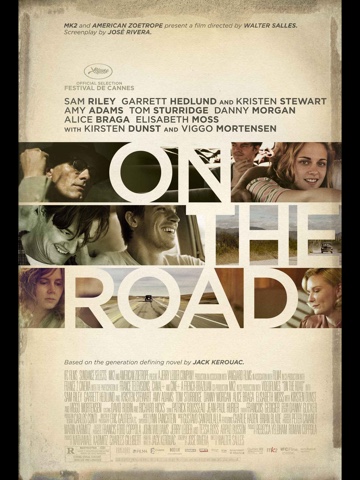 On the Road is too big and too much inside Sal Paradise’s head to easily turn it into a coherent film. Too much has to be left out, too much has to be compressed, to squeeze the travels of its main characters into a two-hour narrative.
Other Beat Generation works faced similar hurdles. Naked Lunch, William Burrough’s classic heroin dystopia, for instance, needed to be smashed to pieces and put back together before it could make sense as a film. Howl, Allen Ginsberg’s classic poem, became a canvas on which to tell the story of its writing and the obscenity trial that followed its publication. Both films were impressionistic re-imaginings that only used the source material as jumping off points. And because of this, both films work well and stand alone as art in their own rights.
On the Road, directed by Walter Salles, suffers because of its source material, both because too much of an effort is made to stay true to the novel and because it deviates from the novel in several strategic ways. The events have been re-ordered, several of the characters changed, and several important scenes have been compressed so much that they almost fail to register (his brief love affair with Terry).
This is not unusual when adapting a book to film, and it’s why it can be dangerous to compare film and source material. Salles’ changes are worth discussing, however, because the cast fresh light on some of the book’s themes — and offer a reminder of what the book is not.
Salles’ cuts and compressions narrow the film’s scope — a thematic shift underscored by the film’s shooting style. Salles keeps much of the film in close-up, often extreme close-up, creating a cramped sense of space. The film is claustrophobic, and the sense of space and openness created by the book has been sacrificed to keep the Sal-Dean friendship front and center.
Dean is played by Garrett Hedlund as a laconic western cowboy, a ’50/s film cliche. He is muted, laconic, almost bored. He is introspective, admits to considering suicide, and attempts to explain his mania and his inability to escape his urges. This personalizes the narrative, shrinks it — it is Dean’s very human failings and his somewhat cliched past that matter, his personal demons rule the film.
The film opens with Dean at a New York City parking garage, showing off his handling of the cars he parks, and then a shot of him stealing a car. This is Dean Moriarty, a quick visual snapshot of something that Sal finds attractive and authentic. Dean is the mad driver, the car thief, the thrill seeker who commits crimes because he is bored and the boredom remains an underlying flaw in Dean’s character. He can’t sit still, which causes him to hurt others, to abandon his lovers, his closest friends.
Here is how the novel opens: “I first met Dean not long after my wife and I split up. I had just gotten over a serious illness that I won’t bother to talk about, except that it had something to do with the miserably weary split-up and my feeling that everything was dead.”
The film, after giving us a glimpse of Dean as car-park attendant, moves to Sal’s dark and claustrophobic bedroom. Sal is played a bit nebishly by Sam Riley. Sal sits at the typewriter as the voice-over bridges the image of Dean stealing a car into Sal writing. “I first met Dean,” Sal says, “not long after my father died. I had just gotten over a serious illness that I won’t bother to talk about, except that it had something to do with my father’s death and my awful feeling that everything was dead.”
The change from failed marriage to dead father is underscored two scenes later, after a drunken party, when Sal and Dean have their first heart-to-heart discussion. They are huddled close. The camera is in their faces, an extreme close-up.
“The day before my father died,” Sal tells Dean, his expression pained, “he took hold of my hand. He looked at it and he said ‘you got no callouses, Sal. You don’t do any real fucking work, boy.'”
Dean, equally mournful, tells Sal that Old Man Moriarty was rarely around, a drunken wanderer who left Dean to his own devices. This, in the film and the book, is designed as a building block for Dean’s character, the essential cause of Dean’s breathlessness and wanderlust. But novel Dean lacks the introspection implied here with film Dean. Novel Dean is chaotic, a whirlwind. He’s about escaping the dull impositions of post-war American culture and it’s gray flannel suits and middle-management jobs. Finding his father is important, but as an adventure, a chance to discuss the old man’s adventures on the Denver streets and through out the Southwest. It is consistent with the book’s ethos of adventure and pure kicks, and it is part of a hip-v.-square dynamic that is buried in the film. This frame is present, but it’s muted, shunted to the side, as the film narrows its focus — one of the reasons for the constant use of close-up shots. Film Dean also seeks kicks, and he shares the wanderlust and allergy to responsibility with novel Dean. But film Dean has been transmuted. His tragicness is connected to his missing father, to a desire for some sort of approval, a desire he shares with film Sal.
“To the old men,” Dean says, lifting his beer as their heart-to-heart closes.“To the good old dead demented men we love,” Sal says.“And the west,” Dean says, a nod to the trips that are to follow.
Later, Dean is lost in morose thought, focused on his failure to find his father. Sal comforts him:
“Here’s what’s going to happen. Right when you think you’re never going to see him again, someone’s going to come and tap you on the shoulder looking for a dime or a light. You’re going to turn around and you’ll be face to face with him.”“That’ll be real nice, brother.”
The sadness of the scene makes Dean seem small, fragile, and hints at the final scene when Dean returns to New York after abandoning Sal in Mexico. Dean is apologetic, wants to talk, but Sal is heading out to a concert. He’s dressed in evening wear, his friend Remi (who plays a crucial early role in the book, but is excised from the film) waiting with two girls and a cab. Sal doesn’t have time for his best friend, who is in obvious pain and needs Sal’s approval and forgiveness. Sal’s clothing tells part of the tail, the flannel shirt swapped for the attire of the elites. Dean is dressed as he always is, in t-shirt and jacket. Something has changed. Something is broken.
This final encounter in the book is more drawn out, with Dean arriving earlier than anticipated and now set apart from the New York crew. It is unclear in the book how much Dean’s abandonment has damaged his relationship with Sal, as Sal is drawn away by his previous commitment to Remi. Dean asks to share a cab to spend as much time as he can with Sal, but Sal demurs — Remi, who Sal screwed over earlier in the novel, dislikes Sal’s friends, and especially Dean.
The similarities here are outweighed by the differences — the film implies this is the first time Sal and Dean have been in contact, while the book makes it clear that they have been writing each other and that Dean had been in New York for a few days before this final scene. The book doesn’t so much as end as it pauses, takes a breath. This is not the last we’ll see of Dean, it seems to say.
These differences highlight the core themes of the book, which is the thrill of nonconformity, the desire for authenticity, and a the ultimate failure of an unthinking hedonism that proves to be selfish and damaging to personal relationships. Mexico is more than just a trip to a whorehouse; and the larger quest made by Sal is about more than just kicks, which often get in the way of his personal growth and understanding.
Dean is the symbol of these currents in the book, a mix of raw sex and desire. His quest at all times is for kicks, and he leaves shattered lives in his wake. He is raging id, a massive and intrusive presence, who like a category 5 storm leaves destruction in its wake. He looks like Henry Fonda and act like the Tasmanian Devil. He should jump with energy, eat up the screen. Dean is kinetic, the brightest star in the constellation, and when he crashes he takes everyone with him.
It is important to remember that the book is about Sal and his quest, his exploration of a changing America, and an attempt to find something essential on the road. Dean, like Jay Gatsby, is a conduit through which we can understand the changes in Sal’s life and the changes in post-war America.
This is not meant as a criticism of the film — though, I did find it shockingly dull and difficult to watch — as much as it is an argument that On the Road’s structural anarchy and the bigness of its vision are not easily translated to the screen.

 Hank Kalet
Has a guy ever given you mixed signals?One minute he’s crazy about you and the next minute you have no clue if he ever wants to see you again?And it’s especially hard when there’s something special between you and you have no idea what went wrong.I assure you it’s nothing that you did.In fact, he may even care about you a great deal and still not be able to stop himself from acting this way.But why does this happen?There’s one BIG reason why men do this…And I discovered this eye opening video that will shed some light on this bizarre behaviour.Discover it here: ==> [ Why he does the bare minimum (and what to do about it) ]It all comes down to a missing “secret ingredient” that not one in a thousand women knows about…And it’s the biggest factor that determines whether a man just “likes” you……or if he sees you as “The One.”You see, this “secret ingredient” is so important to a man that no matter how attracted to you he is, or how strong your chemistry is…If it’s missing, he’ll never be able to truly give his heart to you…And he will always have an unshakeable urge to seek out a woman who has this one “secret ingredient.”Discover it here: ==> [If he’s shutting you out, here’s what’s missing… ]On the other hand, when you know this powerful “secret ingredient”……you won’t believe how effortless, passionate and bulletproof your relationship can be.Trust me, this is going to blow you away.Discover it here: ==> [ The difference between “like” and “love” (most women miss this) ][Sign off]