
(Read Part 12 here, Part 11 here, Part 10 here, Part 9 here, Part 8 here, Part 7 here, Part 6 here, Part 5 here, Part 4 here, Part 3 here, Part 2 here and Part 1 here.)
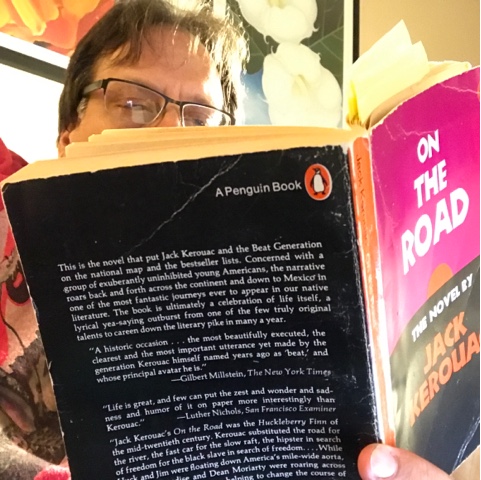
When I started this project, I wasn’t thinking about anniversaries. On the Road turns 60 in September, which would seem to give my most recent re-reading a bit of urgency — a news peg, we’d call it in the newspaper business. But this anniversary had nothing to do with my decision to return to the book after a good decade away. I’ve read this book probably a dozen or more times, and each reading has offered different pleasures and different view points. When I was 19, it was fresh and new, and my own intellectual journey was still in its infancy. I read it in a single sitting and thought I’d take off across the country. I was at Penn State; the bus station wasn’t far, and I imagined buying a ticket with the little money I had, going as far west as the fare would allow, and then hitch hiking the rest of the way.
I didn’t, and I don’t have any regrets. But that memory has always acted as a foundation in my reading and rereading of On the Road and Kerouac’s other books. Desolation Angels made me want to drop everything and become a fire look out. The Subterraneans had me chasing the artistic ones, thinking that the kicks were the thing, while The Dharma Bums pointed me toward a (superficial) exploration of Eastern religion.
Kerouac remained a touchstone, of sorts, but started to recede, to seem less a part of my own writing history as my own work grew more complicated, as I attempted to integrate my journalism into my poetry and I began to fully consider the personal essay as something worth pursuing. (I had been afraid of the format, or perhaps the honesty it requires to do it well.)
So, a reread of Kerouac was not necessarily on my radar. I had an extensive summer book list that included philosophy, poetry and Samuel Becket, and I was working on a long poem on race and America, writing a play, and reporting an immigration story. The last thing I needed was another project.
But Kerouac is always in the air, which is important. He’s not just a personal touchstone, but a cultural one, and On the Road is in many ways the book that signaled much of what was to come in the 1960s and beyond.
Roger Ebert sums up the book’s allure in a 2013 review of the film adaptation. He and his friends “talked idly of pointing them west and not stopping until we reached the Pacific..”
As a teenager, I snatched up the book in its first paperback edition and chose it above any other to display on my desk at the News-Gazette, sometimes underlining trenchant passages. Still in high school, I slipped away to the Turk’s Head, a campus coffee shop, which played Miles Davis and Monk, and Beats were rumored by the townspeople to stand on the tables and recite their poetry, although table-standing seems to run counter to the Beat ethos.
Vin Scelsa, the legendary New York disc jockey (and a personal hero), name drops Kerouac in a 2015 podcast interview with his daughter, describing his movement away from his Roman Catholicism, and his decision not to attend NYU — because, as his daughter Kate says, Scelsa was a rebel.
“It was my Jack Kerouac phase,” Scelsa says. “I was going to go out west and be a fire watcher on a mountain and get in touch with my Desolation Angels, and that whole thing. I was into the whole Beat world, Allen Ginsberg and all that.”
He didn’t. Instead, he found himself at the Upsala College radio station WFMU, where his rebellious streak and innate creativity found it’s outlet in free-form musical programming. I discovered Scelsa probably in 1978 or 1979 when he ruled the late night airwaves and spun records no one else on commercial radio dared play. The timing was propitious — I was growing tired of the commercial stuffed began listening to more punk and early New Wave, and Scelsa’s imprimatur was important. He showed that this new music was important and that it was part of a much larger mosaic of sound that could include both the popular and the underground.
So, I was prepared for what Kerouac had to offer, not realizing how much Kerouac actually paved the way for someone like Scelsa — or how much Kerouac had and would continue to seep into the larger culture.
The 10,000 Maniacs capture this on their 1987 album In My Tribe, with the song “Hey, Jack Kerouac”: Kerouac, Ginsberg and William Burroughs, the song posits, allowed the “Hip flask slinging madmen, steaming cafe flirts,” and “Cool junk booting madmen, street minded girls,” to speak through them. Or to believe this lonely alcoholic writer lost in a changing America spoke for them.
This is why his influence extends beyond literature and into the broader culture. As Kerouac describes in Big Sur — his novelized take on the aftermath of On the Road‘s success — he couldn’t go anywhere without some 20-something wanting to join the party that had happened 10 years earlier. Big Sur is a difficult book, especially for readers still caught up in the romance of On the Road. It describes Kerouac’s descent into alcoholism and his growing alienation from the new youth culture, an alienation that ultimately would push the so called “King of the Beats” in a few years to outright disgust with the hippies.
But Big Sur describes the cultural moment and his influence on it surprisingly well. His book offered this new generation born during and after World War II liberation. And they took it and ran with it.
Which is why Ebert. says the novel “grew not into a movement but into a brand,” one pushed hard by the new advertising industry, and that ultimately turned the novel into something it wasn’t — a buddy-road story and unapologetic exploration of hedonism.
The novel was always more and less than that, but disentangling its core from the myth has long been shunted aside by its fans, who focus on the freedom and not on the book’s darker elements.
This has made the book far more influential than it might have been, given what William Plummer calls its lack of “literary style in the sense that Hemingway, say, or Faulkner did: a controlled and nuanced voice.” This, Plummer says in a 1979 essay in The New York Times, is why Kerouac’s literary progeny are more likely to be found among adherents of the “New Journalism” — writers engaged in deeply reported, long-form forays in which the journalist became a central character.
The pop and fizz of Tom Wolfe’s prose are surely Wolfe’s own, but his and George Plimpton’s buddying-up with outsize characters like Ken Kesey and Alex Karas owes much to Kerouac’s worshipful relation to Cassady. Then, too, Hunter Thompson’s doped-up madcap forays across the continent are almost unthinkable without his Beat predecessor’s model.
His influence extended to poetry, as well, he writes, though the influence filters through Ginsberg, Corso and Ferlinghetti. His then asks an important question: “who reads Kerouac these days?”
Easy: the same kind of kids, mostly young males, who have been reading him since the fanfare died down in the early 60’s. Bob Dylan read him, and so did future novelists Thomas McGuane and Ken Kesey; all three were extremely impressed. Actor Nick Nolte read On the Road while still in high school in Omaha. His statement in a recent interview is eloquent testimony to Kerouac’s effect on American adolescents: “I remember thinking, ‘You mean you can just do that? Pick up and go?’ It seemed incredible to me.” (Plummer)
Nolte played Neal Cassidy in Heartbeat opposite the late John Heard, as Kerouac. Others as various as S.E. Hinton, Sam Shepherd, Patti Smith, Robert Hunter, Donal Logue, and Amber Tamblyn — all interviewed in One Fast Move or I’m Gone, the documentary on the writing of Big Sur — cite his influence. Tamblyn’s presence in the film, which caught critics by surprise, is evidence of the film’s lasting reach. Tamblyn was 25 when the documentary was released in 2008, but talks about her connection to Kerouac like he was an old friend, romanticize grandson the Beats like so many have before.
This isn’t a criticism. It is nearly impossible to read the book for the first time today without succumbing to the same mythology that has made the book the cultural touchstone it has been, and that drew me in 36 years ago. The struggle, for both the new reader and the long-time admirer, is to disentangle what we’ve come to think about the novel from what really takes place.
On the Road, if it is anything, is an elegy for Dean and for an America on the cusp of change written by a writer in thrall to the apocryphal stories created in dime-store novels and cowboy films, in the culture of the day. Dean’s unraveling in the book’s final act — symbolized by the enormous bandage on his thumb, by his increasingly incoherent proclamations — too often is left out of our conversations about the book. Nolte’s comment — “You mean you can just do that? Pick up and go?” — still represents the consensus of assumptions about the book. Sal’s disconnection, his alienation from his moment in time as his friend, who he builds up as a true American archetype, falls into madness is the book’s true thesis.
I don’t think I got that when I was younger, not for a while, at least. But at nearly 55, I do. This, I think, says as much about me as it does about the book, about how my perspective has changed as I’ve grown older. I see things now I didn’t or couldn’t earlier on — such as the dismissiveness the book has toward women, its casual homophobia, its disturbing condescension on race.
All of this was there the first time I read it; I was just incapable of seeing it.
“There are nights when I think that Sal Paradise was right / Boys and girls in America / They have such a sad time together,” sings Craig Finn of The Hold Steady, as he makes his case that the kicks have consequences. “Stuck Between Stations,” the opening cut of Boys and Girls in America, is anthemic and bold, but sad and painful — like the album it leads off and the novel from which it borrows its opening line.
What we have is never enough, Finn sings, so we chase what we don’t have and do not need, thinking it will make us whole. In the end, it can’t, and we are left to struggle and pick up the pieces.
My point is that everyone remembers the party, but no one remembers the clean-up. We remember the excitement, the kicks — the breathless adventures, the drinks, the music. But parties end. People go home, or crawl up in a ball in the corner and sleep. What follows are he recriminations — smoking the butts of cigarettes, drinking stale beer from plastic cups. And the clean-up. No one remembers the clean-up.
On the Road is both party and clean-up. We remember Sal and Dean rushing west and east and west in a crazy buddy movie; we remember the jazz clubs and blow-outs, the Benzedrine-fueled gabfests that took all night. We romanticize these elements, but rarely consider the book for what it is — a romance in the sense of the Romantic-era, of Byron, Shelley and Keats. The English romantics of this second generation were tragic figures, rebels against the contemporary order who created mournful elegies that looked both forward and backward.
On the Road is in that tradition, and is one of the saddest books to be published in America.
Send me an e-mail.

 Hank Kalet