
I thought I was a beat, but I was just a boy
Notes on Re-Reading Kerouac in my 50sPart 11
(Read Part 10 here, Part 9 here, Part 8 here, Part 7 here, Part 6 here, Part 5 here, Part 4 here, Part 3 here, Part 2 here and Part 1 here.)
 “The car belonged to a tall, thin fag” (206). I hadn’t noticed this before, Sal describing a man they met at the travel bureau in San Francisco, using what remains a nasty slur against gays to describe a character with which he obviously has little sympathy.
He lacks a name, “wore dark glasses and drove with extreme care.” His car was a “fag Plymouth,” an “effeminate car,” with “no real power.”
Sal and Dean are heading east, escaping a San Francisco that had become repressive, where the women in Dean’s life — and the lives of his friends — were weighing them down, cutting into their freedom. They visit the travel bureau, which matches passengers willing to cover fuel costs with drivers seeking the companionship and help with expenses.
They catch a ride with “the fag,” along with a “couple, typical halfway tourist,” who are the epitome of square America. Sal and Dean ignore the three, talking in the back seat for the trip’s first leg, talking like new lovers, excitedly, passionately, conspiratorially.
We were telling these things and both sweating. We had completely forgotten the people up front who had begun to wonder what was going on in the back seat. At one point the driver said, “For God’s sakes, you’re rocking the boat back there.” Actually we were; the car was swaying as Dean and I both swayed to the rhythm and the IT of our final excited joy in talking and living to the blank trances end of all innumerable riotous angelic particulars that had been lurking in our souls all our lives. (208)
The juxtaposition of this love-like relationship in the back seat of the Plymouth with the description of the driver is instructive. It has the feel of a man over-compensating for his own
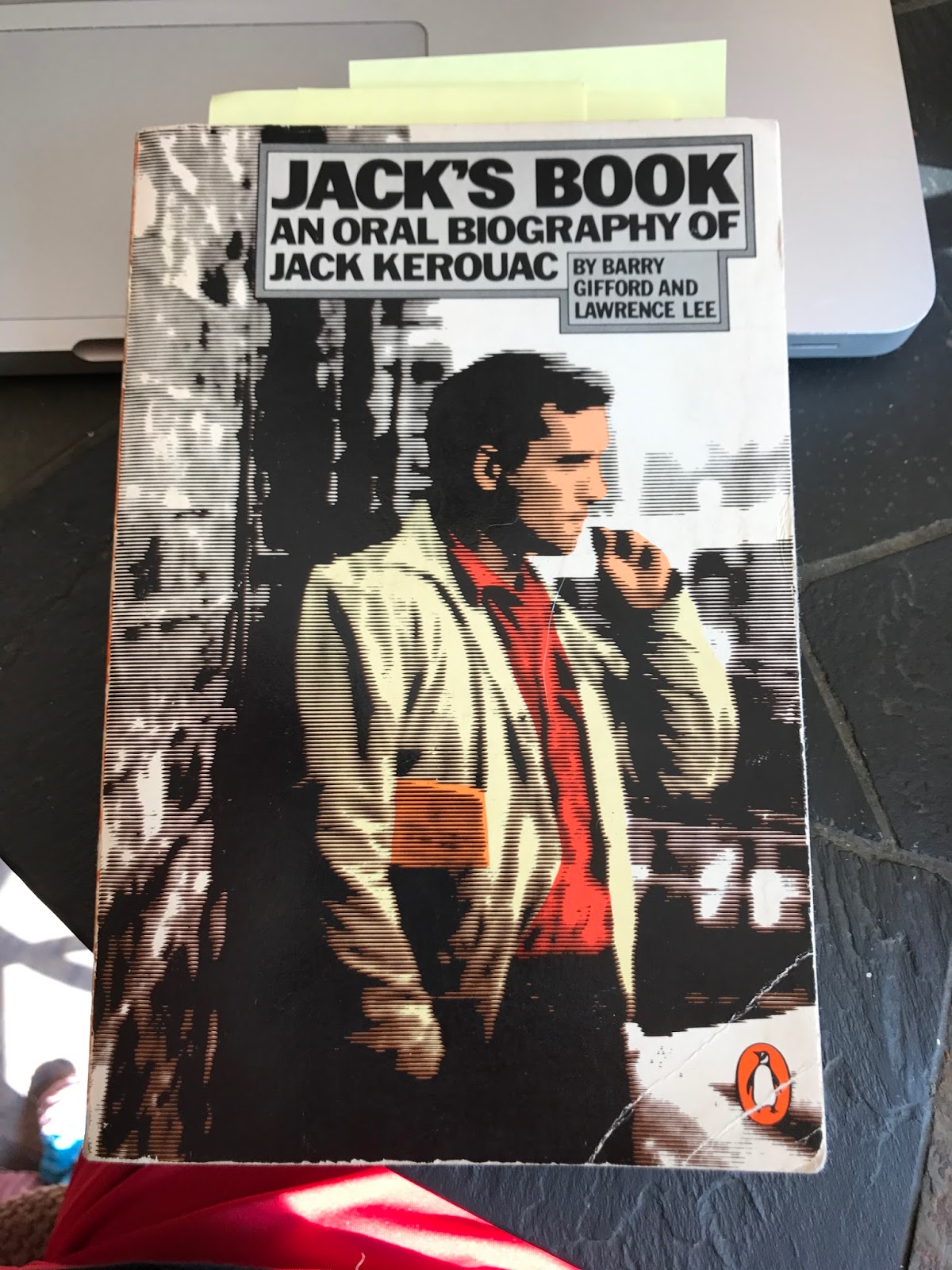
Kerouac had gay friends — Allen Ginsberg, William S. Burroughs, Gore Vidal. In fact, he slept with Vidal (see Vidal’s discussion of this in Jack’s Book: An Oral Biography of Jack Kerouac, 182-184), who described Kerouac as bisexual and not afraid to use his it when it benefited him. Kerouac’s use of anti-gay slurs, then, could be an example of a public homophobia compensating for repressed homosexual urges. This, of course, is just pop-psychology, though some recent studies would appear at least to lend credence to the theory.
Consider this article from Scientific American, which describes an academic study that purports to link homophobia both to this repression and to authoritarian parents who harbor similar views.
The research, published in the April 2012 issue of the Journal of Personality and Social Psychology, reveals the nuances of prejudices like homophobia, which can ultimately have dire consequences.“Sometimes people are threatened by gays and lesbians because they are fearing their own impulses, in a sense they ‘doth protest too much,'” Ryan told LiveScience. “In addition, it appears that sometimes those who would oppress others have been oppressed themselves, and we can have some compassion for them too, they may be unaccepting of others because they cannot be accepting of themselves.”
Keep in mind that these possibilities are couched in conditional language — “may,” “”could,” “it appears” — because our emotions and prejudices do not run in a straight line. Jesse Marczyk, writing in Psychology Today, disputes that a link exists at all, saying there is no research that supports it. That seems too simple, too easily reductive. Homophobia has a lot of causes, which very well may include repressed feelings.
Whether this is the case with Kerouac, we can only make assumptions based on his reduction of this poor traveler to the single slur, “fag,” reinforced by language that shows an obvious disdain — and what others have said about his personal life.
As Barry Gifford and Lawrence Lee write in Jack’s Book: An Oral Biography of Jack Kerouac, there have long been theories about Kerouac’s — and Neal Cassidy’s — sexuality.
Because Ginsberg, Burroughs, Huncke and others in the circle are homosexuals, it has become fashionable to assume Jack and Neal were gay men too repressed to act out their love for each other openly, a theory ratified by the fact that both men, on occasion, sleep with other men. There is no evidence, documentary or otherwise, to support the notion. (88)
And yet, a Kerouac’s editing of his relations with other men — with Vidal’s alter ego in The Subterranean most famously — to remove the sex, along with his willingness to turn to slurs like fag, raise serious questions and should not be elides as we attempt to reconsider On the Road.
In my 20s, I didn’t notice this use of language. Dismissing gays and lesbians, targeting them with vitriol (or worse) and making them the butt of humor was the norm. It wasn’t just the anti gay Reagan administration or conservatives who did this. The stereotypes were everywhere. Gays were nearly always portrayed as unabashed queens, over-the-top and limp-wristed, or as painfully closeted individuals. They were never just characters who happened to be gay; they always had to be the gay character. Even a comedian as open-minded and friendly to the LGBTQ community as Robin Williams made the crude stereotypes of lisping and prancing gays the target of his jokes. It was OK to laugh at the fags at this time.
We’ve moved away from this to a degree. The gay pedophile character remains a trope of American cop shows, while the flamboyant queer and butch lesbian continue to be used for comic relief and the butt of jokes. See the movie and musical versions of Legally Blonde, in which a cardboard lesbian character is presented as completely humorless and the gay pool boy is reprises the flames stereotype. Both characters are meant to be laughed at — rather than with — because they are gay.
Thankfully, other pop-culture presentations do a better job of fleshing out their gay characters so that we laugh with them — Modern Family’s Mitch and Cam, for instance, engender laughter because of their individual quirks and not because of broad stereotypes (though they have been desexualized for much of the show’s run). Saul and Robert on Grace and Frankie are incredibly detailed characterizations of two gay men who came out late in life.
The fight for marriage equality and full citizenship and rights and protections for members of the LGBTQ community have also changed the conversation and allowed many of us to see Kerouac’s nasty portrayal of the “tall, thin fag,” as the homophobic rant it is.
Kerouac writes this during the ’40s and ’50s, when it was common and accepted, when police raided parks looking for pervs, and well before the Stonewall uprising. Some might give him a pass for it — and I do believe it is hard to judge someone outside of our times. He was not unusual for his times, but he also was not he brave trailblazer he could have been.
More significantly, while the book was published in 1957, I am reading it today, with today’s eyes and belief system. One reason for me reading this book now, as I approach 55, is to gauge how my thinking has evolved. I was never a homophobe, but neither was I particularly enlightened, despite having a close friend come out to me. At 20 or so, I probably viewed gay subculture through a romanticized lens, as a leading edge of the avant-garde to which I thought I belonged. It was cool to know gays and lesbians, read their work, listen to their music. To idealize them. I have to admit, though, that this elevation — like Kerouac’s idealizing of African Americans — turned real people and a real communities into objects.
I mentioned this in an earlier post, and it bears repeating: Even the most progressive of us, those with the best intentions, can fall prey to racist or LGBTQ-ist thought. I won’t go so far as to say homophobic thought, because the suffix -phone implies hatred or distaste; this is more about robbing individuals of their identity and turning the into stock figures and stereotypes, which doesn’t require animus.
I’m not looking to rewrite the history of On the Road — it is too much a part of my personal iconography — but it is clear that on so many fronts it has not aged well. It is an artifact, which does not preclude it being read or seen as important literature (there is great debate about this, on which I come down on both sides). The canon is full of writing that should make us squeamish today — Conrad and Kipling, Harriett Beecher Stowe, Fitzgerald and his ugly Jewish stereotyping. We still read and should continue to read these works — but we have to identify and respond to the prejudices of the time and ask how we should respond today.
Literature is a conversation. Novels, poems, and essays talk to and comment on the novels, poems, and essays that came before. This does not necessarily happen in an overt fashion. It often is more subtle, with writers consuming and internalizing the work of their literary ancestors. It is a component of the fuel that drives creativity and commands us to work on our craft.
So, we read Kerouac’s slurs — his caricaturing of women, blacks, Mexicans — and we respond with shock, dismay, and anger. We do this because we have to, and how we express our responses says as much about us as readers as it does about Kerouac.

 Hank Kalet