I thought I was a beat, but I was just a boy
Notes on Re-Reading Kerouac in my 50s
Part 10
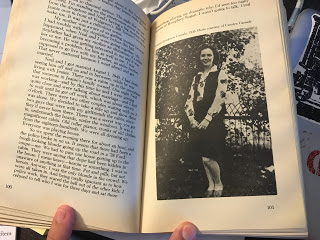 |
| Luanne Henderson, the model for Marylou. |
I call On the Road a young man’s novel, and it’s important to make it clear that the emphasis is both on young and on man.
Consider this description of Lee Ann, his friend Remi’s girl:
She was a fetching hunk, a honey-colored creature, but there was hate in her eyes for both of us. Her ambition was to marry a rich man. She came from a small town in Oregon. She rued the day she ever took up with Remi. On one of his big show off weekends he spent a hundred dollars on her and she thought she’d found an heir. Instead she was hung-up in this shack, and for lack of anything else she had to stay there. She had a job in Frisco; she had to take Greyhound bus at the crossroads and go in every day. She never forgave Remi for it.
Lee Ann is the gold-digger shrew. She is out for the money, hooks up with Remi, thinking him rich, and targets Remi and anyone connected with Remi with a deep resentment. Or so we are led to believe. Remember, On the Road is written in the first person. Everything we see, every bit of information, is filtered through Sal, and it is fair to ask whether this description is accurate.
I’d argue that it’s more complicated, that Sal — and Kerouac himself — can’t see the nuances because his view of the world is constrained by an ingrained sexism. Every female character is placed within one of a set of categories or archetypes.
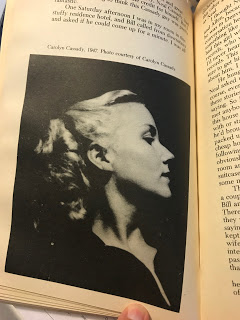 |
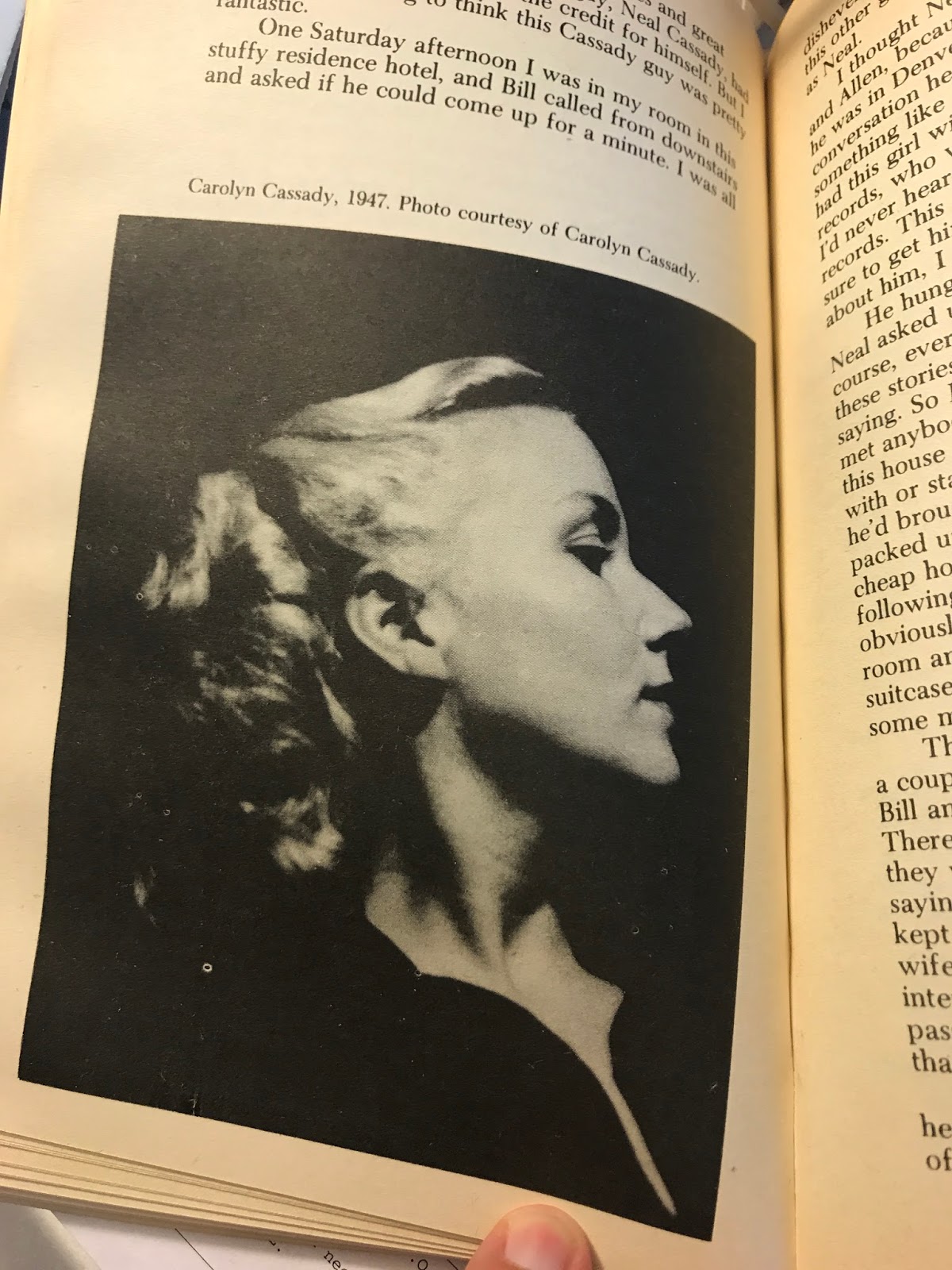
| Carolyn Cassidy — Camille. |
Lee Ann — along with Dean Moriarty’s girls Marylou and Camille — serves as shrew, as ball and chain, as weight around her man’s neck. She is a fairly typical archetype in literature and one of the boxes in which Kerouac traps his women characters.
Babe Rawlins is the “beautiful blonde,” “a tennis-playing, surf-riding doll of the West,” an “enterprising blonde” whose utility in the novel is limited to helping the men, facilitating their kicks or smiling as they go off and do their man things.
The unnamed wife of Walter, an African American that Sal and Dean meet in a bar in San Francisco, fits this same stereotype. The trio goes back to Walter’s tenement flat, where his wife was sleeping. The apartment had only a single bulb, and the men needed the light in the kitchen, where they sat to drink and talk. It was late, of course, and the bulb was above the wife’s bed; Dean climbs up and removes the light and, then, again to plug in the extension chord. the unnamed misses just “smiled and smiled. She never asked Walter where he’d been, what time it was, nothing” (203). When it was time to leave, they “repeated the insane thing all over again. She never said a word.”
And this sums up the book’s relationship to and views about women. As Dean says after they leave Walter’s:
“Now you see, man, there’s a real woman for you. Never a harsh word, never a complaint, or modified; her old man can come in any hour of the night with anybody and have talks in the kitchen and drink the beer and leave any old time. This is a man, and that’s his castle” (203).
Galatea Dunkel is both shrew and enabler. Galatea enters the story as ghost, as hearsay, and reappears periodically. Galatea is Ed Dunkel’s wife; Dunkel is Dean’s Denver pal, a Moriarty acolyte. Galatea is described as sniffing around after Ed, who ultimately marries her so she can pay the costs of a cross-country trip. Dean, Marylou and Ed ditch her in New Mexico, She’s described simultaneously as angry but needy; she blames Dean but desperately wants Ed back. In this way she is both Marylou and Babe, both Camille and Walter’s wife.
Only two women get extended treatments — the Mexican Terry that Sal hooks up with and Mary Lou, who goes on a mad cross-country car trip with Sal and Dean.
 |
| Bea Kozera, Terry, and a friend the year she met Kerouac. |
The figure of Terry is an interesting one. It is probably the tenderest portrait drawn by Kerouac, the one least bogged down by the mythology of his bias. There is real affection in Sal’s words, a sense that he has found something to which he can commit. But not completely. The world hangs over him — the need for money, in particular, but also a general sense of foreboding. After being hooted at by carloads of teens on a dark road outside Arcadia, he offers an internal monologue in which he explains how he “hated everyone of them” (88).
Who did they think they were, yaahing at somebody on the road just because they were little high-school punks and their parents carved roast beef on Sunday afternoons? Who did they think they were, making fun of a girl reduced to poor circumstances with a man who wanted to belove?
The teens pass, and Sal and Terry make their way to “high-school soda fountain,” the only place open, where they come across the teens again. The teens remembered them, and realized that “Terry was Mexican, a Pacheco wildcat; and that her boy was worse than that” (88-89). This is one of the few passages in the book that acknowledges strong current of racism in the United States, a recognition undercut by his needing to refocus the eye on himself. This is white privilege before it had a name, but also evidence of Sal/Jack’s emotional narrowness, his inability to fully get outside of himself.
But the lovers leave — she leading “with her pretty nose in the air, and they wander along the highway. This is still early in their relationship, and one might expect it to create an unbreakable bond, but Sal cannot make that kind of commitment. It is not in his emotional DNA.
Consider his inability later in the novel to commit to Lucille: “She wanted him to be her way” (125). He was
willing to marry her and take her baby daughter and all if she divorced the husband, but there wasn’t even enough money to get a divorce and the whole thing was hopeless, besides which Lucille would never understand me because I like too many things and get all confused and hung-up running from one falling star to another until I drop. This is the night, what it does to you. I had nothing to offer anybody except my own confusion (125-126).
The divorce argument is nothing more than justification; even if Lucille could extricate herself from her marriage, Sal would find other reasons not to stick around. His fatalism and restlessness ultimately doom his relationships, which no woman can understand — save Terry, who promises to follow him east knowing full well it will never happen. She has a restless soul, as well, and so she understands him and that understanding is presented as a willingness to let him walk.
Terry is the one female character who is given agency, though it is limited both by the patriarchal society of America after the war and Kerouac’s limited gender imagination. She is generally described in sympathetic terms, but both as child — a naive, angelic presence — and as a wise, almost Buddha-like presence. She is strong, but also a child, independent yet dependent on family. Her complications deserve an entire book, but we get just a sketch, and she ultimately stands as an example of the minor roles women are given in the beat world.
Marylou, Dean’s sometime-girlfriend-sometime-wife, gets more ink, but is no more fleshed out. Traveling with Dean across country to pick up Sal and then making the trek back west, we are presented with a woman who has many of the same appetites as Dean and Sal, but is painted as a more dangerous presence, as a schemer and, at times, a brake on the men’s adventures. Marylou has ulterior motives, as described by Sal, pits Sal and Dean against each other, seeks to make other women jealous.
But her presence is limited and, in the end, she is drawn with a little more detail, but lacks the shading, the color, of any of the men in the book. She’s two-dimensional, often an after thought like all women in the novel except for Terry. There is a scene in New Orleans that typifies this attitude: Sal, Dean and Ed run across rail tracks in New Orleans so Dean could show Sal his brakeman moves; they leave “Marylou and Galatea were waiting in the car” (155), unconcerned about what they might do or whether they OK with this temporary abandonment — they were out for a drive as a group, after all. Then, when the men get “back to the girls an hour late,” the girls “of course … were mad” (155). He writes this matter-of-faculty, as though it was just the price men pay for their attraction to women, for letting them tag along. Marylou, Camille, Dorothy Johnson — they present as obstacles, impediments, not real fleshed-out characters, not partners in loving relationships, but as objects.
Author: hankkalet
Hank Kalet is a poet and freelance journalist. He is the economic needs reporter for NJ Spotlight, teaches journalism at Rutgers University and writing at Middlesex County College and Brookdale Community College. He writes a semi-monthly column for the Progressive Populist. He is a lifelong fan of the New York Mets and New York Knicks, drinks too much coffee and attends as many Bruce Springsteen concerts as his meager finances will allow. He lives in South Brunswick with his wife Annie.
View all posts by hankkalet


 Hank Kalet