
I thought I was a beat, but I was just a boy
Notes on Re-Reading Kerouac in my 50s Part 8
(Read Part 7 here, Part 6 here, Part 5 here, Part 4 here, Part 3 here, Part 2 here and Part 1 here.)
There was a night in New Brunswick, probably in 1981, well before redevelopment remade the city. We had driven in to see The Rocky Horror Picture Show at the Art Cinema, a theater that had certainly seen better days and now was known for running XXX films and midnight showings of Rocky Horror.
We got there early, had time to kill. There were for of us. Bill was there, and Rich, I think, and Wayne. Wayne would eventually move to Colorado and take up a conservative variation of Christianity. He died about five years ago from a brain tumor.
Wayne was, at this moment, the wild one in our group. Not Dean Moriarty wild, but he certainly was the one most likely to do something reckless or stupid — like the night, also in New Brunswick, when several of us (not me) were up on the rail trestle a block from the theater and down the street from the train station. I was down below — I was and remain the cautious man. I heard the whistle/horn of an oncoming train, then Bob scream out “where’s Wayne.” then just “Wayne,” as the train barreled through and past. Silence. No answer. Then, from out of the darkness he appears, laughing. H. e’d waited until the last moment, he’d ducked off the track on the other side out of sight. It scared the shit out of us, and he found it funny.
 This particular night, we ducked into a small bar called the Stagecoach (I think) a couple doors down from he theater. We were going to get a drink — though we were probably underage, and it’s likely we were already stoned. We walked in and there was a small combo playing jazz in the back. We ordered and sat at a table and just listened. We were the only white people in the place, aside from the guy playing vibes. The band was tight with a strong bottom put down by the bass and drums. Atop this rode the vibes. My wanna-be Beat, late-adolescent mind imagined sparks coloring the air, the rolling swell of notes rising and swirling like a storm.
We finished our drinks, paid the bill, and left with what, in our youthful, white-boy minds, was a great story, an adventure. And for a bunch of suburban kids, I guess it was —but I see now that this sense of adventure was based entirely on a perceived danger, on the “otherness” of the situation, its exotic nature. New Brunswick was a place of “darkness” and we went straight into its heart.
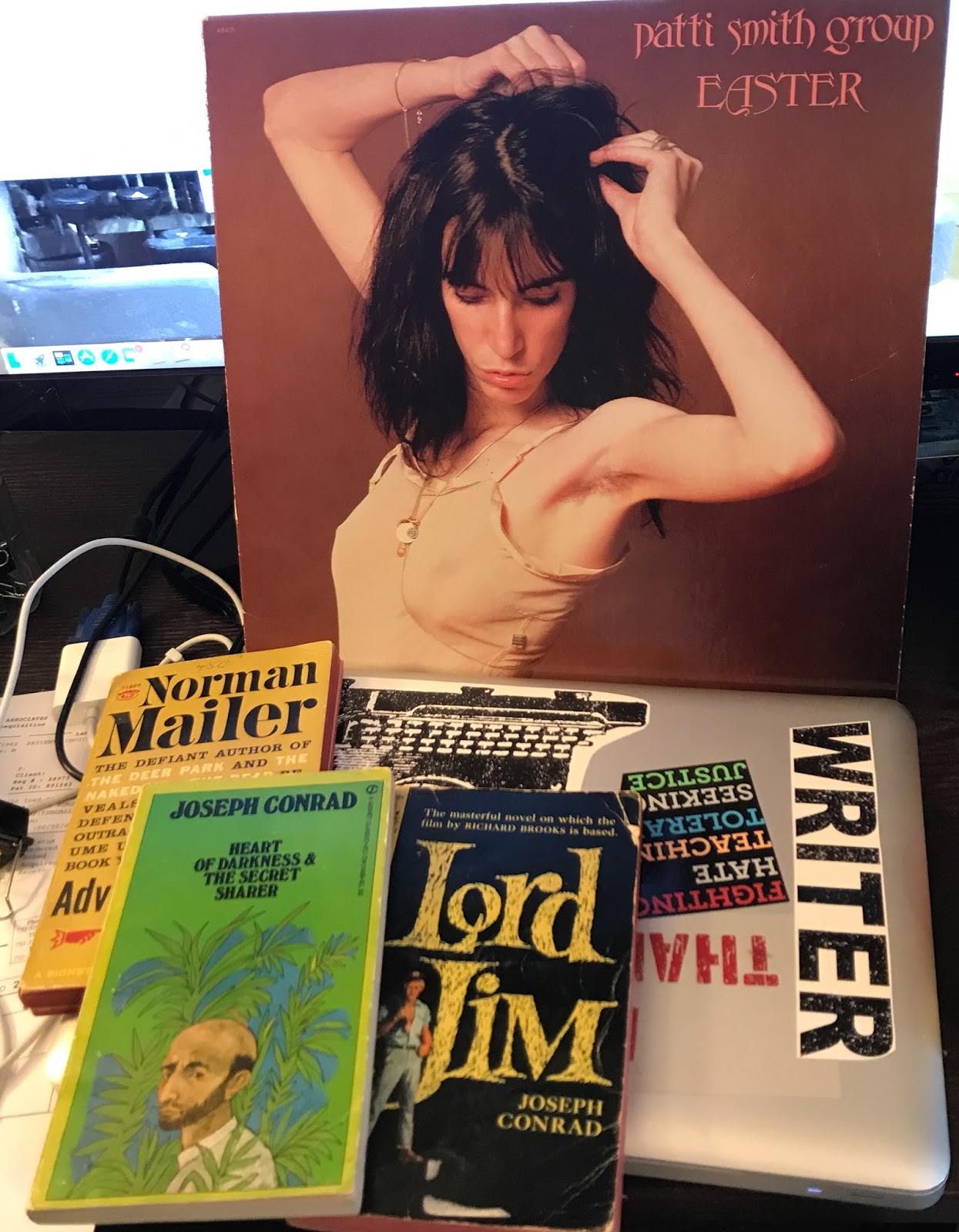
The allusion to Conrad is intentional because, as great and important a writer as he was, he also trucked in racist views like most of his contemporaries. Books like Heart of Darkness and
Lord Jim are rife with ugly stereotypes and, even when a person of color is to be presented in a positive light, it is through the dimming lens of racial typecasting. Kurtz has gone native in Heart of Darkness, which in the English mind circa 1900 was unforgivable. (See Kipling’s The Jungle Book.)
This comes across most strongly in On the Road when Kerouac writes of jazz, as I said, though there are numerous other passages in which his racial reductiveness impairs his perception of reality.
A more extreme variant of this occurs in Denver. A morose Sal “walked with every muscle aching among the lights of27th and Walton in the Denver colored section” (180). He wishes he was black, or more accurately “a Negro,” the use of a noun rather than an adjective reinforcing the sense of difference. The “best the white world had offered,” he says, “was not enough ecstasy for me, not enough life, joy, kicks, darkness, music, not enough night.”
He wants to shed his skin, to get closer to the bone, to the essence of life. To be a Negro, “a Denver Mexican, or even a poor overworked Jap, anything but what I was so drearily, a ‘white man’ disillusioned.” He wanted to shed his “white ambitions” and “exchange worlds with the happy, true-hearted, ecstatic Negroes of America.” The sadness of the passage can make it easy to overlook Kerouac’s use of racial stereotyping, especially because his intention is praise for groups he thinks somehow are more primitive and, therefore, more pure of heart and soul.
Kerouac, writing a scene that takes place in 1947 in a book that’s published in 1957 ignores the legal impediments and segregation imposed on black communities in the south and the de facto segregation of the north. The Civil Rights movement is in its infancy, but the Montgomery bus boycott is making national headlines as he moves the book toward publication. But in Sal/Kerouac’s mind, African Americans can be reduced to types, to caricatures; they are noble savages, primitives who are somehow holier and more pure, closer to a state of bliss unsullied by (white) civilization.
This is common thinking — or was — among the artistic class, especially in the 1950/. It is the central trope in Norman Mailer’s essay, “The White Negro,” in which he describes a cultural marriage between black Americans and
the American existentialist — the hipster, the man who knows that if our collective condition is to live with instant death by atomic war, relatively quick death by the State as l’univers concentrationnaire, or with slow death by conformity with every creative and rebellious instinct stifled (Mailer 304).
Mailer is correct to describe black existence in 1950s America as living with “danger from his first day” — an observation that still holds. “(N)o experience can ever be casual to him, no Negro can saunter down a street with any real certainty that violence will not visit him on his walk” (306).
However, he then makes the leap to ugly stereotyping, painting the black American as “following the need of his body” as a survival technique and eschewing, because he has to, because he can’t afford not to, the “sophisticated inhibitions of civilization” (306).
The Negro, he writes, has therefore
kept for his survival the art of the primitive, he lived in the enormous present, he subsisted for his Saturday night kicks, relinquishing the pleasures of the mind for the more obligatory pleasures of the body, and in his music he gave voice to the character and quality of his existence, to his rage and the infinite variations of joy, lust, languor, growl, cramp, pinch, scream and despair of his organism.
The beat/hipster has bought into this essentialism, he writes, and is using his search for authenticity and spiritual purity, his efforts to become more like The Negro or Kerouac’s fedahin, to escape rather than press for social change. Mailer is far more political than the Beats — the essay originally appeared in Dissent in the fall of 1957 — about the same time that On the Road is published and rockets up the bestseller list. That Mailer ultimately is critical of this new hipster is unimportant — intention in this case does not override Mailer’s overly broad description of The Negro, who is purer in his relation to the world than the American mainstream (read white). He may want more from the new Beat Generation politically, but he still sees blacks as archetypes, as noble savages, as something apart from the rest of polite society.
We see this in Patti Smith’s “Rock ‘n’ Roll Nigger,” a song that compares the American artist, the visionary, the rebel to blacks as an oppressed group, as the principled outsider: the “black sheep,” the “whore,” are unwilling to conform, must stand “outside of society,” are a “rock ‘n’ roll nigger.”
The song, which she performs as an anthem, growling and spitting fire over a rumbling guitar-driven hard rock soundtrack, uses the pejorative ironically, of course, stripping it from its ugly history as an element of control and dehumanization beginning in slave times; it’s also meant to shock — “now that I’ve got your attention….”
The comparison here is meant to be flattering, but intention does not matter. That’s the great misconception when it comes to race issues. One can still be racist or express or hold racist ideas without having any animus toward blacks, Latinos, Asians and so on. Racism means seeing people as the embodiment of their race; it means objectifying people, robbing them of their individual agency. When Jack Kerouac wished he were a Negro because, as he believes, blacks are simpler and, therefore, closer to the essential truth, he’s engaging in racist thinking. When my friends and I transformed this accidental experience of a joyful noise, so to speak, into a white-kid adventure, when we played up the novelty and exoticness of the moment, we were engaging in racist thinking.
That’s one of the points made by Dr. Ibram X. Kendi in Stamped from the Beginning, his important book on the history of racist thinking. All of us, he says, are capable of racist thinking, and that there is a long history of it in the United States, even among those working hardest to end slavery or Jim Crow or even now in the battle against police brutality.
I have a better understanding of this than I did when I was 19 — that I did when I was 29, 39, even 49. I do my best to avoid essentialist thinking, but I’d be lying if I said I’ve rooted it completely from my thought process.
I cringe now at my naivety, at my youthful lack of understanding of this, but rereading On the Road has raised a lot of questions and it’s important that I be honest about that night, even as I try to hold on to the sensation of hearing that music.

 Hank Kalet